Delegating NZQA Sign-Off Without Losing the Trail
22 September 2026 · 7 min read
NZQA no longer sends a panel to check your work once every few years. From 1 January 2026 it stopped opening new External Evaluation and Review (EER) processes altogether, replacing them with a mandatory annual TEO self-review submitted through the provider portal. The compliance obligation didn't shrink — it moved. Instead of preparing for a visit, you're now expected to prove, on any given day, that sign-off happened, who did it, and what evidence sits behind it.
Why this lands on your desk
The annual TEO self-review summary and improvement plan are submitted under your name, but they depend on evidence collected and signed off by people all over the organisation — trainers, assessors, pastoral care staff, programme leads. You own the outcome without owning every input.
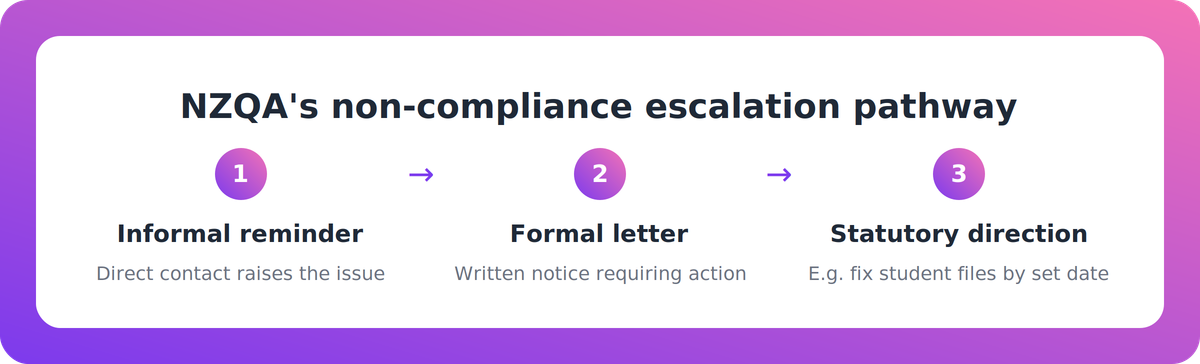
That gap is exactly what NZQA's escalation guidance is built to find. Its published non-compliance pathway moves from informal reminders to formal letters to statutory directions, and NZQA names "make sure student files are accurate and complete by a given date" as a concrete example of what a direction can require. Incomplete or inaccurate files aren't a hypothetical audit risk — they're a named enforcement trigger.
On top of that, the Quality Assurance of Tertiary Education Providers Rules 2026 require you to hand over your quality management system to NZQA on request, with no advance notice. If you didn't have a compliant QMS as at 1 January 2026, you've got until 1 January 2027 to build one. Either way, it's the document — and the sign-offs recorded in it — that has to hold up cold.
And the ground keeps shifting underneath the paperwork. Workforce Development Councils are being replaced by Industry Skills Boards, and Te Pūkenga has been renamed the New Zealand Institute of Skills and Technology (NZIST) as a two-year transitional entity. Every policy that maps to those bodies needs its ownership re-evidenced as the entities it references change names mid-cycle.
From a periodic visit to continuous proof
Under EER, compliance work had a rhythm: build the evidence base, survive the visit, breathe out. The new model has no exhale. Pastoral care reporting against the Education (Pastoral Care of Tertiary and International Learners) Code of Practice is now folded into the same annual TEO self-review submission rather than sitting as its own process, which means one report now carries more weight and more different evidence streams than before.
As of the current research window, NZQA has indicated that templates supporting the new self-review process are still forthcoming. You're running the new model before all the supporting documentation exists — which is precisely the kind of ambiguity that makes a clear internal sign-off trail more valuable, not less.
The escalation pathway you're actually managing
It helps to think of NZQA's escalation ladder as the thing your delegation structure is defending against, not an abstract regulatory process. Each rung assumes a provider had a chance to catch the problem itself and didn't.
A delegated sign-off with no name, no timestamp and no attached evidence is invisible until something goes wrong — at which point it looks exactly like the gap NZQA's process is designed to catch.
Where delegation becomes exposure
Delegating sign-off isn't optional anymore; the workload alone makes that clear. The risk isn't delegation itself — it's delegation that can't be reconstructed six months later when NZQA asks for the QMS or a statutory direction lands.
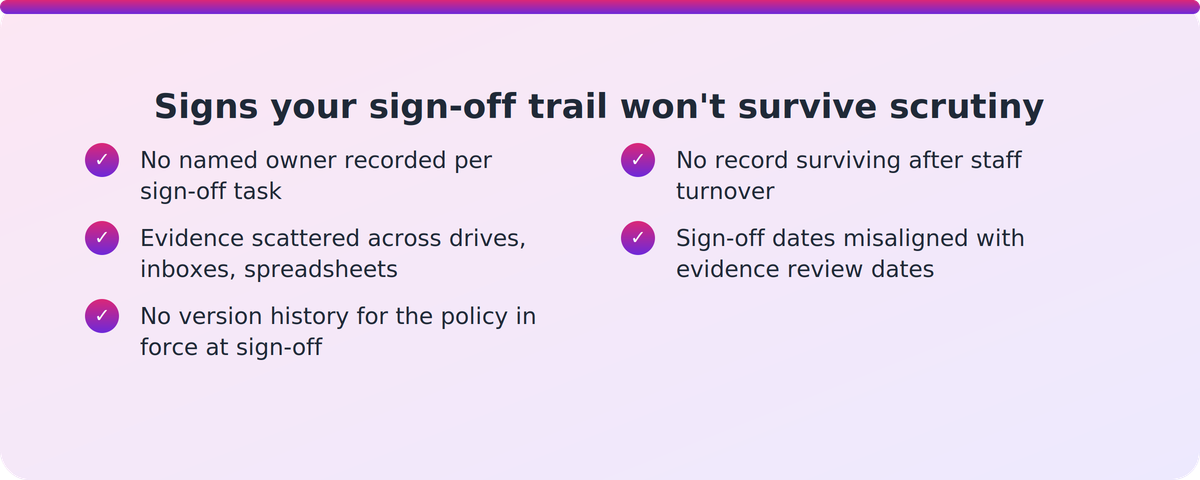
A few of the gaps that turn up most often when providers try to trace sign-off after the fact:
- No single owner recorded against each sign-off task — just "the team" or a shared inbox.
- Evidence living in whichever drive, email thread or spreadsheet the person happened to use that week.
- No version history showing which policy was current when the sign-off was made.
- No record surviving staff turnover — the person who signed off has left, and the reasoning left with them.
- Sign-off dates that don't line up with when the underlying evidence was actually reviewed.
None of these are exotic failures. They're what happens by default when sign-off is delegated verbally or informally under time pressure, which is most of the time.
PTE registration doesn't wait for a QA finding
It's worth remembering that not every risk to your provider's standing is about teaching quality. PTE registration can lapse automatically for administrative reasons — for example, not delivering at least one NZQA-approved programme to enrolled students within a year. That's a reminder that your sign-off trail needs to cover operational and administrative obligations, not just assessment and pastoral care, because NZQA doesn't distinguish between the two when it comes to registration risk.
Don't mistake fewer visits for a lighter touch
Specialist NZ education-law commentary is blunt about this: despite the removal of EER, standards have been tightened and are being more closely monitored, not relaxed. The absence of a scheduled visit isn't a compliance holiday — it's continuous exposure with no fixed date to prepare for. Treat the new model as more demanding than the old one, because on the evidence, it is.
Key takeaways
- NZQA stopped opening new EER processes from 1 January 2026, replacing them with mandatory annual TEO self-review submitted via the provider portal, alongside an improvement plan and a meeting with an assigned self-review evaluator.
- Incomplete or inaccurate student files are named explicitly in NZQA's escalation guidance as a trigger for statutory direction — not a theoretical audit risk.
- Under the Quality Assurance of Tertiary Education Providers Rules 2026, you must be able to produce your QMS to NZQA on request, with providers lacking a compliant one required to build it before 1 January 2027.
- Sector terminology is shifting mid-cycle — Workforce Development Councils to Industry Skills Boards, Te Pūkenga to NZIST — so policy-to-entity mapping needs regular re-checking, not a one-off update.
- Delegated sign-off is unavoidable given the workload, but it only protects you if it's attributable: a named owner, a timestamp, and the evidence it relied on.
Our take
The temptation with a shift like this is to treat it as an administrative inconvenience — new portal, new template, new name for the same job. It isn't. Moving the burden of proof from an external panel to continuous self-attestation changes who's exposed when something is missing, and it puts that exposure squarely on the person who signs the summary. Building a delegation structure that survives staff turnover and a mid-cycle rename isn't glamorous work, but it's the difference between an informal reminder and a statutory direction landing on your desk. Whatever tools or habits you use to get there — a shared register, a QMS with version control, a genuinely enforced naming convention — the test is simple: could someone else reconstruct exactly who approved what, and why, without asking you?
FAQ
Does the move away from EER mean lighter compliance obligations overall? No. NZ education-law commentary is explicit that despite EER's removal, standards have been tightened and providers are being more closely monitored, not less. The change is in the mechanism — continuous self-review instead of a periodic visit — not the bar you're held to.
What's my actual exposure if I delegate sign-off and something is later found missing? NZQA's published escalation pathway runs from informal reminders through formal letters to statutory directions, with incomplete or inaccurate student files cited as a concrete example of what triggers a direction. If a delegated sign-off can't be traced to a named person and dated evidence, that gap is what an investigation finds first.
Do I need to rebuild my quality management system before the 2027 deadline? Only if it wasn't already compliant as at 1 January 2026. The Quality Assurance of Tertiary Education Providers Rules 2026 require providers without a compliant QMS at that date to have one in place before 1 January 2027, and to be able to produce it to NZQA on request at any time in between.
How should I handle policies that reference Workforce Development Councils or Te Pūkenga? Those entities are being replaced — Workforce Development Councils by Industry Skills Boards, and Te Pūkenga by the New Zealand Institute of Skills and Technology (NZIST) as a two-year transitional entity — with NZQA's own rules being rewritten to match. Treat any policy referencing them as due for review now, not at your next scheduled cycle.