Life After ESFA: The DfE Funding Rules for 2026
3 August 2026 · 7 min read
The Education and Skills Funding Agency no longer exists as a standalone body — its functions sit inside the Department for Education, and references to the ESFA have been removed from the funding rules that govern how providers draw down and account for apprenticeship and skills funding. That's not a rebrand. It means the guidance documents, terminology and interpretive habits providers built up over a decade of ESFA rules no longer map cleanly onto the current text, and the gap between the two is exactly where funding clawback risk sits.
What actually changed when ESFA references disappeared
The ESFA's absorption into the DfE is part of a wider reshuffle of the bodies that sit around apprenticeship and skills funding. The Institute for Apprenticeships and Technical Education (IfATE) closed on 1 June 2025, with its standard-setting functions moving to Skills England. Around the same time, the funding rules themselves were rewritten to remove ESFA branding and terminology, reflecting the fact that funding conditions are now a DfE function rather than an arm's-length agency one.
For a provider, this shows up in practical ways:
- The document you used to call "the ESFA funding rules" is now published and framed as a DfE document, and it may use different section references or terminology for the same conditions.
- Guidance notes, FAQs and interpretive letters issued under the ESFA name are no longer the current source of truth, even where the underlying condition hasn't obviously changed.
- Internal policies, checklists and audit templates built around ESFA wording need re-checking, not just re-labelling.
Why old ESFA guidance is now a liability, not a shortcut
It's tempting to treat this as cosmetic — same rules, new letterhead. That's the risky assumption. When a regulator's functions move and its documents are reissued, the specific wording of eligibility criteria, evidence requirements and reporting conditions can shift even where the policy intent stays the same. A provider whose compliance team is still cross-referencing legacy ESFA guidance risks working from a version of the rules that's technically superseded.
That matters most for the teams furthest from policy detail day-to-day — curriculum leads, assessors, and IQA staff who reasonably assume the funding rules haven't moved because nobody told them otherwise. If their evidence templates still cite ESFA terminology, and an EQA visit or funding audit tests against the current DfE-published rules, the mismatch is theirs to explain.
Where the clawback risk actually hides
Funding clawback rarely comes from a single obvious breach. It comes from accumulated small misalignments between what a provider's systems assume the rules say and what the rules currently say. Post-ESFA, the likely friction points are:
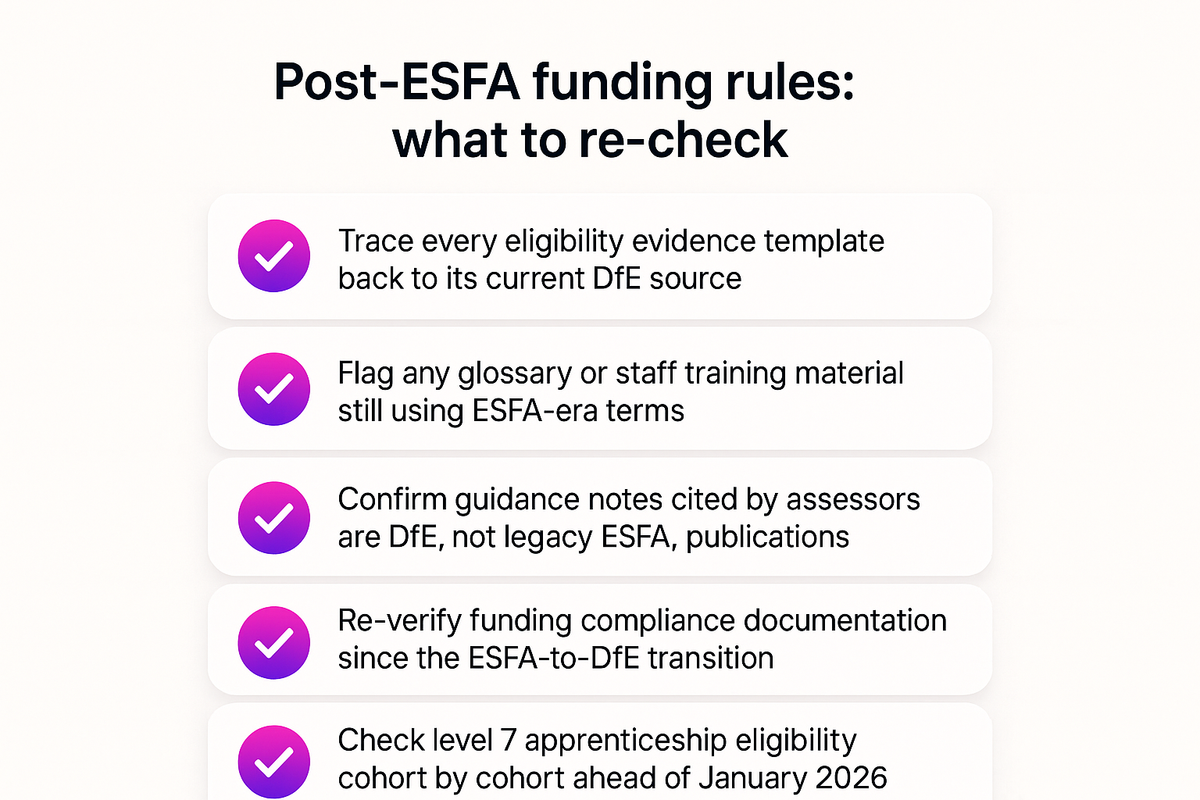
- Eligibility evidence: templates built around old ESFA eligibility wording may not capture the specific fields a DfE-published rule now expects.
- Terminology drift: internal glossaries and staff training materials that still use ESFA-era terms for funding bands, cohorts or evidence types.
- Guidance provenance: staff citing an old ESFA guidance note as authority, when the current authoritative source is a DfE publication with different detail.
- Timing gaps: providers who haven't formally re-checked their funding compliance documentation since the ESFA-to-DfE transition, and are therefore working from an unverified assumption that nothing material changed.
None of this requires a policy scandal to bite. It just requires an auditor asking "where does this evidence requirement come from" and the honest answer being "a document that no longer exists."
The wider churn behind the funding rules
The ESFA-to-DfE shift isn't happening in isolation — it's one piece of a genuinely busy period for UK vocational education regulation:
- Ofsted's renewed inspection framework took effect for further education and skills from 10 November 2025, bringing a five-point grading scale and report cards, with sharper expectations around learner-level data — particularly on inclusion, disadvantage and SEND.
- Skills England has taken on IfATE's former standard-setting role, meaning apprenticeship and occupational standards now sit under a different institutional home than they did a year ago.
- T Levels continue to expand, and V Levels are being introduced alongside A levels and T Levels, adding a further qualification pathway that providers offering vocational routes will need to map against.
- Level 7 apprenticeships are defunded from January 2026, except for younger apprentices and those who are care-experienced — a targeted change that still requires providers to re-check eligibility rules for every affected cohort.
Each of these lands on the same desks that are trying to re-anchor to the DfE's funding rules. None of them is optional reading.
What providers should check now
Before the next EQA visit or funding audit, it's worth treating the ESFA-to-DfE transition as its own compliance task, not a footnote to the bigger regulatory changes happening at the same time.
Key takeaways
- The ESFA no longer exists as a separate body; its functions sit inside the DfE, and the funding rules have been rewritten to remove ESFA references and terminology.
- Guidance, glossaries and evidence templates built on legacy ESFA wording may no longer match the current DfE-published conditions, even where policy intent is unchanged.
- Clawback risk tends to hide in accumulated small mismatches — eligibility evidence, terminology drift, outdated guidance provenance — rather than one obvious breach.
- This transition is happening alongside IfATE's closure and the move to Skills England, Ofsted's new inspection framework from 10 November 2025, the growth of T Levels and introduction of V Levels, and the level 7 apprenticeship defunding from January 2026.
- Providers should treat the ESFA-to-DfE re-anchoring as a distinct compliance check, separate from the other regulatory changes landing at the same time.
Our take
The institutional reshuffle around ESFA, IfATE and Skills England is easy to file under "machinery of government" and move on. That's a mistake. When a funding authority's documents are reissued under a new institutional home, the safest assumption is that something in the detail has moved, not that it hasn't. Providers who treat this as a paperwork exercise — swap the logo, keep the templates — are the ones most likely to discover a gap when an auditor asks for the current source of an evidence requirement. The teams who come through this cleanly will be the ones who re-verified their compliance documentation against DfE sources directly, rather than trusting that ESFA-era shortcuts still hold.
If your funding compliance evidence still traces back to a document with "ESFA" in the title, that's worth a second look before someone else looks first.
FAQ
Does the ESFA still exist? No. The ESFA's functions have been absorbed into the Department for Education, and references to the ESFA have been removed from the current funding rules.
Do the actual funding conditions change just because ESFA references were removed? Not automatically, but the documents are reissued under DfE authorship with potentially different wording, section structure or terminology. Providers should treat the current DfE-published rules as the authoritative source rather than assuming continuity with old ESFA guidance.
How does this relate to IfATE closing and Skills England taking over? They're related but distinct changes. IfATE closed on 1 June 2025 and its standard-setting functions moved to Skills England, while the ESFA's funding administration functions moved into the DfE. Both changes affect providers, but they touch different parts of the compliance picture — standards versus funding rules.
What's the practical risk if a provider keeps using old ESFA guidance? The main risk is a mismatch between a provider's internal evidence templates or eligibility checks and the current DfE-published funding rules, which can surface as a funding clawback finding during an audit or EQA visit.
Does the level 7 apprenticeship defunding from January 2026 affect all apprentices? No. Level 7 apprenticeships are defunded from January 2026 except for younger apprentices and those who are care-experienced, so providers need to check eligibility on a cohort-by-cohort basis rather than applying a blanket rule.