Early Warning on ASQA Non-Compliance: For Compliance Managers
30 September 2026 · 6 min read
ASQA doesn't publish a list of leading indicators, but it does say it selects performance assessments using provider risk indicators. So the signals exist, and you can't see them. The Compliance Manager's best move is to build proxies from the areas ASQA most often finds wanting, and to watch them monthly rather than annually.
Why this hits your desk
You own audit-readiness under the Standards for RTOs 2025, which have applied to every ASQA-regulated RTO since 1 July 2025. Yet the trigger for scrutiny sits in a data set you don't control.
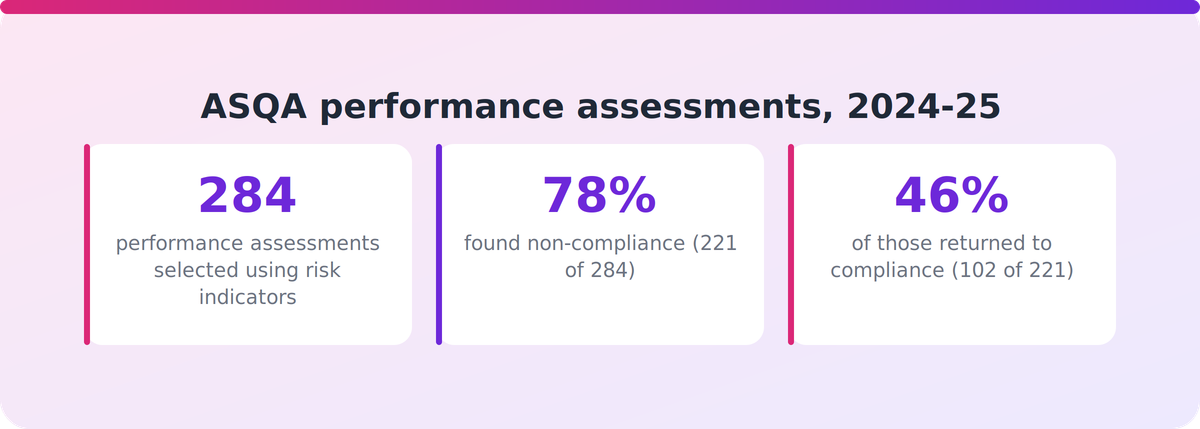
The numbers are sobering. In 2024-25, ASQA conducted 284 performance assessments selected using provider risk indicators. Of those, 221 (78%) found non-compliance. The most common areas were training and assessment strategies and practices, conducting effective assessment, and employing skilled trainers and assessors. Those are cited against the 2015 Standards (clauses 1.1, 1.2, 1.8, 1.13 and 1.16), so check any mapping to the 2025 Standards before you rely on it.
There is a more encouraging number too. Of the 221, 102 (46%) satisfied ASQA they had addressed the issues and returned to compliance. Non-compliance found is not the end of the story. But fixing it under a regulator's clock is a very different week from fixing it on your own timetable.
Then there is the Annual Declaration on Compliance. It goes to your CEO by unique link, and third-party guidance describes it as asserting that the RTO has monitored its own compliance. Your CEO signs. You are usually the person who has to show what the monitoring was.
What ASQA's own material tells you to watch
ASQA doesn't prescribe self-monitoring metrics. Anything below is my suggestion, not a requirement. But the regulator's published patterns are a sensible place to anchor.
ASQA's 2026 Environmental Scan names four risk areas:
- provider governance, market conduct and non-genuine operations
- quality, sufficiency and fitness-for-purpose of training delivery
- integrity of qualifications and competency outcomes
- transparency, accountability and assurance in complex and international delivery models
The Statement of Intent 2026 adds a direction of travel: differentiated regulation, a focus on outcomes over inputs, and continuous improvement. Read together, they suggest a simple test. If ASQA looked only at your outcomes, would they hold up, and could you show the work behind them?
Signals worth tracking before a regulator asks
Each signal below is something you could measure from records you already hold. None comes from ASQA.
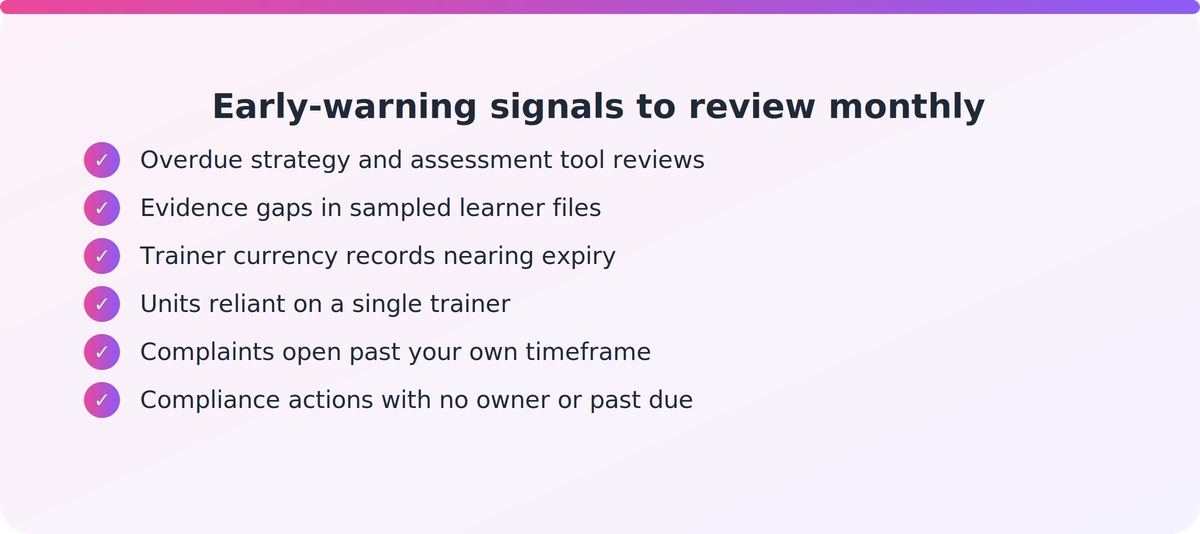
Assessment and strategy signals
- Overdue reviews. Count the units whose training and assessment strategy or assessment tools haven't been reviewed since delivery mode, cohort or training package version changed.
- Evidence gaps. Sample a handful of completed learner files each month. Record how many lack something a reviewer would expect to see, such as a missing judgement or an unsigned observation.
- Coverage you can't demonstrate. Flag any unit where you couldn't quickly show how the assessment covers the requirements of the unit of competency.
Trainer and assessor signals
- Currency records approaching expiry. Track vocational competency and industry currency records by person, with dates.
- Single points of failure. Note units delivered by one trainer, and any recent departures. The JSC-led VET Workforce Project says it is harder to attract and retain experienced professionals and that maintaining vocational currency costs more time and money. The sources don't link this directly to ASQA's findings, but it is a pressure on the same area.
Outcome and governance signals
- Outcome oddities. Look for completion times that are unusually short, or results that cluster suspiciously by trainer or cohort. This speaks to the integrity of competency outcomes.
- Complaints and appeals ageing. The Standards removed the 60-day timeframe, so providers now set reasonable timeframes themselves. Your own target is now a measure you can miss, so track how long matters stay open against it.
- Overdue compliance actions. Count actions with no named owner or past their due date. That is a signal about your compliance system, not your learners.
Build the view, not the dashboard
Start small. Pick five signals, agree a threshold for each with the Head of Training, and review them in a standing monthly meeting. A spreadsheet is enough. What matters is the trend and a named owner for each number.
Two cautions. First, don't over-read the regulator's recent data. From July 2025 to March 2026, ASQA completed 116 performance assessments and 45 (39%) found non-compliance. That figure isn't directly comparable with 2024-25, and ASQA's published material doesn't explain the difference. It is not evidence of a trend, so don't put one in a board paper.
Second, expect the ground to move. ASQA ran 17 workshops in March and April 2026, and a revised Regulatory Assessment and Monitoring Approach was released on 26 June 2026. A checklist written against last quarter's interpretation will drift. Put a review date on your signals as well as your policies.
Key takeaways
- ASQA selects performance assessments using provider risk indicators it doesn't publish, so build your own proxies.
- In 2024-25, 221 of 284 performance assessments (78%) found non-compliance. The most common areas were training and assessment strategies and practices, conducting effective assessment, and trainer and assessor employment (2015 Standards clauses).
- ASQA doesn't prescribe self-monitoring metrics. Any indicators you choose are your own judgement and should be labelled that way.
- The CEO's Annual Declaration on Compliance rests on self-monitoring, so monthly signals give you something concrete to substantiate it.
- Avoid claiming a trend between the 2024-25 and 2025-26 non-compliance rates. They aren't directly comparable.
Our take
Most compliance anxiety comes from being surprised. The regulator isn't the problem. The gap between what it can see and what you can see is. You can't close that gap fully, but you can narrow it by reading your own data the way a risk-based regulator probably would: look for patterns, not isolated errors.
We'd also argue against being the single reviewer of everything. If every signal depends on you chasing it, you are the bottleneck and the early-warning system at once, and that doesn't scale. Give each signal an owner in the business and keep your role as the person who reads the pattern.
A concrete first step for this week: pull the last three completed learner files from your highest-volume unit and ask whether you could defend them tomorrow. What you find is your first indicator.
FAQ
Does ASQA publish the risk indicators it uses to select performance assessments?
No. ASQA says it uses provider risk indicators to select performance assessments, but the material reviewed doesn't list them. Internal early-warning measures are therefore a judgement for each RTO, not a regulatory requirement.
Which areas does ASQA most often find non-compliant?
In 2024-25, the most common areas were training and assessment strategies and practices (clauses 1.1 and 1.2), conducting effective assessment (1.8), and employing skilled trainers and assessors (1.13 and 1.16). These are 2015 Standards clause numbers, so verify any mapping to the 2025 Standards.
Can I say non-compliance is rising or falling?
Not safely. ASQA found non-compliance in 78% of performance assessments in 2024-25 and 39% (45 of 116) from July 2025 to March 2026. The two rates aren't directly comparable, and ASQA's published material doesn't explain the gap.
How does the Annual Declaration on Compliance relate to early-warning monitoring?
The declaration goes to the CEO, and third-party guidance describes it as asserting the RTO has monitored its own compliance. Regular, recorded monitoring gives the CEO and you something to point to if asked how that claim is supported.