Designing ESOL and LLN Assessments for One NZ Standard
6 September 2026 · 6 min read

Designing ESOL and LLN Assessments for One NZ Standard
New Zealand's shift from unit standards to skill standards, landing alongside the 1 January 2026 disestablishment of Te Pūkenga, gives providers a rare chance to fix a persistent equity gap. Assessing one standard with a single fixed instrument disadvantages ESOL and LLN learners, who need different, but equally valid, ways to prove the same outcome.
Why is this happening now?
NZQA is progressively replacing unit standards with skill standards on its directory. That means Private Training Establishments (PTEs), ITPs and Wānanga are already redrafting assessment and moderation materials during the conversion window, all while keeping evidence mapped tightly back to the standard.
The timing compounds the pressure. From 1 January 2026:
- Te Pūkenga is disestablished and transitions to NZIST.
- Ten regional polytechnics are re-established as separate entities.
- Workforce Development Councils are replaced by Industry Skills Boards.
The bodies that set and moderate standards are being restructured at exactly the moment providers are expected to redesign what sits underneath those standards. That's disruptive. It's also an opening — assessment materials are being touched anyway, so this is the moment to touch them properly.
Why one assessment instrument isn't enough for ESOL and LLN learners
A single fixed instrument assumes every learner produces knowledge the same way. That assumption doesn't hold for ESOL and LLN learners, and it particularly fails receptive bilingual learners — people who understand considerably more than they can currently produce in English.
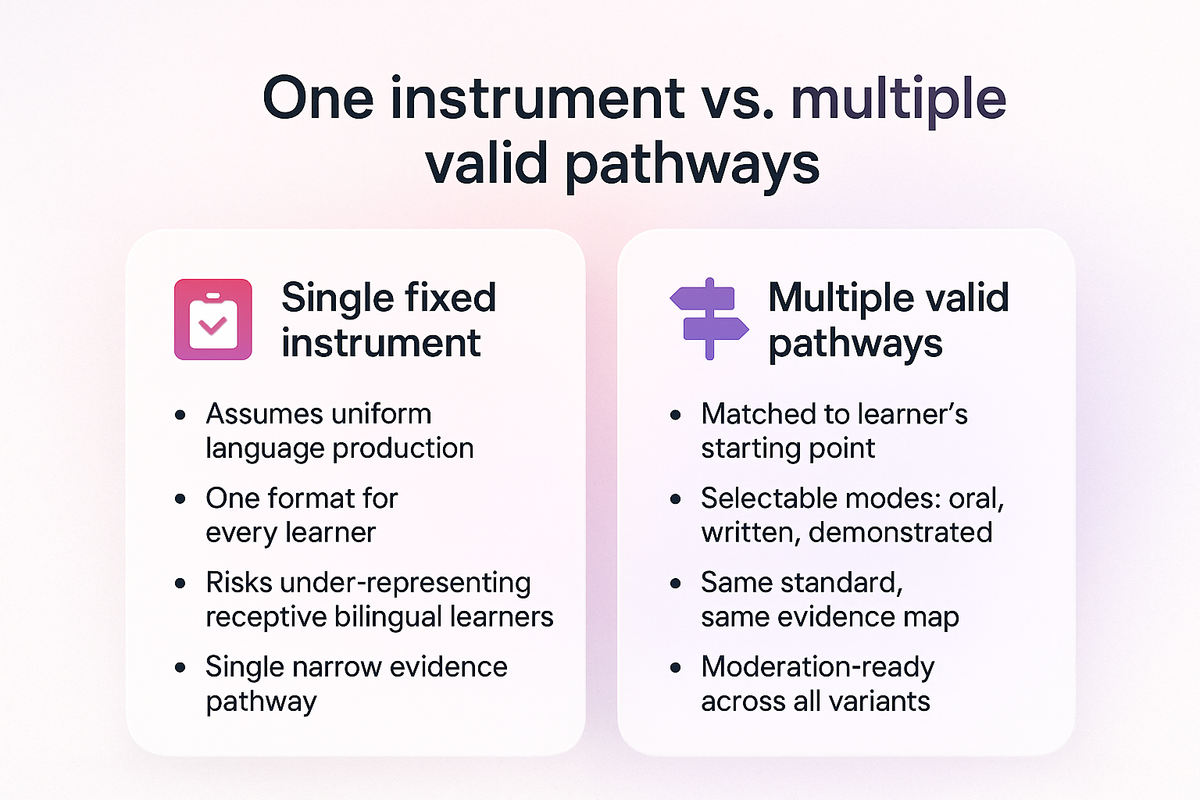
NZQA's own English Language subject guidance and the Ministry of Education's ESOL resourcing already acknowledge this: language-proficiency assessment cannot rely on a single fixed format if it's to fairly capture what a learner actually knows and can do. Sector practice around Māori and Pasifika learners points the same way — a uniform instrument tends to under-represent what a learner is capable of, not because the learner lacks competence, but because the format doesn't fit them.
The practical risk for providers is real. A learner who fails a written assessment for lack of English production, despite clearly demonstrating the underlying skill verbally or on the job, isn't being assessed against the standard. They're being assessed against a format.
What NZ guidance already offers a model
Ako Aotearoa's Starting Points assessment guide, built on the national adult literacy and numeracy learning progressions, offers a working precedent. Rather than measuring every learner against a uniform benchmark, it calibrates assessment to a learner's actual starting point — then tracks progress from there.
That's the logic providers need to extend to unit and skill standard assessment more broadly: multiple valid routes to the same evidence, rather than one route everyone has to fit through.
What's missing is consolidation. No standalone NZ sector publication yet names "one standard, multiple assessment formats for ESOL/LLN learners" as a framework. Right now it exists as scattered regulatory guidance, adult literacy pedagogy, and individual provider practice — good instincts, no shared playbook.
A practical model: mode selection at the point of assessment generation
Emerging AI-assisted assessment design practice is starting to formalise something useful here: selectable assessment "modes" at the point a standard is turned into an instrument. Some tools already distinguish knowledge-based assessment from demonstrated-ability assessment for the same standard.
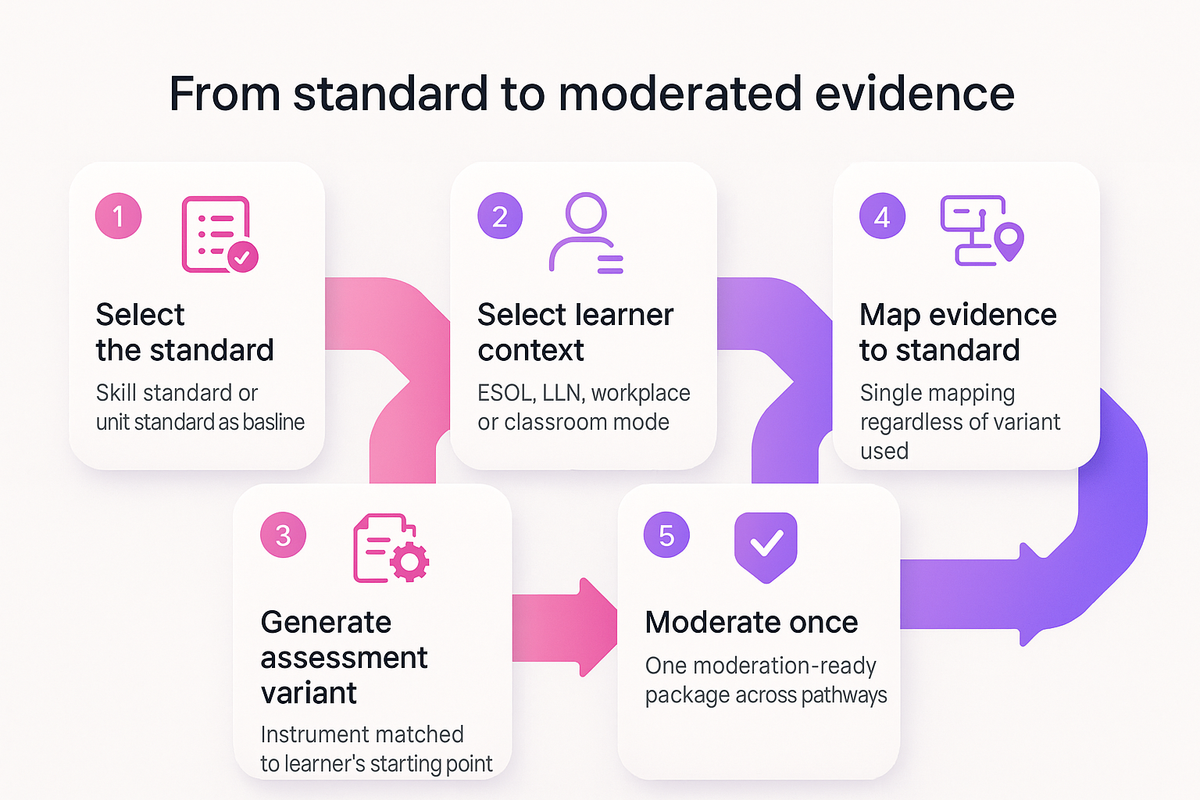
The same pattern extends naturally to ESOL and LLN variants — oral response instead of written, workplace demonstration instead of classroom test, structured interview instead of essay — provided each variant maps back to the identical standard and produces evidence a moderator can review consistently.
A workable sequence looks like this:
- Start from the standard, not the format.
- Identify the learner context — ESOL, LLN, workplace, distance or classroom.
- Generate the assessment variant suited to that context.
- Map the evidence back to the standard, regardless of which variant was used.
- Moderate once, across all variants, against a single evidence map.
That last step matters most for compliance. Moderators aren't reviewing three unrelated assessments — they're reviewing three routes to the same, single piece of evidence.
Key takeaways
- NZQA's move to skill standards, alongside the 1 January 2026 restructuring of Te Pūkenga into NZIST and Workforce Development Councils into Industry Skills Boards, forces providers to touch assessment materials anyway — a genuine opening to redesign, not just re-badge.
- A single fixed assessment instrument systematically disadvantages ESOL and LLN learners, particularly receptive bilingual learners who understand more than they can currently produce.
- NZQA's English Language guidance and Ministry of Education ESOL resourcing already recognise that fixed-format assessment can't fairly capture what these learners know.
- Ako Aotearoa's Starting Points guide is a proven NZ precedent for calibrating assessment to a learner's starting point rather than a uniform benchmark.
- No named sector-wide framework yet exists for "one standard, multiple ESOL/LLN assessment formats" — providers who build one now, ahead of the sector, have a genuine advantage.
Our take
The regulatory transition is being sold as a compliance burden, and for many providers it will feel like one. But the equity gap it exposes isn't new — it's been sitting in plain sight in NZQA's own English Language guidance for years. What's changed is that providers now have permission, and arguably an obligation, to fix it while they're rebuilding materials anyway. The providers who treat this purely as a re-mapping exercise will end up with compliant assessments that still fail the same learners. The ones who use the window to build genuinely selectable, learner-appropriate pathways against a single standard will be ahead of wherever Industry Skills Boards eventually land on this.
A reasonable question worth sitting with: if your current assessment tools couldn't tell you, today, which of your unit standards have only one assessment pathway for ESOL or LLN learners, is that a gap you can see — or one you'd only discover at moderation?
FAQ
Does NZQA require different assessment formats for ESOL and LLN learners? NZQA's English Language subject guidance and Ministry of Education ESOL resourcing both acknowledge that a single fixed assessment format cannot fairly capture what ESOL and LLN learners know and can do, though there's currently no single consolidated NZ framework mandating specific alternative formats.
What happens to unit standards during the shift to skill standards? NZQA is progressively replacing unit standards with skill standards on its directory. PTEs, ITPs and Wānanga need to redraft assessment and moderation materials during this conversion window while keeping evidence mapped back to the standard.
What changes on 1 January 2026? Te Pūkenga is disestablished and transitions to NZIST, ten regional polytechnics are re-established as separate entities, and Workforce Development Councils are replaced by Industry Skills Boards.
What is a receptive bilingual learner, and why does it matter for assessment? A receptive bilingual learner understands considerably more English than they can currently produce. Assessing them only through written or spoken production risks under-representing what they actually know against the standard.
Is there an existing NZ model for calibrating assessment to a learner's level? Yes — Ako Aotearoa's Starting Points assessment guide, built on the national adult literacy and numeracy learning progressions, calibrates assessment to a learner's actual starting point rather than a single uniform benchmark.