Why ESOL and LLN Learners Get a Lesser Assessment
23 July 2026 · 7 min read

Most Australian RTOs know they're supposed to consider language, literacy and numeracy needs before they hand a learner an assessment. Under time pressure, though, trainers often issue ESOL and LLN learners the same paper as the rest of the cohort — quietly creating a compliance gap under the Standards for RTOs 2025, not a defensible, differentiated assessment.
When "one assessment for everyone" becomes a compliance risk
Here's how it usually plays out. A unit of competency gets delivered across several learner groups at once — classroom, workplace, distance, and learners with ESOL or LLN needs sitting inside the same cohort. The trainer building the assessment is already deep into a lengthy unit-of-competency build. Writing one genuinely adapted version for every learner group on top of that is a lot to ask in the time available.
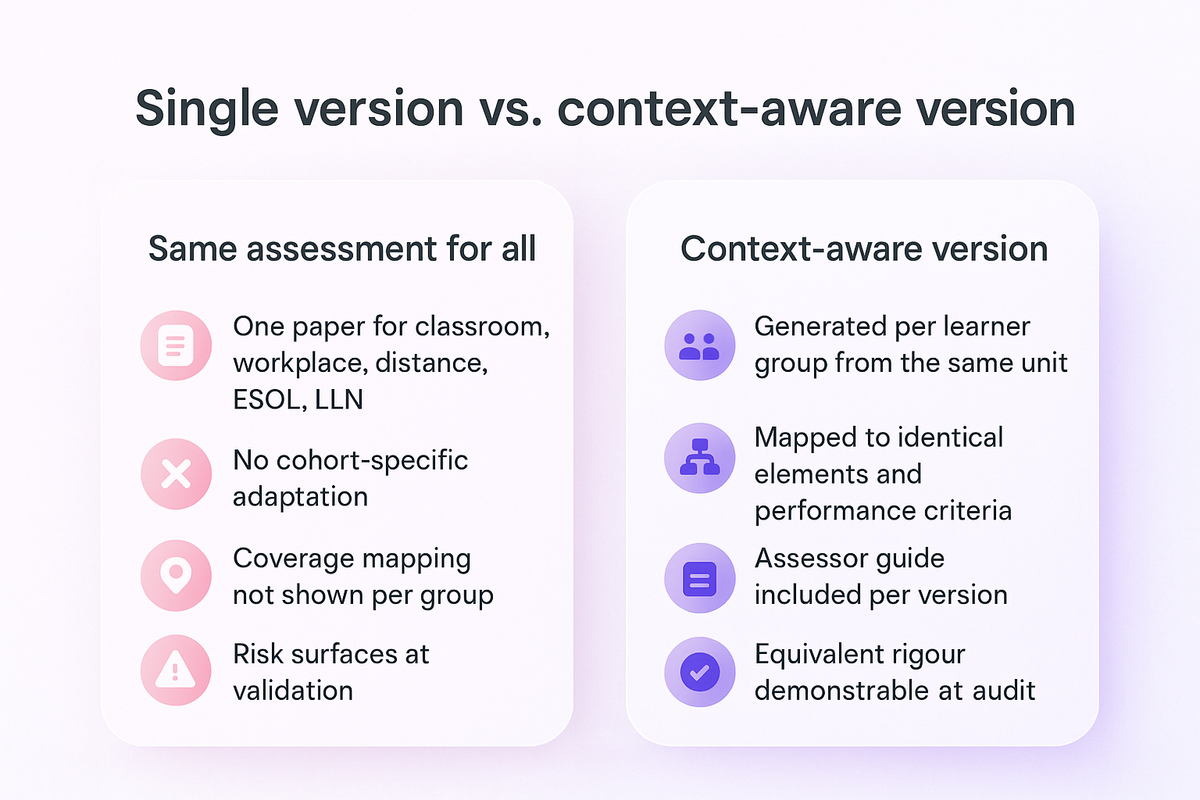
So the default becomes one assessment, issued to everyone. It's rarely a deliberate shortcut — it's what happens when resourcing runs out before the differentiation does.
The problem is that LLN consideration isn't optional. The Department of Employment and Workplace Relations (DEWR) treats LLN assessment as a recognised compliance step in the VET Student Loans program, with its own tool information and application guidance. Industry resources such as vetresources.com.au's guide to LLND testing frame it the same way: a standard due-diligence step before assessment design, not an afterthought once the standard version is finished.
Where the gap actually sits
This isn't just a training-material problem — it's a coverage-mapping problem. If an ESOL or LLN version of an assessment isn't explicitly mapped back to the same elements and performance criteria as the standard version, an RTO has no way to demonstrate equivalent rigour when ASQA comes looking. A learner might get a fairer, more accessible assessment experience, but the paperwork behind it can't prove it tested the same unit to the same standard.
Why differentiation gets skipped under the Standards for RTOs 2025
Assessment writing for a single unit of competency already runs into many hours before anyone thinks about learner cohorts. Add ESOL, LLN, workplace, classroom and distance versions on top, and the build time multiplies. Under resourcing pressure, most RTOs will choose "get one defensible version out the door" over "build five properly differentiated ones" — even though the second option is what the Standards for RTOs 2025 actually expect.
The result is a quiet trade-off: RTOs stay compliant on paper by issuing something, but the something isn't equivalent across cohorts. That gap tends to surface at the worst possible time — during validation, when a moderator notices the ESOL learner's paper doesn't test the same performance criteria with the same rigour as everyone else's.
Building assessments in context, without losing coverage
This is the specific gap VETos is built to close. Instead of one assessment retrofitted for different cohorts, it generates the assessment in the context of the learner group being supported — ESOL, LLN, workplace, classroom or distance — directly from the underlying unit of competency.
Every version, regardless of learner group, maps back to the unit's elements and performance criteria, with an accompanying assessor guide. That mapping is the part that actually protects an RTO at audit: it's what lets a provider show an ESOL-adapted assessment tests the same competency, at the same standard, as the classroom version — not a diluted stand-in for it.
The platform also generates training material linked directly to the assessment, delivered in print-ready and LMS-ready formats, and supports Foundation Skills, volume of learning and delivery evidence requirements aligned to AQF Levels 1 to 6. In practical terms, that means an RTO can produce a genuinely adapted version for a learner group without starting the unit build from scratch each time.
Catching inconsistent judgement before it becomes a validation finding
Even with well-differentiated assessments, there's a second risk: assessors judging different learner groups against the unit inconsistently. Two assessors marking ESOL and workplace-based learners on the same unit can drift apart on standard without anyone noticing — until a validator flags it.
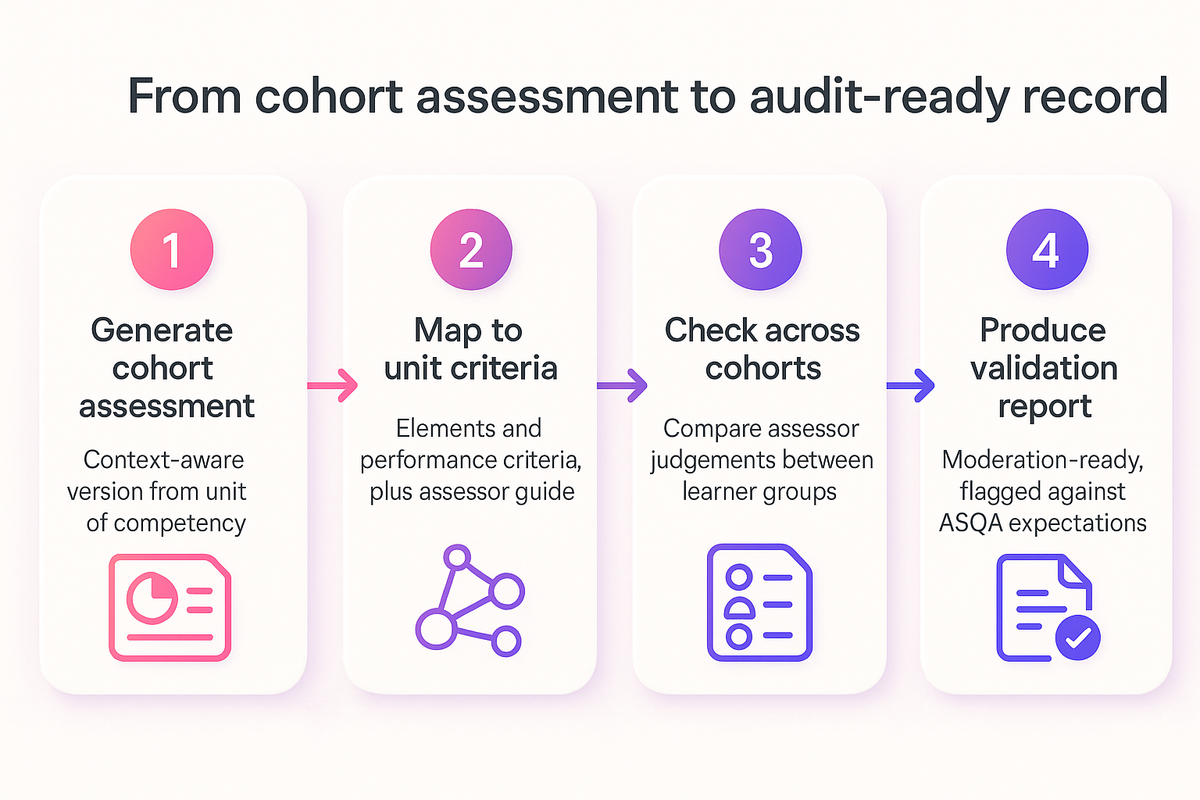
VETos runs cross-cohort consistency checking that compares assessor judgements across different learner groups and flags discrepancies against ASQA audit expectations. Per Supahuman's VET service description, the platform "compares assessor judgments for consistency across different cohorts... and generates moderation-ready validation reports." That's a mechanism for catching the lesser-assessment problem during pre-validation quality management, rather than discovering it when an ASQA auditor asks for evidence.
Key takeaways
- LLN and ESOL consideration before assessment is a documented expectation in the Australian VET sector, not a nice-to-have — DEWR's LLN assessment tool guidance treats it as a compliance step in the VET Student Loans program.
- A single undifferentiated assessment issued across ESOL, LLN, workplace and classroom cohorts is a coverage-mapping risk, not just a fairness issue — it can't demonstrate equivalent rigour to ASQA.
- Differentiated versions only protect an RTO if they map back to the same unit elements and performance criteria as the standard version, with an assessor guide attached.
- Inconsistent assessor judgement across learner groups is a known moderation risk that typically surfaces at audit rather than during delivery.
- Context-aware generation from the same unit of competency, paired with cross-cohort consistency checking, is one concrete way to close both gaps before they become validation findings.
Our take
The "one assessment for everyone" default isn't a sign that RTOs don't care about their ESOL and LLN learners — it's a sign that differentiated assessment design has been treated as extra work layered on top of an already full build, rather than as part of the build itself. Fixing that requires the mapping and the differentiation to happen together, not as a compliance patch applied after the fact. Any provider serious about the Standards for RTOs 2025 should be asking whether their current process makes genuine differentiation the path of least resistance — or the thing that gets cut when time runs short.
FAQ
Do RTOs have to produce a different assessment for ESOL and LLN learners? RTOs are expected to account for language, literacy and numeracy needs before assessment, per DEWR's LLN assessment tool guidance. In practice, that often means an adapted version of the assessment for that learner group — but it must still test the same unit to the same standard as the version used with other cohorts.
Why do so many RTOs end up issuing the same assessment to every learner group? Building one genuinely differentiated version per cohort — ESOL, LLN, workplace, classroom, distance — on top of an already lengthy unit-of-competency build takes significant manual effort. Under resourcing pressure, providers often default to a single version rather than five adapted ones.
What's the actual compliance risk if an ESOL version isn't properly differentiated? If the ESOL or LLN version isn't mapped back to the same unit elements and performance criteria as the standard assessment, the RTO can't demonstrate equivalent rigour. That's a coverage-mapping gap ASQA can identify at validation or audit.
How does VETos help with this specific problem? VETos generates assessments in the context of the learner group being supported — ESOL, LLN, workplace, classroom or distance — directly from the unit of competency, with every version mapped back to the same elements, performance criteria and an assessor guide. It also runs cross-cohort consistency checking that flags assessor judgement discrepancies against ASQA audit expectations.
Is this only relevant to VET Student Loans-funded delivery? No. While DEWR's LLN guidance is framed around the VET Student Loans program, the underlying expectation — that assessment accounts for learner language, literacy and numeracy needs — applies more broadly to sound assessment practice under the Standards for RTOs 2025.