ESOL, LLN & RTO Assessment Design: One Unit, Three Cohorts
14 September 2026 · 7 min read

When a unit of competency has to serve ESOL, LLN and workplace or RPL cohorts, most RTOs end up hand-building three near-identical assessment tools — then scrambling at validation to prove each one still covers the same elements and performance criteria. The real cost isn't the first draft; it's keeping every adapted version traceable back to the unit.
Why one unit becomes three assessment tools
Most trainers know how to contextualise a task. Simplify the language for an ESOL learner. Add numeracy scaffolding for an LLN cohort. Reframe the evidence around a workplace or RPL candidate's actual job. That part isn't the hard bit.
The hard bit is what happens after the adaptation: does the simplified version still assess the same knowledge evidence? Does the workplace-contextualised task still map to the same performance criteria as the classroom version? Under the Standards for RTOs 2025, assessment tools must be validated before use — and validation is exactly where a validator checks that coverage against the unit hasn't quietly drifted between cohort variants.
In practice, this is where a lot of RTOs create risk without meaning to:
- Each cohort variant gets built separately, often by different trainers, with no shared reference point back to the unit's elements and performance criteria.
- RPL and workplace learners are sometimes assessed against a lighter or separate process rather than the same performance criteria as classroom delivery — a shortcut that undermines equivalence of evidence.
- The paper trail showing that all three versions cover the unit equally often doesn't exist until someone builds it manually, under pressure, right before an audit.
The real problem is traceability, not writing
Writing three versions of a task is time-consuming, but it's solvable with enough hours. The problem that actually bites at validation is proving — cleanly, and after the fact — that a simplified ESOL task, a scaffolded LLN task and a contextualised workplace task all still evidence the same unit requirements.
That's a mapping and evidence-trail problem, not a content-generation problem. And it's the piece most RTOs solve badly, because it's the piece that's hardest to do by hand every time a task changes.
How the mapping stays intact when the content changes
This is the specific gap VETos is built to close. Every assessment tool generated in VETos comes with an assessment mapping matrix, pulled from live training.gov.au data — covering both traditional and ASK-format units. That matrix is the record of which elements, performance criteria, knowledge evidence and performance evidence each task actually covers.
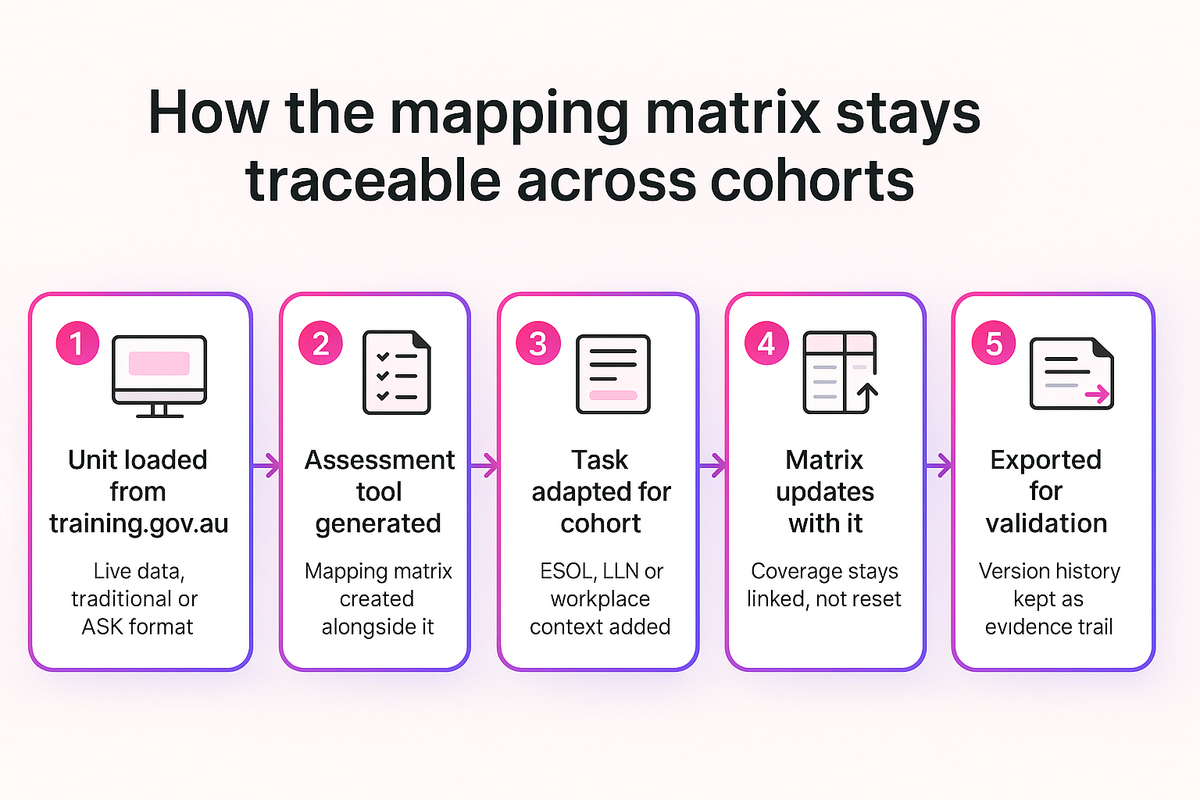
The part that matters for multi-cohort delivery: adapting a task for a different learner group doesn't reset that matrix. If a trainer simplifies wording for an ESOL learner or adds a numeracy scaffold for an LLN learner, the mapping updates with the task rather than being rebuilt from scratch. The matrix can be exported for pre-use validation, and version history is kept as an evidence trail — so a validator can see what changed and confirm coverage still holds, rather than an RTO reconstructing that history under deadline pressure.
Language Support for ESOL, LLN and multilingual learners sits inside the same generation step as multi-format delivery — online, blended, face-to-face and print-ready. That means a cohort-specific variant isn't a separate build; it's a parallel version generated from the same mapped unit source, alongside the classroom version.
The same logic applies to RPL and workplace evidence. Rather than treating it as a lesser or separate pathway, the design intent is that workplace-contextualised evidence maps to the same performance criteria as standard delivery — so an assessor can see equivalence, not just a different-looking task.
What doesn't change
None of this replaces professional judgement. A qualified assessor still validates and signs off every assessment tool against the Principles of Assessment and the Rules of Evidence before it's used with learners. The platform's role is to keep what they're checking — coverage, currency, traceability across cohort variants — accurate and easy to verify. The competency decision, and the validation sign-off, stays with the assessor.
What changes is the amount of manual reconstruction an RTO has to do to prove that three versions of a task still add up to one unit properly assessed.
Key takeaways
- Serving ESOL, LLN and workplace/RPL cohorts under one unit of competency usually means three near-duplicate assessment tools — and three separate chances to lose the link back to the unit's requirements.
- Under the Standards for RTOs 2025, validators specifically check whether adapted versions still cover the same elements, performance criteria and evidence requirements — this is a traceability check, not a writing-quality check.
- RPL and workplace evidence should map to the same performance criteria as classroom delivery, not a separate or lighter process.
- VETos generates a mapping matrix with every assessment tool from live training.gov.au data, and that matrix updates when a task is adapted rather than resetting — exportable for pre-use validation with version history as the evidence trail.
- Language Support for ESOL, LLN and multilingual learners is generated in the same step as multi-format outputs (online, blended, face-to-face, print-ready), not as a separate cohort build.
- A qualified assessor still validates and signs off every tool against the Principles of Assessment and Rules of Evidence — the platform keeps the paperwork honest, not the competency call.
Our take
The multi-cohort assessment problem gets framed as a content problem far more often than it should. Writing a simplified task or a workplace-contextualised task isn't where RTOs lose time or risk — it's proving, cleanly, that the simplified or contextualised version still holds up against the same unit. Any tool that helps generate cohort variants faster but doesn't keep the mapping attached to each one is solving the smaller half of the problem. The harder half, and the half that actually shows up in a validation finding, is traceability.
FAQ
Do ESOL and LLN assessment variants need to be validated separately from the standard version? Under the Standards for RTOs 2025, every assessment tool used with learners needs to be validated before use — including cohort-specific variants. What matters at validation is being able to show each variant still covers the unit's elements, performance criteria and evidence requirements, not treating each version as an entirely separate build.
Should RPL be assessed against different performance criteria to classroom delivery? No. RPL and workplace evidence should be evidenced against the same performance criteria as standard delivery. Treating it as a separate or lighter process is a common design shortcut that weakens equivalence of evidence and creates risk at audit.
How does VETos keep coverage consistent across ESOL, LLN and workplace variants of the same unit? VETos generates an assessment mapping matrix with every assessment tool, built from live training.gov.au unit data. When a task is adapted for a different cohort, the matrix updates with it rather than resetting, and version history is kept as an evidence trail you can export for pre-use validation.
Does this remove the need for an assessor to validate the tools? No. A qualified assessor still validates and signs off every assessment tool against the Principles of Assessment and the Rules of Evidence before it's used. The mapping matrix is there to keep what they're checking accurate and traceable — it doesn't make the competency decision for them.
Does this work for both traditional and ASK-format units of competency? Yes. The mapping matrix is generated from live training.gov.au data covering both traditional units and units in ASK format, so the same approach applies regardless of which format the unit is published in.
If your RTO is rebuilding assessment tools from scratch for every ESOL, LLN or workplace cohort under a unit, it's worth looking at where the time is actually going — writing the content, or reconstructing the evidence trail afterwards. Assessment mapping is the part of this we've built VETos around; it's worth a closer look if that second problem sounds familiar.