ESOL LLN assessment resources NZ: adapt, don't dilute
14 October 2026 · 6 min read
Most New Zealand providers teach one unit standard to very different people: ESOL learners, learners building literacy and numeracy, and experienced workers who need to prove what they already do. The usual fix is to maintain near-duplicate resources by hand. Every copy is one more thing that can drift away from the standard.
Why does one unit standard turn into five sets of materials?
It starts with good intentions. A trainer sees that a cohort of ESOL learners is struggling with the reading load of an assessment. So they rewrite it in plainer language. Then a workplace group needs examples from their own site. Then a distance cohort needs a different format.
Six months later there are five versions of the same assessment. Nobody is quite sure which is current, and nobody has checked that all five still ask for the same evidence.
That's the quiet workload. It rarely appears in a plan or a budget, but it eats trainer time every intake.
What should change for ESOL and LLN learners, and what shouldn't?
The principle is simple: adapt the language and context, never the standard.
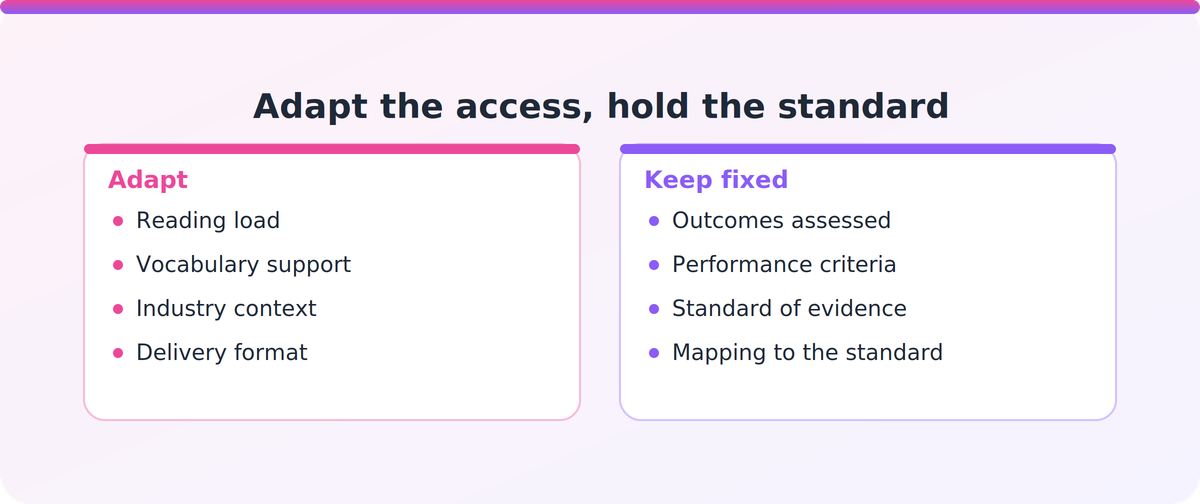
Support for ESOL and LLN learners is access to the same standard, not a diluted version of it. The task, the performance criteria and the level of evidence stay fixed. What flexes is everything wrapped around them.
What you can adapt
- Reading load and sentence complexity
- Vocabulary support and glossaries
- Industry context, so the scenario matches the learner's actual workplace
- Delivery format: classroom, workplace or distance
What you hold constant
- The outcomes and performance criteria being assessed
- The standard of evidence required
- The link from every question or task back to the standard
This reframing matters for fairness too. A learner who completes an adapted assessment should have demonstrated exactly what every other learner demonstrated.
Where does traceability break down?
Writing the adapted draft is the easy part. The hidden cost is proving, afterwards, that each version still covers the same standard.
That proof gets tested at awkward moments. A moderator asks how an assessment maps to the standard. Someone questions a consent-to-assess decision. A standard is replaced and you need to know which of your many versions are affected.
When adaptation happens in separate Word files, answering those questions means opening each one and checking by eye. The more versions you keep, the more likely one is out of step.
Why does this matter more under the PTE Rules 2026?
The PTE Rules 2026, in force from 19 January 2026, replace External Evaluation and Review with self-review and monitoring. That puts more weight on the records a provider keeps for itself.
If you're the one reviewing your own practice, you need evidence you'd be comfortable standing behind: what was assessed, against which standard, in which version, and who approved it. Disciplined, traceable adaptation stops being a nice habit and becomes part of how you show quality.
How does VETos approach contextualised learner resources?
VETos is the AI operating system we built for vocational education, and this problem sits squarely inside what it does. It works in two linked parts.
Learner resources. VETos generates study guides and learner resources contextualised to a provider's industries and learners. That includes reading-level and language support for literacy, numeracy and ESOL cohorts. The VETos NZ page lists learner study support, including ESOL and literacy and numeracy, as a use case.
Assessment tools. You pull a unit or skill standard into the workspace and build directly against it. Assessment tools are designed to hold up to NZQA moderation, whether standalone, clustered, grouped or integrated. They come with mapping and assessor guidance.
Three supporting details matter for the traceability problem:
- Version history, currency control and audit trails are kept as the content is created, so consent-to-assess and moderation questions can be answered from the record.
- As skill standards replace unit standards, existing materials are upgraded to the new standard and the mapping is regenerated.
- Everything exports to Microsoft Word (.docx) and Adobe InDesign (.idml), and the FAQ also lists SCORM packages among the content types generated.
What's the proof, and what isn't?
Here's the honest version. Mast Academy, a New Zealand PTE, rebuilt how it creates courses with VETos. The headline figures on the site are six weeks before and six minutes with VETos, and the NZ page describes an 80% reduction in content development time. That is evidence of course-creation speed. It is not an ESOL or LLN learner outcome, and we're not presenting it as one.
We also haven't published learner outcome data for ESOL or LLN cohorts. If a vendor offers you that kind of claim without the data, ask to see it.
Does this replace trainers and assessors?
No. The VETos FAQ is explicit that it doesn't replace trainers and assessors, and that it would be wary of any tool that claimed to. Deciding what a particular cohort needs, and whether a learner has met the standard, is educator judgement. Software can carry the repetitive work of drafting, mapping and recording so that judgement gets more of the time.
Key takeaways
- One unit standard often serves ESOL, LLN and workplace learners, and hand-built variants multiply quickly.
- The real cost is traceability: proving every adapted version still covers the same standard.
- Adapt reading load, language support and industry context. Keep the assessed standard fixed.
- The PTE Rules 2026 shift more of the quality burden onto your own records and self-review.
- VETos contextualises learner resources and builds assessment tools against the standard, with mapping, assessor guidance and an audit trail. Trainers and assessors still make the calls.
Our take
Most providers don't have a content problem. They have a version-control problem dressed up as a support strategy. We think the sector is better served by treating the standard as the one fixed point and making everything else adjustable and recorded. If you can't show a moderator how an adapted resource ties back to the standard, the adaptation isn't finished yet.
FAQ
How do I adapt assessments for ESOL learners without changing the unit standard?
Change the support, not the requirement. Simplify reading load, add vocabulary support and use familiar industry context, while keeping the outcomes, performance criteria and evidence standard identical. Then keep a record showing the adapted version still maps to the same standard.
What is the difference between ESOL and LLN support in vocational training?
ESOL support helps learners who are developing English as an additional language. LLN support helps learners strengthen literacy and numeracy skills in any language. Both can need adjusted reading levels and clearer context, but the learners and their needs differ, so the support should too.
Do the PTE Rules 2026 change how PTEs should manage assessment records?
The PTE Rules 2026, in force from 19 January 2026, replace External Evaluation and Review with self-review and monitoring. That makes your own records of assessment design, mapping and approvals more important, because you're the one demonstrating quality.
Can AI generate ESOL and LLN assessment resources in NZ?
VETos generates learner resources with reading-level and language support for ESOL and literacy and numeracy cohorts, and builds assessment tools against a unit or skill standard with mapping and assessor guidance. It supports trainers and assessors rather than replacing them. Review every output against your learners' needs.
If you're maintaining several versions of the same assessment today, a good first step is to list them and check how each one traces back to the standard. If you'd like to see how VETos handles that, you can take a closer look at Supahuman.