ESOL Vocational Assessment: A 2026 Audit Blind Spot
20 September 2026 · 8 min read
ESOL Vocational Assessment: A 2026 Audit Blind Spot
Assessment tools that tick every box on paper can still fail the learners they're meant to assess. Since the Standards for RTOs 2025 took full effect, ASQA's audit approach checks actual evidence rather than policy documents — and with RPL and foundation-skills assessment named as 2026 priority risk areas, RTOs that never validated their tools for ESOL, low-literacy or culturally and linguistically diverse (CALD) learners are carrying more exposure than their mapping files suggest.
What changed under the Standards for RTOs 2025
The Standards for RTOs 2025 have been fully in force since 1 July 2025. The practical shift for providers is in how audits are run. Rather than confirming that a policy exists, ASQA's 2026 review approach examines:
- Completed assessment tools and the student work they produced
- Trainer and assessor records, including how judgements were reached
- Validation outcomes across the portfolio, not just validation schedules
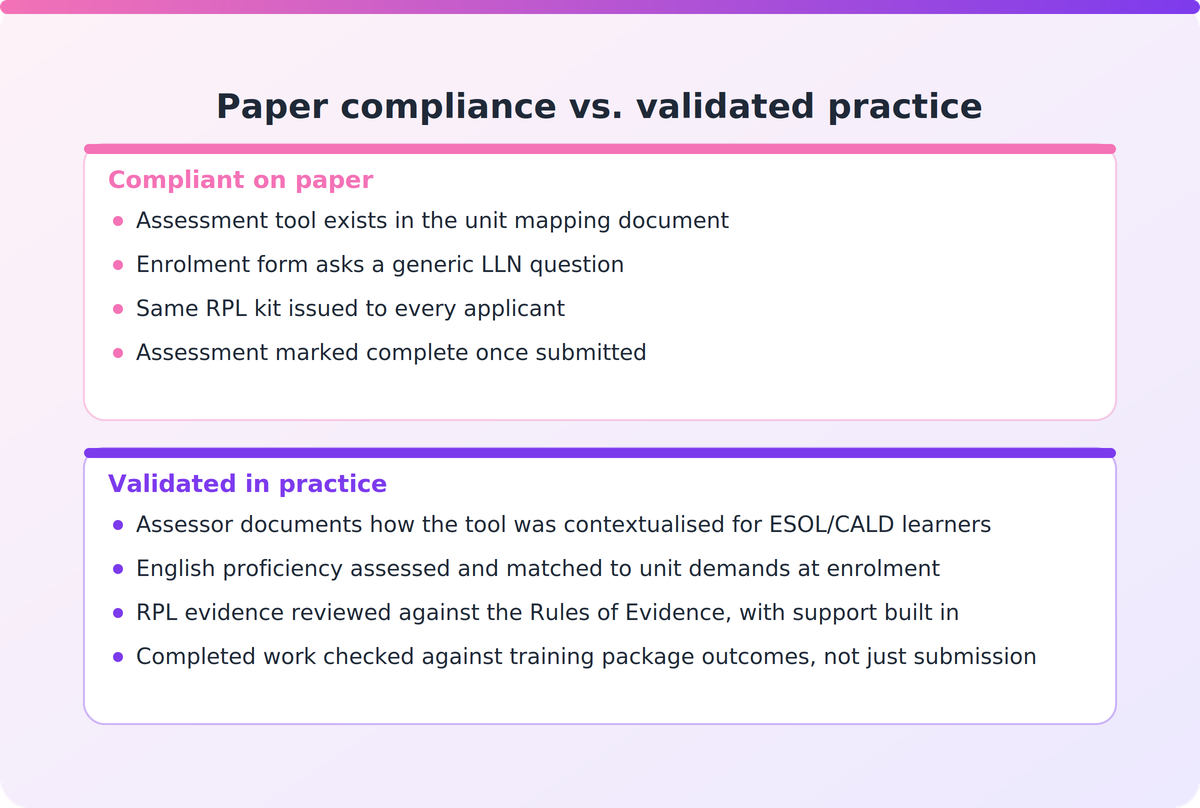
- Whether learners genuinely acquired the competency described in the relevant training package, not simply whether they submitted work
That last point matters most for ESOL and low-literacy cohorts. A learner can complete an assessment task without the task ever having been checked for whether its language demands matched their proficiency — and under the current audit lens, that gap now shows up in the evidence, not just in theory.
Why this is a compliance risk, not only an access issue
ASQA's own Information Practice Guide is explicit: RTOs must demonstrate how they communicate the language, literacy, numeracy (LLN) and digital literacy skills a learner needs to succeed in a training product. Failing to consider LLN proficiency at enrolment is listed as a compliance risk in its own right — not a quality-improvement suggestion.
For CRICOS providers, the obligation is even more direct. ASQA guidance confirms that overseas students' English language proficiency must be assessed against a documented policy before enrolment. That's a regulatory requirement, not a best-practice option.
The distinction auditors are now drawing looks like this:
The evidence base: what the research shows
This isn't a hypothetical concern manufactured by tighter audits. NCVER research on foundation-skills learners — including its *Laying the foundations* and *Journeying through VET* studies — shows migrant learners typically enrol in vocational training specifically to secure employment outcomes, and completion patterns in this cohort are an active area of research and policy attention.
Jobs and Skills Australia's more recent work on partial qualification completions adds further data on CALD learner outcomes, reinforcing that language and literacy proficiency is measurably linked to whether a learner finishes — and whether the competency they're assessed against reflects what they can actually demonstrate.
Put together, the research and the regulatory settings are now pointing the same direction: assessment validity for ESOL and CALD learners is an outcomes question with a paper trail attached.
RPL: a specific pressure point for 2026
Recognition of Prior Learning is heavily used by mature-age migrant and ESOL learners who bring genuine industry experience but may need support demonstrating it against a training package's language and documentation expectations. ASQA has named RPL assessment as a priority risk area for 2026, with increased scrutiny on how RTOs deliver and document the process.
For RTOs, that means the RPL pathway can't lean on a generic evidence-collection template. Auditors will be looking for:
- How LLN and cultural context were factored into the RPL evidence-gathering approach
- Whether assessors documented reasonable adjustments distinct from lowering the standard
- Whether completed RPL files show genuine competency evidence, not just checklist completion
What audit-ready ESOL assessment actually looks like
Meeting this standard doesn't mean writing a separate assessment for every learner. It means the validation process explicitly accounts for language and literacy variation, and that account is documented.
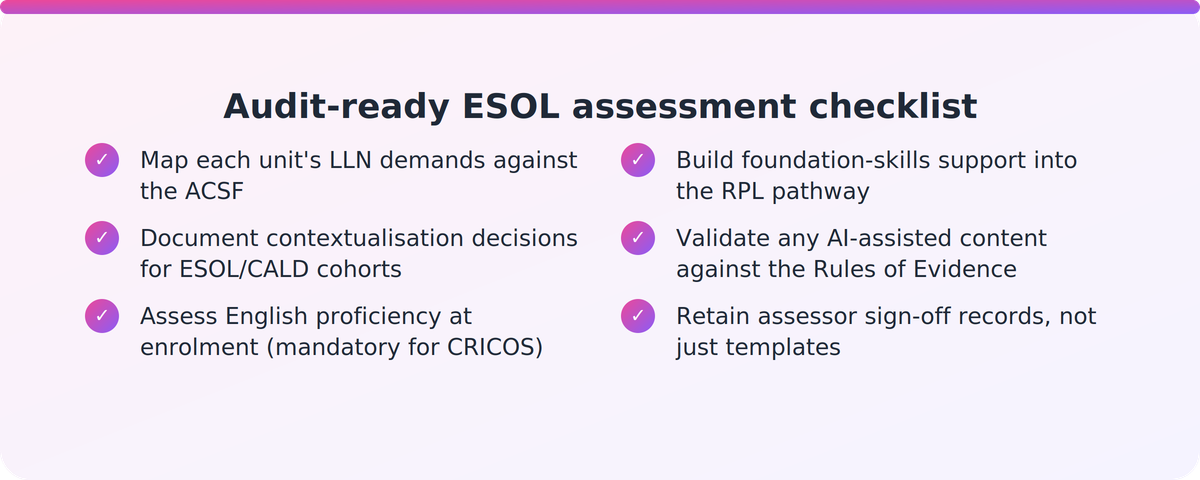
A reasonably defensible approach includes:
- Mapping the LLN demands of each unit of competency against the Australian Core Skills Framework (ACSF)
- Documenting contextualisation decisions made for ESOL, low-literacy or CALD cohorts, not just noting that adjustments are "available on request"
- Assessing and recording English language proficiency at enrolment, mandatory for CRICOS providers and good practice everywhere else
- Building foundation-skills support into the RPL pathway rather than treating it as a bolt-on
- Retaining evidence of assessor sign-off on contextualised materials, not just the templates used to produce them
On that last point, ASQA has also flagged AI-generated assessment content as an emerging authenticity risk. Any technology used to contextualise assessments for ESOL learners still has to route through a qualified assessor's judgement against the Principles of Assessment and the Rules of Evidence — speed doesn't remove that step, it just changes where the effort goes.
Key takeaways
- The Standards for RTOs 2025 have shifted ASQA's 2026 audits toward examining actual assessment evidence, completed student work and validation outcomes, not just policy documents.
- RTOs must demonstrate they've considered LLN proficiency at enrolment; CRICOS providers must assess English language proficiency against a documented policy before enrolment.
- RPL is a named 2026 priority risk area, with direct relevance to mature-age migrant and ESOL learners who lean on this pathway.
- NCVER and Jobs and Skills Australia research show completion and outcomes gaps for migrant and CALD foundation-skills learners are measurable, not theoretical.
- Any AI-assisted contextualisation of ESOL assessments still needs documented assessor validation against the Rules of Evidence to withstand audit.
Our take
The practical problem for most RTOs isn't a lack of goodwill toward ESOL and CALD learners — it's that assessment validation has historically been treated as a one-off event covering "the assessment tool" rather than an ongoing check across every cohort that tool is actually used with. That gap was tolerable when audits sampled paperwork. It's a liability when auditors are checking whether the learner in front of them could genuinely demonstrate the competency in the training package.
We'd argue the fix isn't a parallel set of "ESOL versions" of every assessment, which just multiplies the compliance surface area. It's building contextualisation and unit-of-competency mapping into the same process from the start, so a workplace variant, an ESOL-adjusted variant and a distance-delivery variant all trace back to the same evidence requirements and the same assessor sign-off. Some platforms built specifically for Australian VET compliance, including Supahuman VETos, are starting to design around exactly that link between contextual generation and audit-ready mapping — which is worth watching as the 2026 audit cycle plays out.
Worth sitting with before your next validation cycle: if an auditor pulled ten completed assessments from your most linguistically diverse cohort tomorrow, would the file show that the tool was checked for them specifically — or just that it exists?
FAQ
What is ESOL vocational assessment, and why does it matter for RTO compliance? ESOL vocational assessment refers to assessment tools and processes designed or adapted for learners whose first language isn't English. It matters because ASQA's Information Practice Guide requires RTOs to demonstrate they've considered LLN proficiency at enrolment, and the Standards for RTOs 2025 now bring auditors into actual assessment evidence rather than just policy statements.
Do the Standards for RTOs 2025 require English proficiency testing at enrolment? For CRICOS providers, yes — ASQA guidance confirms overseas students' English language proficiency must be assessed against a documented policy before enrolment. For domestic learners, RTOs must still demonstrate they've considered LLN proficiency as part of enrolment and training design, even without a mandated test.
Why is RPL assessment flagged as a particular risk for ESOL and CALD learners? ASQA has named RPL as a priority risk area for 2026, and mature-age migrant learners rely heavily on this pathway to have industry experience recognised. Auditors are scrutinising whether RPL evidence-gathering genuinely accounts for language and cultural context, or whether it simply follows a generic checklist.
Can AI be used to adapt assessments for ESOL learners under current ASQA expectations? It can, but ASQA has flagged AI-generated assessment content as an emerging authenticity risk. Any AI-assisted contextualisation still needs documented review by a qualified assessor against the Principles of Assessment and Rules of Evidence — the technology can speed up drafting, but it can't replace the validation step.
What evidence should an RTO keep to show its ESOL assessments are valid? At minimum: LLN mapping against the Australian Core Skills Framework for each unit of competency, documented contextualisation decisions for ESOL or CALD cohorts, enrolment-stage proficiency records, and assessor sign-off on any adapted or AI-assisted materials — kept as retrievable evidence, not just referenced in a policy.