Fees Free Is Ending: How PTEs Should Build Training Now
13 October 2026 · 6 min read
Final-year Fees Free closes on 31 December 2026, and first-year Fees Free has already gone. For PTEs, that removes a funding-linked enrolment lever and shifts the contest to completion, support and affordability. Programmes built around coached, practice-rich, modular delivery will be better placed than those that relied on a fee headline.
What exactly is changing with Fees Free?
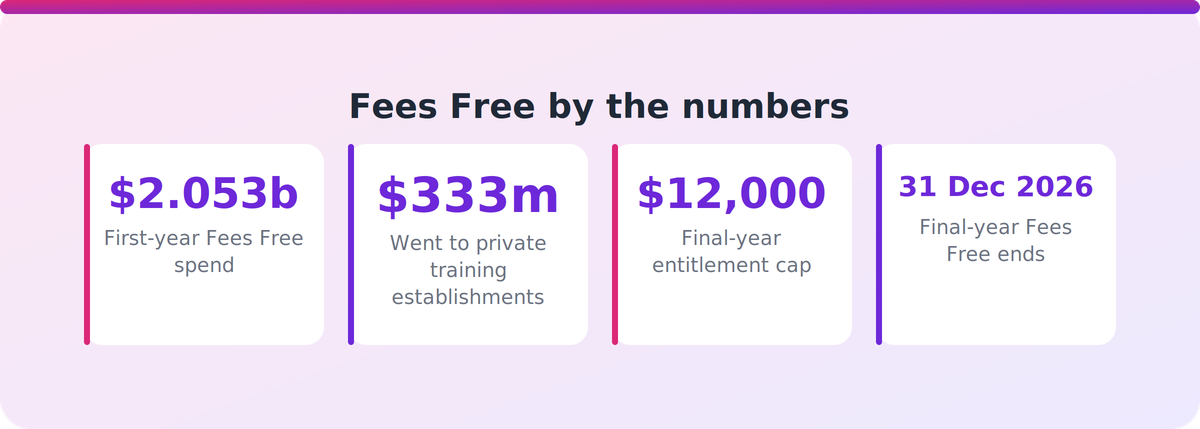
The short answer: the scheme is winding down, and the final-year version has a hard stop. According to the Tertiary Education Commission (TEC), final-year Fees Free covers up to $12,000 in fees for a final year of tertiary study, or the final two years of work-based learning. The study must have started on or after 1 January 2025 and be completed by 31 December 2026.
Three details matter for programme design:
- The cap is whichever comes first: $12,000, 1 EFTS, or 24 months of work-based learning.
- Cross-credited study generally doesn't count towards the entitlement.
- Learners can change TEOs in their final year and still receive it, provided they stay in the same qualification.
Learners can claim within 12 months of completion, up to 31 December 2027. Anyone finishing in 2027 or later gets nothing.
How much did PTEs depend on it?
More than most marketing plans admit. NZ Herald, reporting on a TEC briefing, put first-year Fees Free spending at $2.053b, with $333m going to private training establishments.
That support is gone. The Minister's argument is that reimbursement after completion doesn't remove up-front cost barriers, so the Government has little reason to rebuild it in the same form.
Is Fees Free likely to return?
Probably not in its current shape. The evidence the Government is leaning on is unflattering:
- Research reported by The Conversation found little evidence that a fees-free year widened tertiary access. A final-year model may do more for completion, but is even less likely to change who enters study.
- B2B News argues the scheme barely reached the trades and technical pipelines employers are short of.
To be fair, this is still a political landscape. Transition detail remains provisional, as Careerforce notes, and election-year politics could shift the settings. Plan for the current rules, not for a reversal.
Where is the money going instead?
Budget 2026 points growth towards foundation and trades pathways. As reported by RNZ, the Ministry of Education and Newsroom:
- An additional 1,000 Youth Guarantee places from 1 July 2026 ($86.9m), for 16–24-year-olds.
- Trades Academy places double to 20,000 by 2030 ($69m operating over four years).
- Most subsidy rates are frozen, apart from a 2 percent rise for foundation courses.
- Providers can raise domestic fees by up to 6 percent.
Frozen subsidies plus permission to lift fees is an awkward combination. Learners lose a rebate just as price pressure rises.
What does NZQA's rulebook add?
The Private Training Establishment Rules 2026 took effect on 19 January 2026. NZQA's rules reflect the removal of External Evaluation and Review in favour of self-review and monitoring. This is context, not a Fees Free provision, but the two land together.
With fees no longer doing the persuading, a PTE needs its own evidence of completion and outcomes. That evidence serves learners, employers, schools and NZQA alike.
How should PTEs build training now?
The research found no PTE-sector commentary on redesign, so what follows is our inference, not sourced fact. If fees are the lever you no longer have, these are the levers left:
- Design for completion first. Map where learners stall and build support into those points, rather than bolting it on.
- Think modular. Shorter, stackable components let learners show progress early and keep costs visible.
- Anchor in employer and school partnerships. Youth Guarantee and Trades Academy growth rewards providers who can show a credible pathway into work.
- Make practice the core. Repeated, coached practice is what turns a qualification into confidence on the job, and confidence is what keeps learners enrolled.
- Keep production costs down. With subsidies frozen, you can't fund a six-week instructional design cycle for every scenario.
That last point is where the economics have shifted. Role plays, simulations and coached practice used to be the expensive end of training, needing facilitators, actors and long build times. AI-generated scenarios, tailored to a learner's trade or workplace and produced in minutes, change that maths. It's the kind of thing we're building at Supahuman, but the principle holds whatever tools you use.
Key takeaways
- Final-year Fees Free ends on 31 December 2026. First-year Fees Free has already ended.
- PTEs received about $333m of the $2.053b first-year spend, so the loss is material.
- Budget 2026 favours Youth Guarantee, foundation and Trades Academy pathways, with subsidies frozen and domestic fees allowed to rise by up to 6 percent.
- NZQA's 2026 rules put more weight on a PTE's own evidence of outcomes.
- Practice-rich, supported and modular design is the likely competitive answer. That's our inference, not a policy requirement.
Our take
Many PTEs treated Fees Free as a marketing line. When it goes, whatever is left in the programme has to carry the weight. We think the providers who come out ahead will be the ones who can show, with evidence, that learners finish and can do the job. Coached practice at a sustainable cost is the most direct way to get there, and it's now a design decision rather than a nice-to-have.
FAQ
When does final-year Fees Free end?
It ends on 31 December 2026. The final year of study, or final two years of work-based learning, must have started on or after 1 January 2025 and be completed by that date. Learners can claim within 12 months of completion, up to 31 December 2027 (TEC).
How much is the final-year Fees Free entitlement?
Up to $12,000, 1 EFTS or 24 months of work-based learning, whichever comes first. Study cross-credited from a different qualification generally doesn't count (TEC).
How do the Budget 2026 changes affect PTEs?
Budget 2026 froze most subsidy rates, with a 2 percent rise for foundation courses, and let providers raise domestic fees by up to 6 percent. It also funded 1,000 more Youth Guarantee places from 1 July 2026 and plans to double Trades Academy places to 20,000 by 2030.
What does the end of Fees Free mean for NZQA compliance?
Fees Free isn't a compliance matter. However, the Private Training Establishment Rules 2026, effective 19 January 2026, reflect a move to self-review and monitoring. PTEs therefore need their own evidence of completion and outcomes.
Could Fees Free come back?
It's possible but unlikely in the same form. Research and commentary suggest the scheme did little to widen access or reach trades shortages. Transition details are provisional and election-year politics could change settings, so plan on current rules.