Formative Design for VET: What the 2025 Standards Require
30 August 2026 · 7 min read

Formative Design for VET: What the 2025 Standards Require
A module built once and left alone used to be defensible instructional design. Under the Standards for RTOs 2025, it's closer to an audit finding waiting to happen. ASQA no longer treats learning design as content delivery — it treats it as evidence that practice, feedback and coached repetition actually happened, and static content can't produce that evidence on its own.
Why this lands on your desk
You're the one who has to defend the design, not just the delivery. When an ASQA auditor asks how a training product builds competence — not just how it's paced or published — the answer sits in your instructional design decisions: how practice is sequenced, how feedback loops back into learning, how differently a First Nations learner's experience is catered for versus a generic cohort.
The 2025 Standards for RTOs commenced 1 July 2025, and ASQA's 2026 audits are assessed against these Standards, not the 2015 framework RTOs have designed against for a decade. If your content architecture, assessment tools and practice sequencing still reflect the old model, that gap is now yours to close — and yours to answer for at audit.
Standard 1.3 makes design quality an audit line item
Standard 1.3 requires the assessment system to be fit-for-purpose and consistent with the training product, with assessment tools reviewed before use against the Principles of Assessment and Rules of Evidence. That's not a paperwork exercise. It's a direct statement that design has to produce valid competency judgements — and a module with no built-in practice or feedback structure struggles to clear that bar, because there's nothing in it to generate the evidence an assessor needs.
Coached practice is now a compliance expectation
ASQA's own guidance states that training must be structured and paced to allow sufficient time for instruction, practice, feedback and assessment. Read that again: practice and feedback sit alongside instruction and assessment as required components, not optional extras layered on top once the "real" content is built.
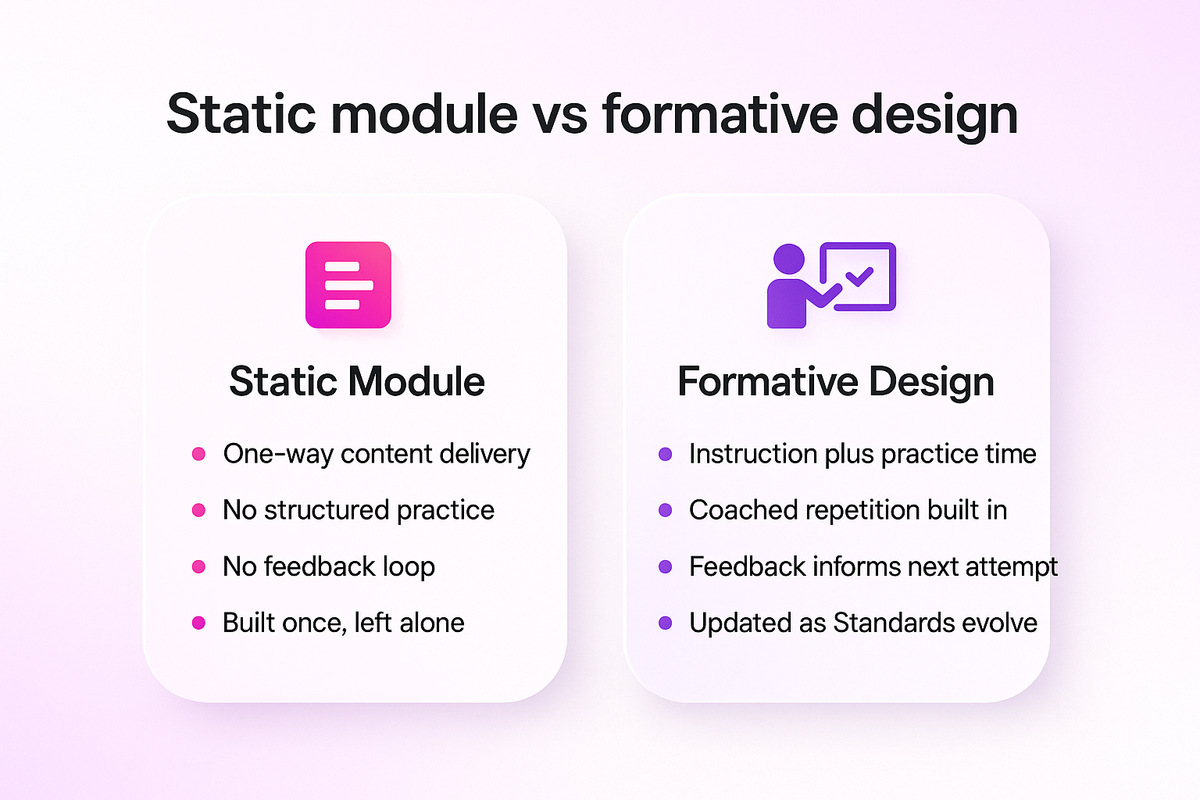
This is the shift that matters for formative learning design in VET. A one-off explainer video or a static PDF module can inform. It can't coach. If a learner never gets a structured chance to attempt a skill, get feedback on it, and try again, the design itself is arguably out of step with what ASQA now expects to see evidenced.
Cultural safety and inclusion are design specs, not disclaimers
Outcome Standards 2.4, 2.5 and 2.6 introduce explicit, auditable requirements around supporting students with disability, cultural safety for First Nations people, and student wellbeing — and they apply to every RTO, regardless of current enrolment. ASQA's Diversity and Inclusion practice guide gets specific: speak respectfully about First Nations culture and knowledge, recognise unequal access and experience across the VET sector, and involve First Nations voices in reviewing training and assessment materials.
For you, that means differentiated design is no longer a values statement in a policy document. It's a design spec you need to be able to point to — who reviewed the materials, what adjustments exist for different learners, how wellbeing is supported through the learning journey.
Your content architecture has a shelf life
From 1 July 2025 the updated Training Package Organising Framework embeds a purpose-led, principles-based approach to qualification design, replacing the one-size-fits-all structure many training packages were built against. Content architecture built to the old framework will need reworking as training packages are updated under TPOF. If your design system assumes a fixed unit structure that no longer matches the framework, that's design debt compounding in real time, not a future problem.
The workforce shortage makes "build once" impossible anyway
Jobs and Skills Australia data shows VET teachers have been in national shortage for two years, with close to half the workforce aged over 50 and roughly 3,800 more VET teachers needed over five years. That capacity pressure lands squarely on design teams: fewer trainers to co-develop content, fewer subject-matter experts with time to spare, and less human bandwidth to keep static modules current as training packages and Standards shift underneath them.
AI-assisted design is now a governed practice, not a shortcut
ASQA has released Principles for the Responsible Use of AI in VET, requiring strong governance, human oversight and accountability, and secure handling of information wherever AI supports design or delivery. If you're using AI to help build scenarios, assessments or content faster — and increasingly, you will need to — that use has to be documented, overseen and defensible, the same as any other design decision.
Key takeaways
- The Standards for RTOs 2025 commenced 1 July 2025, and 2026 ASQA audits assess evidence against these Standards, not legacy 2015 requirements.
- Standard 1.3 requires assessment tools to be fit-for-purpose and reviewed before use — static, practice-free modules make that harder to evidence.
- ASQA guidance formalises practice, feedback and coached repetition as required elements of structured, paced training, not optional additions.
- Outcome Standards 2.4–2.6 make cultural safety, disability access and wellbeing auditable design requirements for every RTO, First Nations enrolments or not.
- TPOF reform and the ongoing VET teacher shortage mean content architecture and design capacity both need to flex faster than a "build once" model allows.
Our take
The uncomfortable truth in the 2025 Standards is that ASQA has essentially formalised what good instructional designers already knew: content without practice doesn't build competence, and one-size-fits-all design doesn't serve every learner. The Standards just made that a compliance line instead of a professional judgement call, which raises the stakes but also gives you leverage — you can now point to a specific clause when you argue for time and budget to build formative, contextual practice rather than another static module.
The hard part is capacity, not conviction. Rebuilding practice-rich, differentiated learning experiences at the pace TPOF and the 2025 Standards demand, with a shrinking pool of trainers to co-design with, is a genuine constraint. Some instructional design teams are starting to use AI to generate contextual role-plays and coached-practice scenarios faster than manual build cycles allow — Supahuman's Nova is one example — but ASQA's AI Principles are explicit that governance and human oversight of that process stay with you, not the tool. Whatever gets you to formative design faster, the accountability for its quality doesn't move.
FAQ
Does a static e-learning module automatically fail the 2025 Standards for RTOs? Not automatically, but it's a risk factor. ASQA's guidance requires training to be structured and paced to allow instruction, practice, feedback and assessment. A module with no built-in practice or feedback loop makes it harder to evidence that requirement, and Standard 1.3 requires assessment tools to be fit-for-purpose and reviewed before use.
Do Outcome Standards 2.4–2.6 apply if we have no First Nations students currently enrolled? Yes. These Standards, covering support for students with disability, cultural safety for First Nations people, and student wellbeing, apply to every RTO regardless of current enrolment profile — they're about design and capability, not current cohort composition.
What does TPOF reform mean for existing content I've already built? From 1 July 2025, the Training Package Organising Framework moved to a purpose-led, principles-based structure, replacing the previous one-size-fits-all model. As training packages update under TPOF, content architecture built against older package structures will likely need reworking to stay aligned.
If I use AI to help build scenarios or assessments, does that create compliance risk? It can, if it's ungoverned. ASQA's Principles for the Responsible Use of AI in VET require strong governance, human oversight and secure handling of information wherever AI supports design or delivery — the RTO remains accountable for the outcome regardless of how it was produced.
If you're mapping your own design backlog against the 2025 Standards this quarter, start with one question: for every unit you're responsible for, can you point to where the learner practises, where they get feedback, and where that loop repeats? If the answer is no, that's your priority list — before an auditor makes it for you.