Formative Learning Design in NZ: Guarding the Practice Gap
11 October 2026 · 7 min read
When a design timeline tightens, the first thing to go is rarely content. It's rehearsal: the scaffolded, repeated, feedback-rich practice that happens before a learner is assessed. Under New Zealand's new quality framework, that cut is more visible than it looks. It belongs on your risk register, not just your trade-off list.
A caveat first. The research behind this piece has no data on how common practice cuts are in NZ programmes. What follows is a reasoned argument built on the regulatory context, not a measured finding.
Why this lands on your desk
You own programme and assessment design while the ground moves. NZQA's integrated Quality Assurance Framework went live in January 2026. Updated rules followed. Standards-setting has shifted to the Industry Skills Boards. Each shift creates rework, and rework competes directly with the time it takes to build practice into learning.
There is also a structural reason practice gets cut. It rarely shows up as a compliance line item. Nobody audits a rehearsal activity the way they check a records-retention schedule, so it is the easiest thing to postpone when you are short of hours.
If you are redesigning or maintaining content for a new owner, with less time and fewer people, that postponement can quietly become permanent.
What changed in how quality gets evidenced
NZQA stopped starting new external evaluation and review (EER) processes and consistency reviews. Providers now submit an annual self-review summary report and meet NZQA to discuss their improvement plan (NZQA, 15 January 2026). Quality evidence is now ongoing and provider-generated, rather than periodic and externally led.
The Quality Assurance of Tertiary Education Providers Rules 2026 sit behind this. They require an up-to-date quality management system, annual self-reviews, monitoring, sub-contracting requirements and retention of assessment records. Your design decisions about practice and feedback are part of that evidence trail, whether or not anyone has labelled them that way.
In an annual conversation about improvement, a design team that cannot show how learners are prepared to meet assessment standards has a harder story to tell.
Where the proposed ratings would expose the gap
NZQA has proposed rating providers Highly Effective, Effective or Not Effective. According to a secondary report (Indian Newslink), the ratings would weigh four criteria:
- programme and micro-credential design
- education delivery
- assessment practice
- quality management systems
Consultation closed on 7 September 2026, and I could not find the outcome. Treat it as a direction of travel, not settled policy.
The point stands either way. Design and assessment practice are the two criteria most directly tied to how well rehearsal is built in. A programme can pass every documentation check and still send learners into assessment cold. That is a design-quality problem, and it would surface in exactly the criteria you are accountable for.
Reform is a reason to revisit practice, not freeze it
Some of the rule changes loosen the brakes on updates. The Programme Approval Rules 2026 reduce approval requirements for qualifications made up entirely of skill standards. They also remove the need for Industry Skills Board endorsement for Type 2 programme changes. The DASS Rules 2026, re-issued on 19 January 2026, no longer set a five-year maximum review period.
Two things follow. Updates may be cheaper to make, so there is less excuse for frozen practice components. And standards can now be reviewed on a different rhythm, so a design that hard-wires scenarios to a fixed point in time risks going stale.
The Industry Skills Boards now develop and maintain industry qualifications and unit standards, run national external moderation, and endorse consent-to-assess applications and micro-credentials in their areas. You are designing to standards owned by industry-led bodies. Keep your practice scenarios close to the workplace reality those boards represent, and keep them easy to swap.
Five questions before a design is signed off
Use these as a quick screen when time is short.
- Where in this programme does a learner attempt the skill before it counts?
- Who gives feedback, and how soon does it arrive?
- Can the learner repeat the attempt after feedback?
- Does the scenario reflect current workplace conditions for this standard?
- Could we show an evaluator or moderator how practice leads to the assessment task?
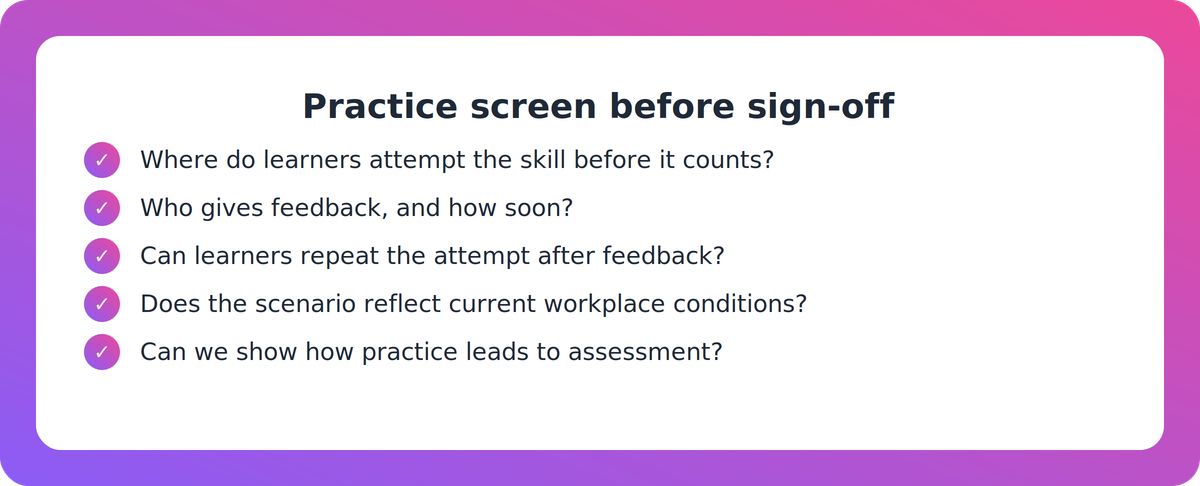
If you answer "nowhere" to the first question, you have found the gap. It is far easier to name it in design than to explain it later.
Practice, integrity and cultural approaches
NZQA's academic integrity guidelines cover upholding, preventing, detecting and responding to misconduct. They ask providers to consider different cultural approaches to teaching, learning and assessment, and to consider generative AI use.
NZQA does not say formative practice is the answer, and I am not claiming it does. But as a design consideration it fits well. Supervised, observable practice with feedback gives you evidence of a learner's actual capability, and room to build in culturally responsive approaches, well before a high-stakes judgement.
Capacity is part of the story
Most Te Pūkenga programmes, functions, assets and staff moved to regional polytechnics from 1 January 2026. The disestablishment Bill would close Te Pūkenga at the end of 2026. The Minister has acknowledged that disestablishment will not be completely equitable (RNZ).
Fewer people, new owners and moving standards are exactly the conditions under which practice gets deferred. Name that pressure openly with your manager. It is a better conversation than quietly absorbing the cut.
Our take
The practice gap is not a time-saving trade-off. It is a design-quality risk that happens to be invisible in the places we usually look for risk.
We think the most useful move for an instructional designer this quarter is to make practice visible. Put it in the design brief as a named component, with its own line in the programme map and its own feedback loop. Then it is no longer the thing quietly sacrificed when a deadline moves.
When you must cut, cut deliberately and in the open. Record what was removed and why, and flag the risk. A documented decision is defensible. An undocumented gap is the one you will be asked about.
Key takeaways
- Formative practice is the easiest thing to cut because it rarely appears as a compliance line, and that is exactly why it needs protecting.
- NZQA's quality framework now relies on ongoing, provider-generated evidence, including an annual self-review summary and an improvement-plan discussion.
- The proposed provider ratings (outcome not found) would weigh programme design and assessment practice, the two criteria closest to practice.
- Looser update rules and ISB-owned standards are reasons to refresh practice scenarios regularly rather than freeze them.
- If you must cut practice, document the decision and the risk instead of absorbing it silently.
FAQ
Is formative practice a formal NZQA requirement?
The research does not show NZQA requiring formative practice by name. The argument is indirect. Programme design and assessment practice are among the proposed rating criteria, and your design choices are part of the quality evidence trail.
Have NZQA's Highly Effective, Effective and Not Effective ratings been confirmed?
Not as far as the research shows. The ratings were proposed, consultation closed on 7 September 2026, and the outcome was not found. Treat them as a direction of travel and check NZQA for updates.
What do the Industry Skills Boards change for my design work?
Since 1 January 2026 the eight boards develop and maintain industry qualifications and unit standards, handle national external moderation, and endorse consent-to-assess applications and micro-credentials in their areas. Keep practice scenarios close to the workplace reality they represent.
How does this connect to academic integrity and AI?
NZQA's guidelines ask providers to consider generative AI and different cultural approaches to assessment. Supervised, observable practice with feedback is a natural design fit, but that is a design judgement, not something NZQA states.