Why Formative Practice Now Passes NZQA's Self-Review Test
15 September 2026 · 8 min read

NZQA no longer wants proof that your content exists — it wants proof that learners can perform. From 1 January 2026, self-review replaces new External Evaluation and Review (EER) processes as the default assurance model, and the instructional designers who can show rehearsed, demonstrated capability will clear that bar far more easily than the ones holding the thickest module library.
Why this hits your desk
Under the new integrated Quality Assurance Framework (iQAF), with updated Rules in force from 19 January 2026, NZQA stops opening new EER processes from 1 January 2026. In their place, providers must produce an annual self-review summary report and have a quality management system operating by 1 January 2027. That's not a compliance team's problem to solve in isolation — it's a design problem. Self-review asks you to evidence that learning changes behaviour, and the only design artefacts that do that convincingly are the ones built around practice, not pages.
At the same time, the Directory of Assessment and Skill Standards Listing and Operational Rules 2026 has removed the old five-year maximum review period for skill standards. Currency is no longer something you check on a cycle — it's something you manage continuously, standard by standard, as reviews land whenever they land.
And you're doing both of these with fewer hands than before. The 2025 vocational education legislation disestablished Te Pūkenga and stood up 10 regional polytechnics and 8 Industry Skills Boards (replacing the six former Workforce Development Councils) from 1 January 2026, with NZIST running as a two-year transitional entity to manage programme handover. Sector reporting from FE News in December 2025 flagged an unsettled 2026 ahead, with financial viability questions for some polytechnics still open. That restructure has already cost capacity: at least 154 roles and one campus were cut across ten institutes of technology and polytechnics as disestablishment was prepared, on top of courses discontinued along the way. Fewer designers are now expected to maintain more qualifications across more owners.
The self-review shift moves the burden of proof onto your design choices
Under the old EER model, an external reviewer eventually turned up and formed a judgement. Under self-review, you generate the evidence base yourself, continuously. That changes what "good" learning design looks like on paper. A well-written module that nobody has been tested against is weak evidence. A role play, a simulated client interaction, or a coached practice scenario with a recorded outcome is strong evidence — because it shows the capability being exercised, not just described.
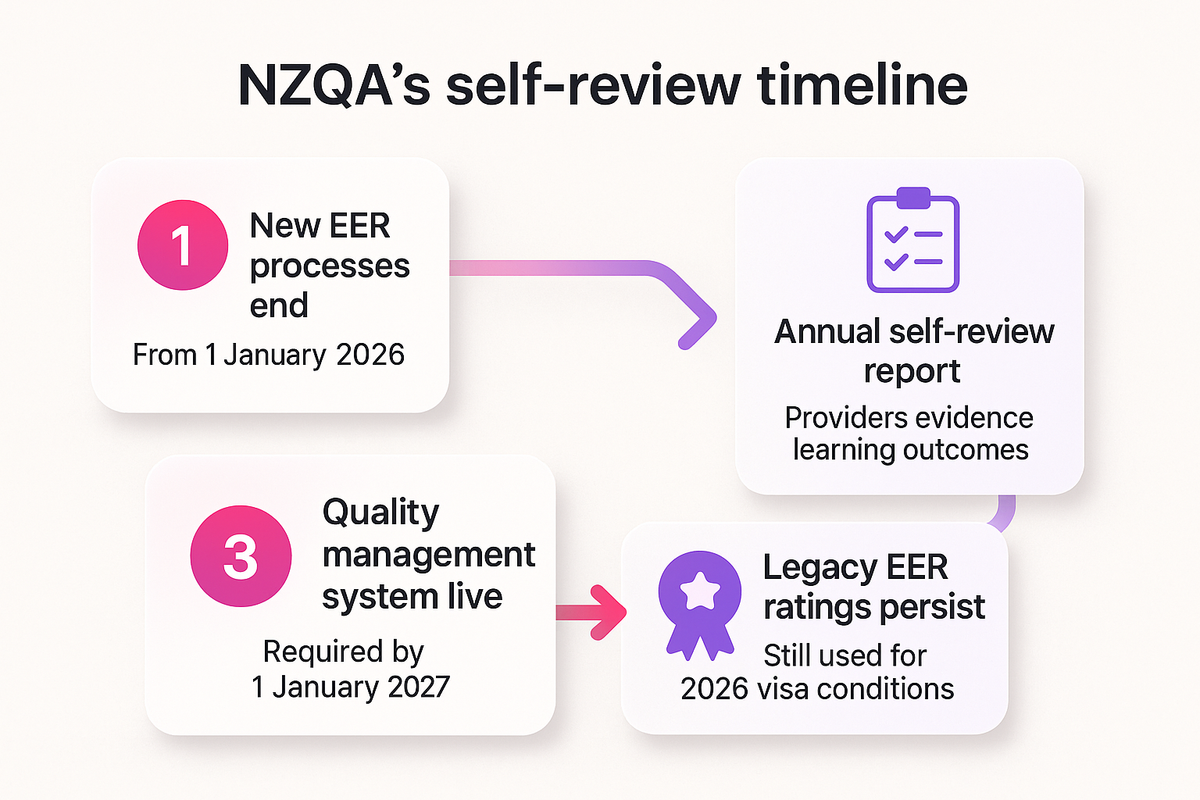
One caveat worth flagging to your compliance colleagues: Immigration New Zealand has confirmed it will keep using existing EER category ratings for 2026 visa conditions even as NZQA moves away from EER as its own assurance mechanism. Legacy evidence doesn't disappear just because the model producing it has changed — it's worth keeping that evidence intact rather than assuming a clean break.
Content currency is now a live design problem, not a periodic one
With no fixed maximum review period for skill standards, the assumption that you can build a resource once and revisit it in five years no longer holds. Every revision to a standard is now a potential trigger for redesign work, arriving on an unpredictable schedule. That's the practical source of instructional design debt: content built as static reading material has to be rewritten every time the standard shifts underneath it, while content built as scenario-based practice tends to flex more easily because the underlying skill, not the wording, is what's being rehearsed.
Fewer designers, more moving qualifications
The workforce reductions documented alongside Te Pūkenga's disestablishment aren't abstract — they mean the instructional design capacity available to maintain currency across a reshuffled qualification landscape has shrunk exactly as the volume of change has grown. If your team is smaller than it was two years ago and the number of standards under active review has gone up, something has to give. The pragmatic answer isn't to write less carefully — it's to design fewer static assets and more reusable practice formats that can absorb a standard update without a full rebuild.
Cultural competency can't be satisfied by a PDF
Cultural competency obligations sit across several places at once: the Education and Training Act 2020's requirement for culturally responsive education, the Te Hono o Te Kahurangi quality assurance pathway for providers working with kaupapa Māori or mātauranga Māori, and the Teaching Council's 2026 Standards, which call for learning experiences reflecting Te Tiriti o Waitangi partnership. None of these are met by a compliance paragraph sitting in a course guide. Te Hono o Te Kahurangi specifically expects a cultural, education or employment pathway that's relevant to ākonga, whānau, hapū and iwi — something demonstrated in how learners engage, not just referenced in what they read.
Separately, providers still carry a Code for pastoral care obligation to complete a self-review and publish a summary, though attestation submission is currently paused pending further NZQA guidance. It's another live self-review thread instructional designers may be asked to support with evidence, on top of academic quality assurance.
What rehearsed capability actually looks like in evidence terms
If you're building the case for self-review, the artefacts that hold up tend to share a few features: they put the learner in a realistic, contextual scenario; they generate a recordable outcome (a decision, a response, a completed task); they can be repeated with variation rather than being a one-off tick; and they map cleanly back to the specific skill standard or unit standard being assessed. Sector commentary on AI-assisted content drafting suggests these formats can now be produced and kept current faster than traditional design cycles allow — worth watching as a live discussion point, though it remains sector opinion rather than NZQA guidance.
Key takeaways
- From 1 January 2026, NZQA stops opening new EER processes; providers need an annual self-review summary report and a quality management system live by 1 January 2027 — instructional design evidence now carries more of the compliance weight.
- The Directory of Assessment and Skill Standards Listing and Operational Rules 2026 removes the fixed five-year review cycle, making content currency an ongoing design task rather than a periodic one.
- At least 154 roles were cut across institutes of technology and polytechnics during Te Pūkenga's disestablishment — design capacity has shrunk as the number of qualifications in flux has grown.
- Cultural competency obligations under the Education and Training Act 2020, Te Hono o Te Kahurangi, and the Teaching Council's 2026 Standards call for lived, contextual practice, not static compliance text.
- Immigration New Zealand will still use existing EER category ratings for 2026 visa conditions, so legacy evidence shouldn't be discarded even as the assurance model shifts.
Our take
Self-review is going to reward instructional designers who've quietly been building practice-based assessment all along, and expose the ones who've been measuring completion instead of capability. That's not really a new pedagogical argument — good instructional designers have always known that reading about a skill and doing it are different things. What's changed is that NZQA has now made the gap between those two things a compliance risk rather than just a quality one. If a self-review summary report has to argue that your graduates can actually do the job, a bank of quiz-and-read modules is a weak witness. A learner who has rehearsed the real scenario, under realistic pressure, with a recorded result, is a much better one.
FAQ
Does the move to self-review mean external checks on quality have stopped? No. NZQA stops opening new EER processes from 1 January 2026, replacing them with annual self-review summary reports and a required quality management system by 1 January 2027. Immigration New Zealand will also continue using existing EER category ratings for 2026 visa conditions, so past EER outcomes still matter operationally.
Do I need to redesign every existing module before 2026? Not immediately, but prioritise standards most likely to be revised under the Directory of Assessment and Skill Standards Listing and Operational Rules 2026, which removed the fixed five-year review period. Build your redesign backlog around currency risk, not an arbitrary schedule.
How do I evidence cultural competency in a self-review without it looking like a checklist? Show it operating — learner pathways or practice scenarios connected to whānau, hapū and iwi context, aligned to the Te Hono o Te Kahurangi pathway and the Teaching Council's 2026 Standards on Te Tiriti o Waitangi partnership, rather than a stand-alone policy statement.
Who actually owns programme content now that Te Pūkenga is disestablished? Ownership is transitioning to the 10 regional polytechnics and 8 Industry Skills Boards from 1 January 2026, with NZIST acting as a two-year transitional entity managing handover. Confirm current ownership before committing design effort to any shared programme.