Generative AI NZQA Guidance: What Providers Should Expect
18 October 2026 · 7 min read
NZQA hasn't issued new tertiary-specific generative AI rules. What it has done is leave responsibility with providers: own your AI policy, redesign assessment, keep humans in charge. With TEC's sector-wide AI tender raising the governance bar, generative AI NZQA guidance is settling into a provider-led model.
Generative AI NZQA Guidance: What Providers Should Expect
Has NZQA issued new generative AI guidance for tertiary providers?
No. We found no new NZQA tertiary-specific guidance, consultation or draft between 20 July and 18 October 2026. The operative document is still NZQA's Academic integrity and Artificial Intelligence page, which appears to date from about late 2025.
That page is expectations-based and principles-led. It isn't a rulebook. That's the point worth sitting with.
What does NZQA actually expect today?
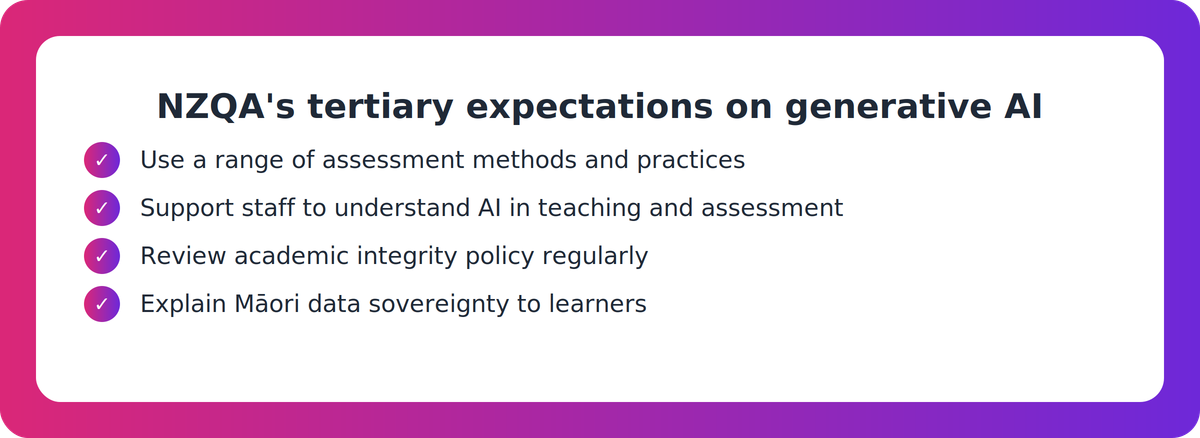
The tertiary page asks providers to do a handful of things. None of them is a prescriptive technical requirement.
- Use a range of assessment methods and practices to help prevent and detect cheating.
- Support staff to understand how generative AI can be used in teaching, learning and assessment.
- Review academic integrity policy regularly as new technologies arrive.
- Explain Māori data sovereignty to learners.
The page also points to material from Quality and Qualifications Ireland (QQI) as recommended reading. That's an Irish resource, and a sign NZQA is happy to borrow good thinking rather than write everything from scratch.
Where does responsibility sit if NZQA won't prescribe?
With you. Universities New Zealand's Sector AI Position Statement (27 August 2026) sets a common approach to responsible AI use, while noting each university is autonomous and sets its own policies. We've only seen the summary, not the full text, but it points to a decentralised, provider-led model.
The research agrees. A peer-reviewed review of eight NZ universities found most take an open but cautious approach, with policy completeness varying. Otago Polytechnic, Victoria University of Wellington and the University of Canterbury each publish their own position or policy. Same principles, different execution.
For PTEs, wānanga and polytechnics, the practical reading is simple. "NZQA hasn't said" isn't a defence. Your policy is the policy.
What does NZQA's own use of AI tell us?
NZQA piloted AI marking for NCEA Literacy Writing. It had the work independently reviewed (NZCER found it fit for continued operational use) and kept humans in the loop under a "human at the helm" model.
This is a school-level example, not tertiary policy. Any read-across to providers is inference. But the logic is clear enough: test it, get it independently checked, keep a person accountable.
Why does TEC's AI tender matter for assessment?
On 24 September 2026, TEC opened a GETS tender (closing 23 October 2026) for enterprise- or education-grade general-purpose generative AI. It covers universities, polytechnics and wānanga, for up to about 420,000 staff and students.
It isn't just a licence purchase. The tender also has to support administration, identity, security, privacy, governance, usage management and support. Whether PTEs can access it is unconfirmed.
Two things follow:
- Baseline expectations rise. If a large part of the sector gets governed, supported AI access, "learners are using it anyway" gets harder to justify as a plan.
- Access may be uneven. If PTEs sit outside the arrangement, they'll need their own answers on privacy, security and equity.
There's also a live dispute. Business Desk (9 October 2026) reports that staff and students say they weren't consulted. The Tertiary Education Union says the tender is being treated mainly as an IT and procurement exercise despite its effects on teaching and assessment. Expect that argument to continue.
Where is the direction of travel?
The following is our inference, not announced policy. Pulling the signals together, providers will likely be expected to:
- own their AI policies and review them regularly;
- redesign assessment rather than lean on detection software;
- show human oversight and validation of AI-assisted work;
- keep Māori data sovereignty and privacy safeguards visible.
The Tertiary Education Strategy 2025–2030 commits to strengthening sector leadership on AI. A University of Auckland analysis (13 August 2026) asks what a degree should provide if AI can perform tasks once used to show competence. That question lands hard in vocational programmes where unit standards and qualifications rest on demonstrated skill.
One caution. A claim circulating that NZQA warns against over-relying on detection software comes only from a vendor blog. We couldn't verify it, so we haven't built on it. The page's emphasis on varied assessment methods does lean the same way, though.
What should providers do now?
You don't need to wait for a rulebook. A sensible sequence:
- Audit your policy. When was your academic integrity policy last reviewed against generative AI? Does it name Māori data sovereignty?
- Map assessment risk. Which assessments can be completed by a chatbot? Which require observed, live or contextual performance?
- Shift toward demonstrated skill. Role plays, simulations, oral questioning and coached practice are harder to outsource and closer to workplace competence.
- Train your staff first. NZQA expects staff to understand how AI can be used in teaching, learning and assessment. That includes assessors and moderators.
- Document human oversight. If AI touches feedback, marking support or content creation, record who checks it and how.
- Plan for the TEC outcome. Work out what you'd do if you can't access a sector-wide tool, and what you'd do if you can.
A question worth taking to your next academic board: if detection tools disappeared tomorrow, would your assessment still tell you what a learner can actually do?
Key takeaways
- No new NZQA tertiary-specific generative AI guidance appeared between 20 July and 18 October 2026. The expectations-based academic integrity page still applies.
- Providers carry the responsibility for AI policy, in line with Universities New Zealand's decentralised position.
- TEC's tender, covering up to about 420,000 staff and students, raises governance expectations. PTE access is unconfirmed.
- The likely direction (inference, not policy) is assessment redesign, human oversight and visible Māori data sovereignty safeguards.
- A consultation dispute over the tender is building, so the sector conversation is far from settled.
Our take
NZQA's silence isn't a gap. It's a design choice, and it hands providers the harder job. Detection is the easy thing to buy; redesigning assessment so it shows real, observed capability is the work that lasts. We think the providers who treat this as a teaching and assessment question, not an IT one, will be the ones comfortable when expectations tighten.
FAQ
Does NZQA have specific generative AI rules for tertiary providers?
Not new ones. NZQA's Academic integrity and Artificial Intelligence page is expectations-based and principles-led. It asks providers to use varied assessment methods, support staff, review policy regularly and explain Māori data sovereignty to learners.
What is TEC's generative AI tender?
TEC opened a GETS tender on 24 September 2026, closing 23 October 2026, for enterprise- or education-grade general-purpose generative AI. It covers universities, polytechnics and wānanga, for up to about 420,000 staff and students, and includes governance, privacy and security requirements.
Can PTEs access the TEC sector-wide AI arrangement?
That's unconfirmed. The tender is aimed at universities, polytechnics and wānanga, so PTEs should plan on the basis that they may need their own governance and access arrangements.
Should providers rely on AI detection software?
NZQA's page points to a range of assessment methods and practices rather than a single detection tool. A claim that NZQA warns against over-relying on detection comes only from an unverified vendor blog, so treat redesigning assessment as the safer foundation.
Does NZQA's AI marking pilot apply to tertiary providers?
Not directly. It's an NCEA school-level example in which NZQA kept humans in the loop and had the pilot independently reviewed. Any read-across to tertiary providers is inference, though the human-oversight principle is a useful guide.