The Hidden Tax of Disconnected Systems for NZ COOs
30 July 2026 · 9 min read

The compliance shocks landing on New Zealand training providers this year aren't the real problem. The real problem is that most providers still run reporting and process knowledge through people, not systems — so every regulatory change becomes a scramble instead of a routine update.
That distinction matters more this year than most. Three separate shocks are hitting providers at once: a full NZQA rules rollover, the biggest structural change to vocational education in a decade, and a funding environment where the sector's own regulator is shedding staff. None of these were designed to break your operation. But if your enrolment, delivery and reporting systems still depend on manual reconciliation and a couple of people who "just know how it works", this is the year that gets exposed.
Why this lands on your desk
You own the systems, the processes and the people who keep enrolments, delivery, reporting and finance running day to day. That makes three specific pressures yours to carry, not your CEO's or your compliance manager's alone.
First, the Tertiary Education Commission's Single Data Return is submitted three times a year, and resubmission of the August and December returns is only accepted in exceptional, approved circumstances. An error from duplicate data entry or a system that doesn't reconcile isn't admin friction anymore — it's a funding and monitoring consequence that sticks.
Second, NZQA's rules rollover in January and February 2026 — the integrated Quality Assurance Framework, the Private Training Establishment Rules 2026, and sub-contracting requirements moved into the new Quality Assurance of Tertiary Education Providers Rules 2026 — requires providers to prove enrolment and academic records are properly held even where delivery is sub-contracted. That's a direct test of whether your process knowledge lives in a system or in someone's head.
Third, the disestablishment of Te Pūkenga, the stand-up of the New Zealand Institute of Skills and Technology as a transitional entity, the re-establishment of ten regional polytechnics, and eight new Industry Skills Boards replacing Workforce Development Councils from 1 January 2026 all change who you report to and hand data off to for work-based learning. You're being asked to re-map process ownership at exactly the moment you have the least slack to do it.
Three shocks, one operations team
Line these up and the timing is not kind:
- Rules: iQAF and the PTE Rules 2026 replace the 2025 registration rules and the 2022 enrolment and academic records rules, remove the annual PTE fee, move non-funded PTEs to biennial financial reporting, and end External Evaluation and Review as previously known.
- Structure: Te Pūkenga is disestablished, NZIST runs as a two-year transitional entity, ten regional polytechnics come back, and eight Industry Skills Boards take on work-based training oversight from 1 January 2026.
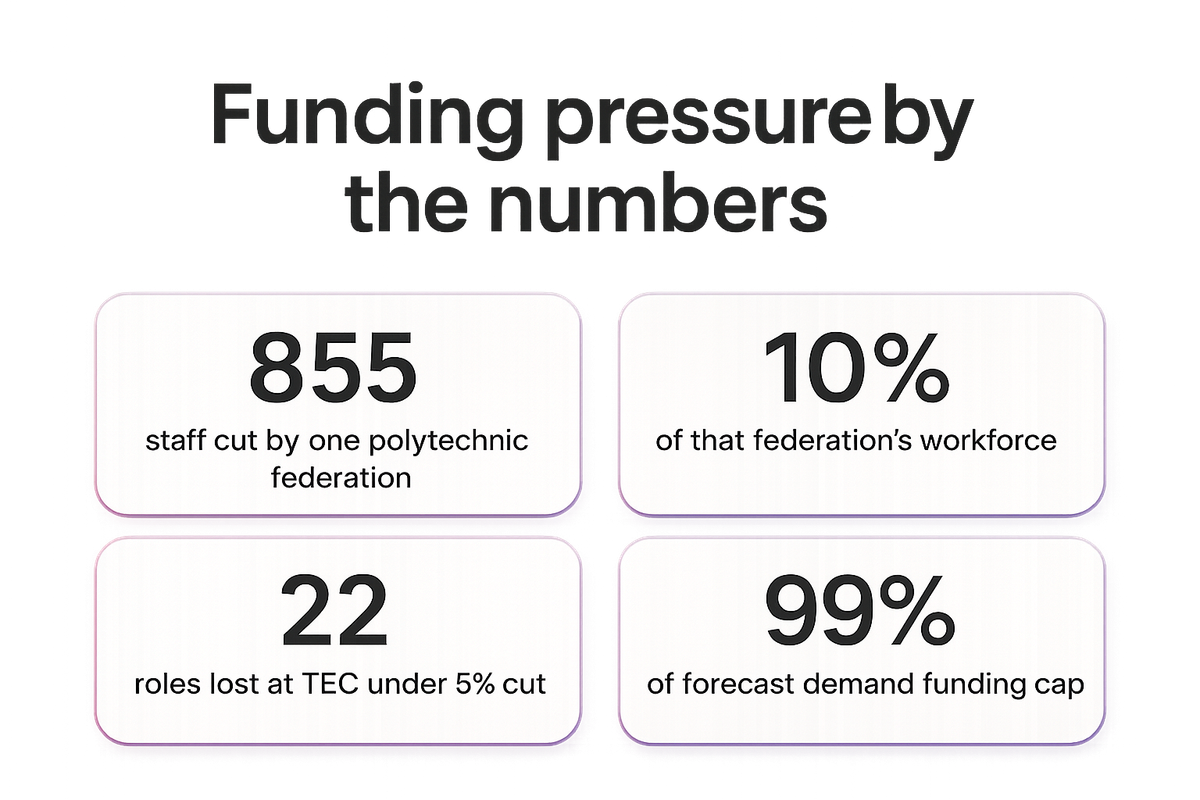
- Funding: TEC itself is losing 22 roles under a government-mandated 5% cut to its operating funding, has signalled that 2027 planning is happening in "a very challenging fiscal environment," and has told providers not to assume current funding levels continue. Funding volume is capped at 99% of forecast demand, and the Fees Free scheme closes at the end of 2026. One major polytechnic federation cut 855 staff — roughly 10% of its workforce — to post a $16.6m surplus after absorbing more than $80m in funding cuts.
Each of these is manageable on its own. Together, they mean the same reporting and compliance workload — or a growing one, given roughly 250,000 people study across New Zealand's VET system each year through both on-campus and on-the-job pathways — has to be carried by fewer people, with less institutional memory to fall back on.
The real cost isn't the rule changes
Here's the thing about a rules rollover, a sector restructure and a funding squeeze: none of them are, by themselves, an operational crisis. What turns them into one is fragmentation — systems that don't talk to each other, data re-keyed by hand across enrolment, delivery and reporting platforms, and processes that exist only as tribal knowledge.
Take sub-contracting. Under the new rules, a PTE remains responsible for holding enrolment and academic records even when a sub-contractor delivers the training. If your sub-contractor relationship runs on emailed spreadsheets and a verbal understanding of who updates what, you have no clean audit trail the day NZQA or a funder asks for one. That's not a rules problem. That's a systems problem you've been carrying for years, now exposed by a rules change.
Or take the Single Data Return. If your student management system, your finance system and your delivery tracking don't reconcile automatically, someone is manually cross-checking numbers before every submission — and given that August and December resubmissions aren't generally available, that person's accuracy on the day is the whole safety net. That's an enormous amount of institutional risk sitting on one person's shoulders, at a time when headcount across the sector, including inside TEC itself, is shrinking.
And the sector restructure compounds it. When your reporting counterparty for work-based learning shifts from a Workforce Development Council to an Industry Skills Board, or your polytechnic relationship shifts through NZIST's transitional arrangements, every undocumented handoff has to be rebuilt from memory. Documented processes survive a change of counterparty. Processes that live in one manager's head don't.
What resilient operations actually looks like right now
This isn't an argument for more headcount — the sector clearly can't afford that, and TEC's own cuts make the point starkly. It's an argument for treating this transition as the forcing function to fix what fragmentation has been costing you quietly for years:
- Map every point where data is re-keyed rather than flowing between systems, and prioritise the ones feeding the SDR or NZQA reporting.
- Document sub-contracting data ownership explicitly — who holds enrolment and academic records, and how they're transferred back to you — before an audit asks the question.
- Write down the reporting relationships that are about to change counterparty (Industry Skills Boards, NZIST, regional polytechnics) rather than relying on whoever currently manages that relationship to carry it in their head.
- Treat capacity planning as a systems question first: can your current tooling absorb the same compliance load with the team you have, or does every peak still mean overtime and error risk?
None of this requires a big transformation project. It requires an honest audit of where your operation depends on a person instead of a process, done now, while you can still choose the order you fix things in rather than fixing them under audit pressure.
Key takeaways
- TEC's Single Data Return allows resubmission of August and December data only in exceptional circumstances, so manual data entry errors carry real funding consequences, not just admin rework.
- NZQA's rules rollover (iQAF, the PTE Rules 2026, sub-contracting provisions, and the end of EER) requires providers to prove enrolment and academic records are properly held even when delivery is sub-contracted.
- The disestablishment of Te Pūkenga, NZIST's transitional role, ten re-established regional polytechnics, and eight new Industry Skills Boards change who providers report to and hand off data with for work-based learning.
- Sector-wide funding pressure — including TEC's own loss of 22 roles and one federation's cut of 855 staff after $80m in funding cuts — means the same compliance load has to be carried by fewer people.
- Providers with documented, systematised processes are better placed to absorb this transition than those relying on individual staff to hold reporting and compliance together.
Our take
The sector conversation this year has largely been about the rule changes themselves — what iQAF means, what the PTE Rules 2026 change, how Industry Skills Boards will operate. That's necessary reading, but it misses the operational story underneath it.
What's actually being tested is whether your organisation's compliance capability sits in your systems or in your people. Providers who've spent the last few years reconciling spreadsheets manually and relying on one or two staff who "know how the SDR works" are going to find this transition genuinely hard, regardless of how well they understand the new rules. Providers who've already pushed toward integrated, documented processes will experience the same rules rollover as a configuration update.
That's not a comfortable message when budgets are being cut and headcount is under pressure. But it is the honest one: the fix here isn't more people watching the compliance calendar. It's fewer places where a person has to be the system.
FAQ
Does the NZQA rules rollover change how often we submit the Single Data Return? No — the SDR is a separate reporting mechanism run through TEC and the Ministry of Education, submitted three times a year via DXP Ngā Kete. The NZQA rules rollover (iQAF, the PTE Rules 2026, and the new Quality Assurance of Tertiary Education Providers Rules 2026) governs registration, enrolment and academic records and sub-contracting obligations, but SDR timing and resubmission restrictions sit with TEC.
If we sub-contract delivery, who is responsible for holding enrolment and academic records under the new rules? The PTE remains responsible for holding enrolment and academic records even where a sub-contractor delivers the training, under the sub-contracting provisions now sitting in the Quality Assurance of Tertiary Education Providers Rules 2026. That makes the data hand-off arrangement with any sub-contractor a compliance question, not just an operational preference.
Who do we report to now that Te Pūkenga has been disestablished? NZIST operates as a transitional entity for a two-year period, ten regional polytechnics have been re-established, and eight Industry Skills Boards have replaced Workforce Development Councils from 1 January 2026 to oversee work-based training. Which body you report to and exchange data with for work-based learning depends on your specific delivery arrangements during this transition.
Should we assume our current funding levels will continue into 2027? TEC has explicitly said providers should not assume current funding levels continue, describing 2027 planning as happening in a challenging fiscal environment, with funding volume already capped at 99% of forecast demand and the Fees Free scheme closing at the end of 2026.