Hospitality Staff Training NZ: Beyond the 90-Day Trial
14 September 2026 · 8 min read

Hospitality Staff Training NZ: Beyond the 90-Day Trial
New Zealand's 90-day trial period was built as an employment law safeguard, not a training plan — but plenty of tourism and hospitality operators are running it as one. Formal enrolments in hospitality-related qualifications have fallen sharply since 2015, while a separate 90-day clock on personal grievance rights keeps ticking regardless of trial eligibility. That leaves operators with less institutional support than ever to get new staff performance-ready fast.
The trial period and onboarding aren't the same thing
It's an easy mix-up. The 90-day trial period, available to employers with fewer than 20 staff, lets a business end employment within that window without facing a personal grievance claim over the dismissal itself. It's a risk tool for the employer, not a development framework for the employee.
Canterbury Today's coverage of the issue is blunt about the difference: a trial period "doesn't tell someone what good looks like, and it doesn't build confidence." Confidence and competence come from structured onboarding — clear standards, repeated practice, feedback — not from a clause in an employment agreement.
For operators who treat the 90 days as a wait-and-see period rather than an active onboarding window, the trial clause becomes a fallback for hiring mistakes instead of a backstop while a real induction plan does its job.
Why the training pipeline can't cover the gap
Operators used to lean on the formal training system to arrive with job-ready recruits, or to fill skills gaps quickly through short qualifications. That system has been shrinking for a decade.
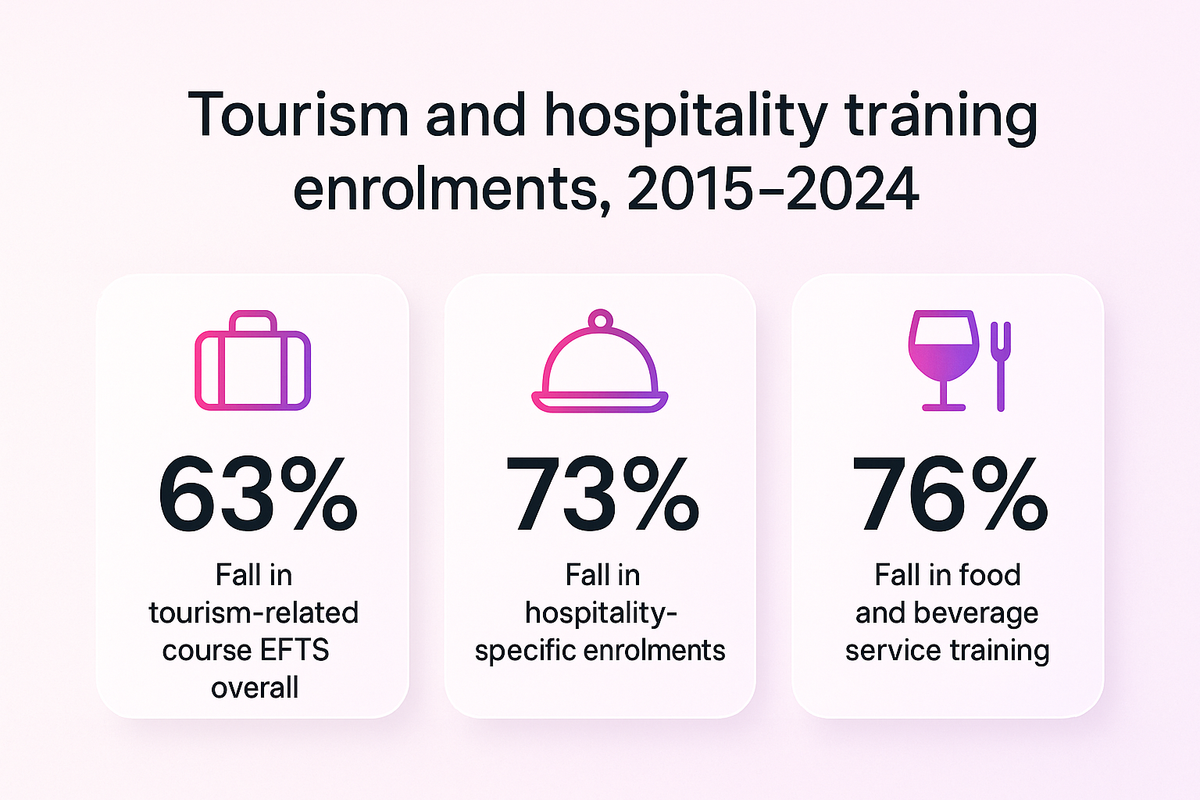
Research cited by The Conversation and Lakes Weekly Bulletin shows tourism-related course enrolments in New Zealand fell from 3,750 EFTS in 2015 to 1,355 in 2024 — a 63% drop. The decline is sharper in the disciplines operators rely on most:
- Hospitality-specific enrolments: down 73%
- Food and beverage service training: down 76%
Institutions such as Toi Ohomai still offer structured qualifications — the New Zealand Diploma in Hospitality Management (Level 5) on the NZQF is one example — but enrolment volumes mean far fewer graduates are entering the sector pre-trained. Kiwi Coaches' sector reporting confirms training and onboarding gaps are now an active 2026 operational constraint, compounding driver shortages and the loss of experienced operators across tourism transport and hospitality more broadly.
The upshot: operators can no longer assume new hires arrive with baseline skills from NZQA-recognised programmes or unit standard training. Onboarding has to do more of the work it never used to.
Different clock, same risk depending on your headcount
Business size changes what the 90 days actually protect against, and it's worth being precise about it.
- Employers with fewer than 20 staff can use a 90-day trial period to end employment without the employee being able to raise a personal grievance over that dismissal.
- Employers with 20 or more staff cannot use the trial period this way — they must run full personal grievance procedures from day one of employment.
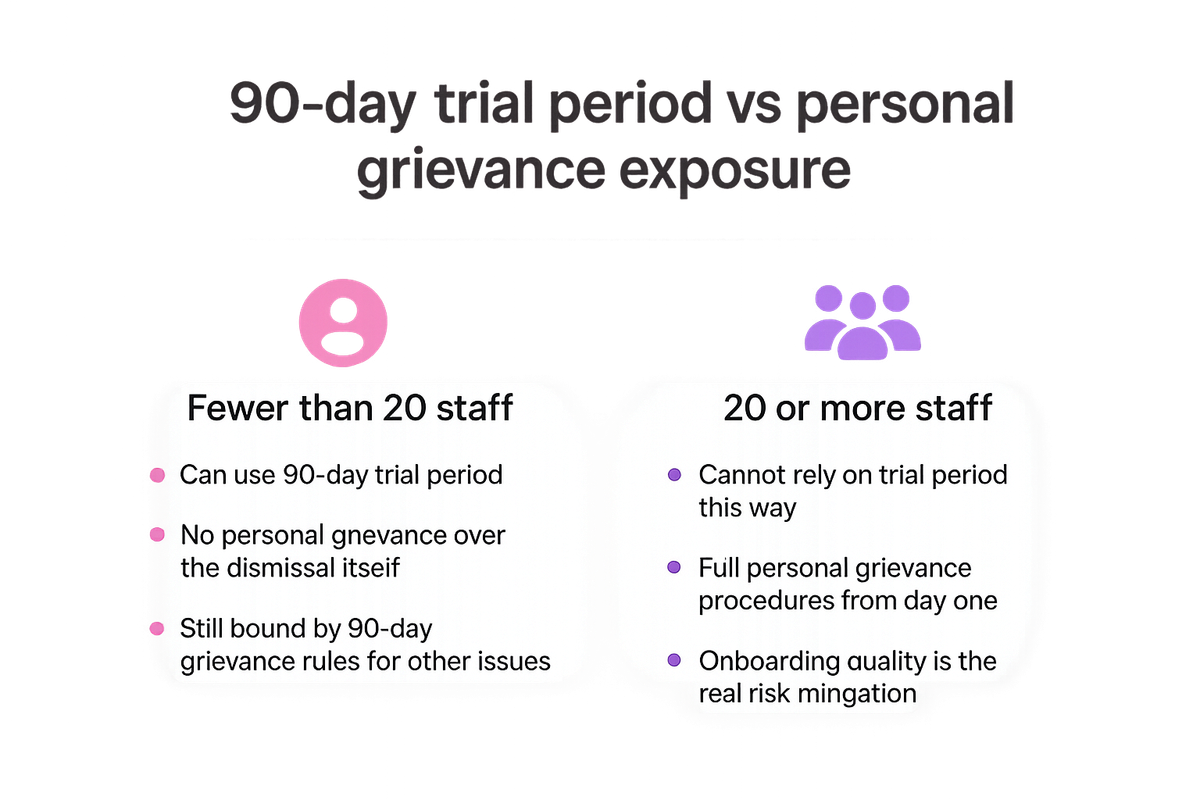
Either way, the Employment Relations Act 2000 gives every employee 90 days to raise a personal grievance for unjustified dismissal, disadvantage, discrimination or harassment. That clock runs regardless of trial eligibility. For larger, multi-site hospitality and tourism employers — hotel groups, venues, transport operators — the trial clause offers no shortcut at all. Onboarding quality, not contract wording, is the actual risk mitigation.
What job-ready looks like before day 90
Getting a new hire genuinely ready to perform — not just aware of policy — within three months means covering more than an orientation session and a handbook. A workable onboarding standard typically includes:
- Role-specific scenario practice (handling complaints, upselling, service recovery) before the hire faces a real guest interaction unsupervised.
- Repeated, coached rehearsal rather than a single training session — skills that aren't practised more than once rarely stick.
- Clear, observable checkpoints at 2, 6 and 10 weeks so managers know whether someone is tracking to job-ready, not just present.
- Consistency across shifts and sites, so a trainee's experience doesn't depend entirely on which supervisor happens to be rostered on.
Most operators know this in principle. The constraint is capacity: building customised scenario training for every role, at every site, is exactly the kind of instructional design work that used to take weeks and a dedicated L&D function — resources most hospitality businesses don't have spare.
A live test case: hiring at pace for the NZICC opening
The pressure this creates isn't hypothetical. With the New Zealand International Convention Centre opening in Auckland, government reporting via Beehive.govt.nz confirms the Ministry of Social Development is working directly with SkyCity to fill a wide range of permanent and part-time roles at speed.
That's a concentrated, high-volume hiring event landing directly on top of a thinner training pipeline. It will test, in public, whether operators can bring large numbers of new starters to a consistent standard fast enough to matter — or whether quality gets diluted to hit headcount targets.
It's also why the conversation is shifting toward technology-assisted onboarding. Hospitality New Zealand has co-hosted sector webinars — including one with Behemoth Brewing — explicitly framing AI as a response to onboarding and retention pressure. That's a signal from the peak industry body that AI-assisted hiring and onboarding is moving from novelty to normal practice, not a hedge on whether it's relevant.
Key takeaways
- Tourism-related course enrolments fell 63% between 2015 and 2024 (3,750 to 1,355 EFTS), with hospitality-specific training down 73% and food and beverage service training down 76%.
- The 90-day trial period only protects employers with fewer than 20 staff from personal grievance claims over dismissal — it isn't a substitute for onboarding, and it does nothing for employers with 20 or more staff.
- Every employee has 90 days under the Employment Relations Act 2000 to raise a personal grievance for unjustified dismissal, disadvantage, discrimination or harassment, regardless of trial period eligibility.
- Job-ready onboarding needs repeated, role-specific scenario practice and observable checkpoints inside the first 90 days — not a one-off induction session.
- Hospitality New Zealand's own webinar activity signals the sector is already treating AI-assisted onboarding as a legitimate response to the training pipeline squeeze.
Our take
The 90-day trial clause has quietly become a crutch for operators who don't have time to build proper onboarding, and that's a mistake that shows up as turnover, not compliance risk, in the medium term. The more useful shift isn't legal — it's operational: building fast, repeatable, role-specific practice for every new starter, at every site, without needing a formal training pipeline that's clearly no longer supplying it. For multi-site and larger operators carrying full personal grievance exposure from day one, this stops being optional. The businesses that treat the first 90 days as a genuine skill-building window, rather than a legal trial, are the ones that will handle hiring surges like the NZICC opening without a dip in service standards.
FAQ
Does the 90-day trial period count as onboarding under New Zealand employment law? No. The trial period is a legal mechanism that lets employers with fewer than 20 staff end employment within 90 days without the employee raising a personal grievance over the dismissal. It has no requirement to include structured training, coaching or performance support — onboarding is a separate operational responsibility.
Can employers with 20 or more staff use the 90-day trial period? No. Employers with 20 or more staff cannot rely on the trial period to avoid personal grievance procedures — they must run full personal grievance processes from an employee's first day, making onboarding quality the primary way to manage early-employment risk.
How long do employees have to raise a personal grievance in New Zealand? Under the Employment Relations Act 2000, employees generally have 90 days to raise a personal grievance for unjustified dismissal, disadvantage, discrimination or harassment. This applies regardless of whether a 90-day trial period was used.
Why has hospitality staff training in New Zealand declined so sharply? Research cited by The Conversation and Lakes Weekly Bulletin shows tourism-related course enrolments fell from 3,750 EFTS in 2015 to 1,355 in 2024, a 63% drop, with hospitality-specific and food and beverage service training falling even further — 73% and 76% respectively.
Is the hospitality sector responding to the training pipeline gap with technology? Yes. Hospitality New Zealand has co-hosted sector webinars, including one with Behemoth Brewing, specifically framing AI-assisted approaches as a response to onboarding and retention pressure, signalling the industry body sees this as a mainstream operational conversation rather than a fringe experiment.