Industry Consultation Under the Standards for RTOs 2025
3 August 2026 · 7 min read

Industry consultation under the Standards for RTOs 2025 is no longer a policy an RTO keeps on file and revisits once a year. It's an ongoing, evidenced practice that auditors now expect to see reflected in current assessment tools and training materials — and RTOs that can't produce that evidence quickly are facing regulatory action, not a rectification period.
What actually changed under the Standards for RTOs 2025?
The Standards for RTOs 2025 took effect nationally on 1 July 2025, the result of more than four years of work by the Department of Employment and Workplace Relations (DEWR) with state and territory regulators and sector peak bodies. The stated aim was to lift quality and integrity across vocational education.
One of the quieter but more consequential shifts sits inside the Outcome Standards: a stronger, ongoing emphasis on industry consultation. According to VET Advisory Group's analysis of the new framework, RTOs must now demonstrate active engagement with industry stakeholders to:
- Validate training and assessment strategies against real workplace practice
- Align content and assessment tasks with current industry expectations
- Keep learning resources updated so they reflect what employers actually need
This isn't a new concept in VET — consultation has always mattered. What's changed is the expectation of continuity and proof.
Why is industry consultation suddenly a live audit risk?
Precision RTO Resources frames this plainly: the Outcome Standards' focus on industry-relevant skills demands rigorous, ongoing consultation rather than a one-off sign-off buried in a training and assessment strategy document. A consultation record from two years ago, disconnected from a training package update or a change in workplace practice, no longer counts as current evidence.
VET Advisory Group's compliance-challenges analysis backs this up from the audit side. It names assessment validity, reliability, sufficiency and training package alignment as a persistent weak spot in ASQA audits — and calls out industry consultation in assessment design specifically as a recurring gap.
The evidence bar has moved
Commentary from RTO Coach points to a broader shift in what auditors accept as proof. Auditors are no longer satisfied by policy documents that describe what an RTO intends to do. They want current, context-specific evidence drawn from actual operations — meeting minutes, employer feedback loops, updated assessment mapping — that shows practice matches policy in real time.
For an RTO, that means the difference between passing and failing an audit can come down to whether consultation evidence is:
- Current — tied to the most recent version of the relevant training package
- Traceable — linked directly to specific units of competency and assessment tools
- Contextualised — reflecting the actual industry and learner cohort being served, not a generic template
Why does the jurisdictional timing gap matter?
The Standards apply nationally from 1 July 2025, but transition support isn't uniform. The Victorian Registration and Qualifications Authority (VRQA) is giving its RTOs until 1 January 2027 to fully transition. That creates a genuine compliance timing gap for any provider operating, or planning to operate, across state lines.
An RTO registered through ASQA but delivering into Victoria, or vice versa, needs to be clear on which timeline applies to which part of its operation — and shouldn't assume a longer transition window in one jurisdiction buys leniency everywhere else.
What does ASQA's 2025–26 enforcement posture signal?
Recent commentary on ASQA's June 2026 Industry Update suggests the regulator is treating 2025–26 as a year of enforcement rather than consultation. The pattern described: fewer audits, but sharper ones, with non-compliance findings increasingly moving straight to regulatory action rather than opening a rectification window.
That's the sting in the tail for industry consultation specifically. It's exactly the kind of requirement that's easy to under-document — everyone talks to industry, few keep an audit-ready trail of it — which makes it a predictable target for a regulator running fewer, more targeted reviews.
What does audit-ready industry consultation actually look like?
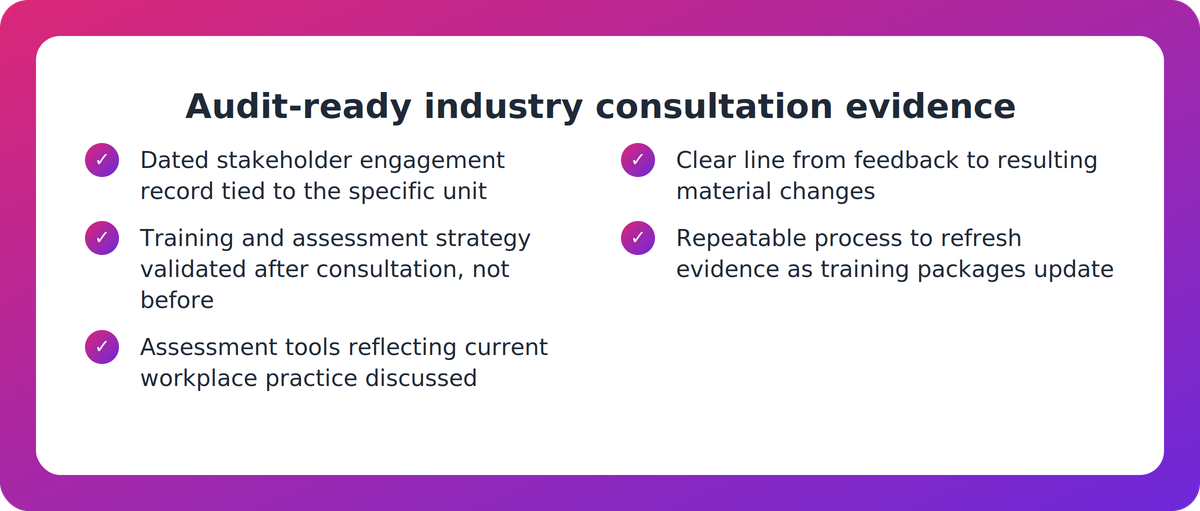
Based on the compliance commentary above, an RTO that wants to walk into an ASQA audit with confidence should be able to produce, for any current unit of competency:
- A dated record of industry stakeholder engagement, tied to that specific unit or qualification
- Evidence the training and assessment strategy was validated against that consultation, not written before it
- Assessment tools that visibly reflect the industry context and current workplace practice discussed
- A clear line from consultation feedback to any resulting change in training materials or assessment design
- A repeatable process for refreshing this evidence as training packages update, not a one-off exercise
Key takeaways
- The Standards for RTOs 2025, national from 1 July 2025, have hardened industry consultation into a continuous, evidenced practice rather than a filed policy.
- Assessment validity, sufficiency and training package alignment — including industry consultation in assessment design — remain a persistent ASQA audit weak spot.
- Auditors now expect current, context-specific evidence of stakeholder engagement, not descriptive policy documents.
- VRQA's transition support to 1 January 2027 creates a timing gap for RTOs operating across Victoria and other jurisdictions.
- ASQA's 2025–26 posture points to fewer, sharper audits, with non-compliance more likely to trigger direct regulatory action than a rectification period.
Our take
Industry consultation has always been treated as the soft edge of compliance — the thing everyone does informally but rarely documents with rigour. The Standards for RTOs 2025 close that gap, and a leaner, sharper ASQA audit cycle means providers no longer get a second chance to backfill the paperwork after the fact. The RTOs in the strongest position aren't the ones with the thickest policy folder; they're the ones whose assessment tools and training materials visibly carry the fingerprints of a recent, specific conversation with industry — because that evidence trail is what an auditor is now looking for first.
If your consultation records, unit mapping and assessment materials live in separate systems that don't talk to each other, that's worth a hard look before your next audit does it for you.
FAQ
What is the industry consultation requirement under the Standards for RTOs 2025? The Standards for RTOs 2025 require RTOs to demonstrate active, ongoing engagement with industry stakeholders to validate training and assessment strategies, align content with current industry practice, and keep resources workplace-relevant — not a one-off sign-off.
When did the Standards for RTOs 2025 come into effect? The Standards for RTOs 2025 took effect nationally on 1 July 2025, following work led by the Department of Employment and Workplace Relations with states, territories, regulators and sector peak bodies.
Why is industry consultation a common ASQA audit finding? VET Advisory Group's compliance analysis identifies assessment validity, reliability, sufficiency and training package alignment — including industry consultation in assessment design — as a persistent weak spot in ASQA audits.
Does every state follow the same transition timeline? No. While the Standards apply nationally from 1 July 2025, VRQA is supporting Victorian RTOs to transition by 1 January 2027, creating a compliance timing gap for providers operating across jurisdictions.
Is ASQA giving RTOs time to fix consultation gaps found in an audit? Recent commentary on ASQA's 2025–26 activity suggests the regulator is running fewer, more targeted audits, with non-compliance increasingly leading straight to regulatory action rather than a rectification period.