Authentic Assessment in an RTO: For Instructional Designers
11 October 2026 · 6 min read
Coached role-play is the first thing to go when a design runs out of time or money, because it is the costliest part to build, schedule and resource. Under the 2025 Standards for RTOs, that cut is no longer only a budget call. Simulation is conditional, so thin practice is a quality and compliance exposure.
Why this lands on your desk
You own the call on what stays in a design when the money runs out. Role-play, simulation and facilitated practice need people, rooms and time, so they are the easy items to trim. Nobody questions a trimmed scenario in a project meeting. They question it later, when a learner freezes with a real client or a validator asks what the simulation actually simulated.
You also answer for alignment to the training package and the 2025 Standards. ASQA's guidance says some units may mandate workplace assessment. A generic simulation in that unit is a compliance risk as well as a weak piece of learning design.
Then there is the maintenance load. Every scenario and assessment tool you build is something you will probably have to revisit. Bespoke role-play is the most expensive thing to rework, which is one more reason it gets cut early.
What the regulator's language asks of practice
The 2025 Standards for RTOs took effect on 1 July 2025 and are regulated by ASQA. They have three elements: the Outcome Standards, the Compliance Standards and the Credential Policy. DEWR says they were designed around learner outcomes. That framing helps you. It supports the argument that practice must produce demonstrable capability, not just content coverage.
Simulation is conditional, not optional
ASQA's guidance on practical training and assessment says assessment requirements may allow simulation to complement workplace assessment where not all unit requirements can be assessed. It also says some units may mandate workplace assessment.
So the design question is not 'role-play or no role-play'. It is which parts of this unit can legitimately be practised and assessed in simulation, and which cannot.
Fidelity is the bar
ASQA's online assessment guidance gives role-play scenarios in a real-time video-based assessment as an example of simulated assessment. It expects realistic workplace conditions, plus the equipment and resources stated in the Assessment Requirements. Its users' guide for accredited courses lists role plays among assessment methods and says simulated environments must simulate the real-life working environment.
Read together, that is a fidelity standard. A loosely scripted, generic scenario may not meet it. It is also your best argument for investing in context, because you can point to the regulator's own wording.
One signal to watch, with a caveat. CAQA, a consultancy, reports an ASQA data collection on workplace assessment in Individual Support, Carpentry and Early Childhood Education, linked to Standard 1.8 and to whether providers substitute classroom simulation where workplace assessment is required. We have not verified that against an ASQA notice, so treat it as a sign of scrutiny, not a confirmed position.
Design debt is structural
Qualification reform is phased, with new templates available to developers from 1 July 2025. Industry Skills Australia's 2026 Statement of Response says it will keep embedding Qualification Reform principles across Training Package development and maintenance.
For you, that means practice content tied to specific units needs a review cycle from day one. A scenario built as a one-off production will age badly. A scenario built as a maintained asset, with its context, unit links and assessment conditions documented, can be updated rather than rebuilt.
Where AI helps and where it stops
The Sector reports that ASQA's AI principles do not introduce new regulatory requirements. They help providers manage AI use within existing obligations, including the 2025 Standards. Assessors are still expected to be satisfied that evidence is sufficient, current and genuinely the student's work.
Consultancy sources (CAQA, SKG Consulting) report ASQA messaging that AI cannot make assessment decisions or complete validation where qualified people are required. SKG also says AI-generated assessment instruments tend to be generic and detached from delivery context. That is exactly the quality failure you are judged on.
The workable reading is a split. AI can plausibly help on the design and practice side, such as drafting scenario variations or giving learners more rehearsal. Competency judgements stay with qualified people. If any tool blurs that line, that is a governance problem, however fast it is.
A five-question audit for your next build
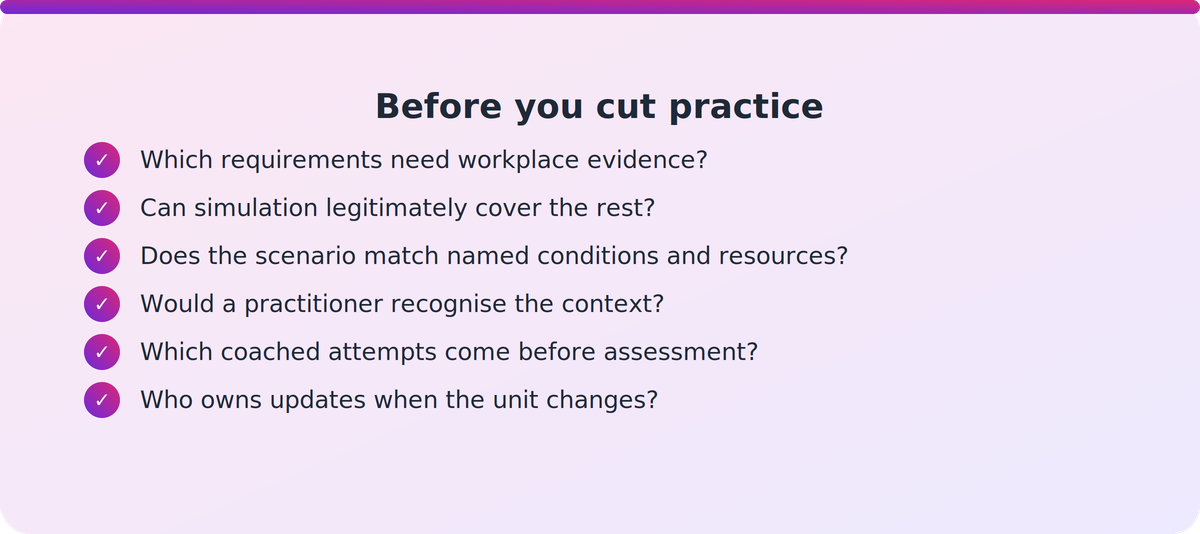
Before you cut practice from a unit, run it through these questions.
- Which requirements in the unit's Assessment Requirements need workplace evidence, and which could simulation cover?
- What conditions, equipment and resources does the unit name, and does the scenario reproduce them?
- Would someone who works in this role recognise the client, the documents and the constraints, including the cultural context they actually work in?
- What formative, coached attempts will the learner have had before the assessed one?
- Who owns this scenario when the training product changes, and how will you know?
If you cannot answer the first two, you are not ready to decide what to cut.
Key takeaways
- Coached role-play is cut first because it is costly, but under the 2025 Standards for RTOs, simulation is conditional, so the cut carries compliance risk.
- ASQA's guidance expects simulation to reflect real workplace conditions and the Assessment Requirements. Some units may mandate workplace assessment.
- Qualification reform means practice content needs a maintenance plan, not just a build budget.
- Reported ASQA messaging says AI cannot make assessment decisions or complete validation. Generic AI-written instruments are a quality risk.
- Treat realistic, regulation-grounded practice as a design requirement, not a premium add-on.
Our take
The usual framing is wrong. Practice is not the luxury layer you add when the budget allows. It is where authentic assessment either happens or does not. Content coverage is cheap to defend until someone asks what the learner could actually do.
The harder, more useful work is making realistic practice cheaper to build and easier to keep current, without outsourcing judgement. Tools can lower the cost of rehearsal. They cannot carry the accountability.
Your first step this week is small. Pick one unit where practice was trimmed and ask the first two audit questions. If the answers are uncomfortable, you have found your next design priority.
FAQ
Is simulation allowed in RTO assessment?
Yes, conditionally. ASQA says assessment requirements may allow simulation to complement workplace assessment where not all unit requirements can be assessed. Some units may mandate workplace assessment, so check each unit's Assessment Requirements.
What makes a role-play scenario meet ASQA's expectations?
ASQA's guidance expects simulated environments to reflect the real-life working environment. For online assessment it also expects realistic workplace conditions and the equipment and resources stated in the Assessment Requirements.
Can AI make assessment decisions or validate assessments?
Consultancy sources (CAQA, SKG Consulting) report ASQA messaging that it cannot, where qualified people are required. The Sector reports that ASQA's AI principles add no new requirements and that assessors must be satisfied evidence is sufficient, current and genuinely the student's work.
How do I keep scenarios current as training products change?
Plan for it from the start. Qualification reform is phased, with new developer templates available from 1 July 2025, and Industry Skills Australia says it will keep embedding reform principles. Document each scenario's unit links and context, and assign a review owner.