Instructional Design Cost Per Unit Standard: Hidden Hours
6 October 2026 · 7 min read
The instructional design cost per unit standard isn't the first build. It's everything after: re-mapping when a standard is revised, supporting two versions at once, and evidencing review to NZQA. No New Zealand source puts a number on those hours. That's exactly why you need to start counting them yourself.
Why this lands on your desk
You answer for whether learning stays aligned to current standards. NZQA says a standard may be revised for new requirements, legislation changes, updated cross-references or assessment issues. Each of those can mean rework on learning and assessment you've already delivered.
Meanwhile, the ground is moving. The Workforce Development Councils were disestablished on 31 December 2025, and eight Industry Skills Boards now provide standard-setting. Te Pūkenga is a transitional entity, renamed NZIST and due to be disestablished by 31 December 2026 (RNZ).
Then there's capacity. The Spinoff reported more than 150 jobs cut and a campus closed at Te Pūkenga ahead of disestablishment. Designers across the sector are being asked to hold quality and currency steady with fewer hands.
A candid note: I couldn't find an authoritative NZ source on hours or cost of design per unit standard. So treat "hidden hours" as a lens for naming work, not a statistic. Anyone quoting you a neat figure is guessing.
The review clock no longer ticks predictably
New unit standards were listed with a planned review date of around five years. The 2026 Directory rules remove the five-year maximum review period. The 2026 qualification rules do the same for qualifications and micro-credentials, and add a process for assigning expiring status to those not awarded or reviewed for a set period.
The practical effect is that you can't plan around a steady update rhythm. Some reviews are scheduled: the Core Generic assessment standards (excluding Literacy and Numeracy and Financial Capability) are due for review by 31 December 2027. Many others will arrive when they arrive.
The rules also moved. NZQA's rules, updated to align with iQAF and the vocational changes, came into force on 19 January 2026. The Programme Approval, Recognition and Accreditation Rules 2026 reduce requirements for approving qualifications made up entirely of skill standards, and remove the need for ISB endorsement for Type 2 changes. Lighter approval doesn't mean lighter design work. It may mean changes arrive faster and with less ceremony.
A hidden-hours ledger you can start this week
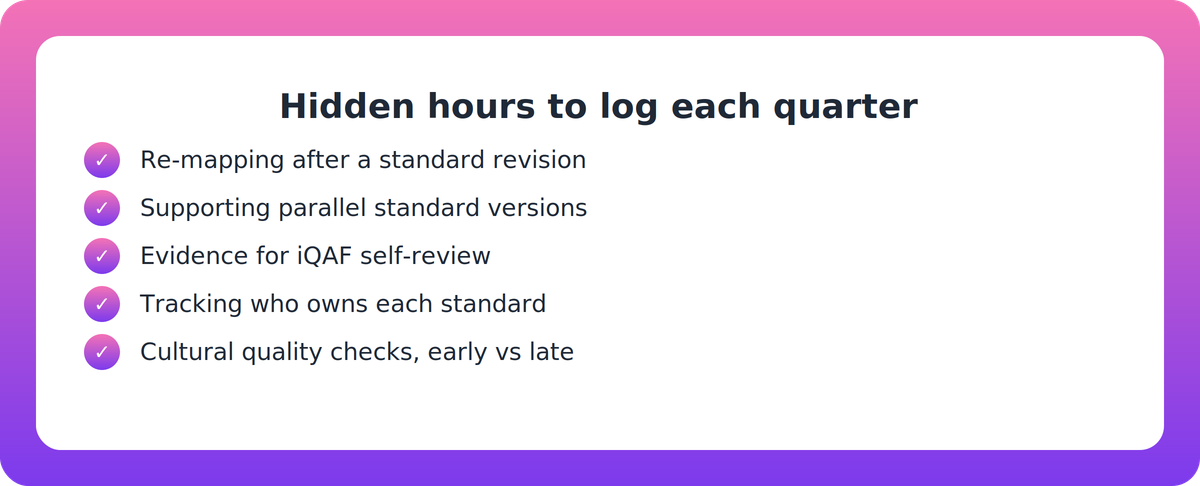
Cost per unit standard is hard to defend when the work is invisible. Here are the recurring categories worth logging, even roughly, for a quarter:
- Re-mapping on revision. Time spent re-reading a changed standard, finding every activity, resource and assessment it touches, and updating them.
- Parallel versions. NZQA says learners who hold the old version of a unit standard may still be able to be awarded the qualification. My inference, not NZQA's wording: you may need to support more than one version at once.
- Review evidence. Under iQAF, providers submit an annual self-review summary report and meet NZQA to discuss the improvement plan. You may be asked to show how learning design is reviewed and improved.
- Ownership tracking. Working out which body now owns a standard your content maps to, and whether that is about to change.
- Cultural quality checks. Time spent testing design against Māori-centred expectations, covered below.
You don't need timesheets for this. A shared spreadsheet with a date, a trigger and a rough time estimate is enough. After a quarter you'll have the first real evidence on this topic that anyone in your organisation has seen.
Who owns the standard you're mapping to?
This sounds administrative until it isn't. Standard-setting is shifting to Industry Skills Boards, ten regional polytechnics were established from 1 January 2026, and the Minister told a select committee that Te Pūkenga's disestablishment would not be completely equitable. If your programme sits in a transition, the people who answer your questions today may not be the ones who do in six months.
Keep a simple register: standard, current owner, last change notice, next known review date, and where your learning is affected. It takes an hour to set up. It saves the scramble when a change notice lands.
Cultural quality is a design input, not a final check
NZQA's Te Hono o Te Kahurangi is a whare ako framework and methodology NZQA uses for quality assurance in the tertiary sector, with guidelines for evaluative quality assurance. Māori-centred quality expectations are part of how quality gets judged, not a layer added at the end.
That matters for cost. If cultural review happens after content is built, it creates rework. If it shapes the brief, it doesn't. When you log hidden hours, note how much cultural-competency work was late-stage correction versus early-stage design. The gap is a business case.
What iQAF changes about the conversation
The integrated Quality Assurance Framework is live and applies to PTEs, wānanga, polytechnics, industry skills boards and government training establishments. From 1 January, NZQA isn't starting new EER processes or assuring consistency reviews, though those underway will be completed. In their place, the annual self-review and improvement conversation carries the weight.
That's an opening. A self-review is a place to say, with evidence, "here is the recurring work needed to keep our learning aligned, and here is what it takes." Your ledger turns an invisible burden into a line in that report.
Our take
The sector talks about design cost as a build price: so many weeks, so many dollars, per standard. That framing is why designers get squeezed. It treats a living alignment job as a one-off project.
With review periods loosened and structures shifting, maintenance is the main cost, and nobody is measuring it. Designers who count it will win the argument about capacity. Those who don't will keep absorbing it quietly until quality slips, then be asked why.
I'd go further. Part of your job is now to make the cost of currency visible to the people who fund it. That's not a distraction from design. It's what keeps design possible.
Key takeaways
- The main cost of a unit standard is the maintenance, versioning and review after launch, not the first build.
- No authoritative NZ source quantifies design hours per standard, so track your own rather than borrowing figures.
- The 2026 rules remove the five-year maximum review period for standards, qualifications and micro-credentials, so update timing is less predictable.
- Standard-setting now sits with Industry Skills Boards. Keep a register of who owns each standard you map to.
- Treat Māori-centred quality expectations and iQAF self-review evidence as design inputs from the start.
FAQ
What is the instructional design cost per unit standard in New Zealand?
There is no authoritative NZ figure. The research behind this post found no source quantifying design hours or cost per unit standard. The most defensible approach is to log your own build and maintenance time over a quarter or two.
Why do unit standard changes create rework for designers?
NZQA says standards may be revised for new requirements, legislation changes, updated cross-references or assessment issues. Any revision can affect delivered learning and assessment that was mapped to the earlier version.
Has the five-year review cycle for unit standards gone?
New unit standards were listed with a planned review date of around five years, but the 2026 Directory rules remove the five-year maximum review period. Qualification rules also remove maximum review periods for qualifications and micro-credentials.
How does iQAF affect instructional designers?
Providers submit an annual self-review summary report and meet NZQA to discuss the improvement plan. Designers may be asked to evidence how learning design is reviewed and improved, so a record of recurring alignment work is useful.
A question worth sitting with: if your manager asked tomorrow what it costs to keep one standard current for a year, could you answer? If not, start the ledger this week.