Instructional Design Debt: The Real Cost of 'Finished' Courses
28 July 2026 · 6 min read

A 'finished' course is a fiction in UK vocational education right now: it's simply content that hasn't been reopened yet. Skills England has 210 apprenticeship standards under active revision this reform cycle alone, and Ofsted no longer accepts a folder as proof of currency. Your sign-off date isn't a deadline — it's someone else's start line.
Why this lands on your desk, not compliance's
Curriculum currency gets filed under 'compliance' on an org chart, but you're the one who actually owns it. You wrote the scheme of work, mapped it to the standard, built the assessment criteria. When Skills England revises a standard, when Ofqual tweaks a qualification specification, when Ofsted's inspectors ask to see currency 'lived, not laminated', it's your materials being tested.
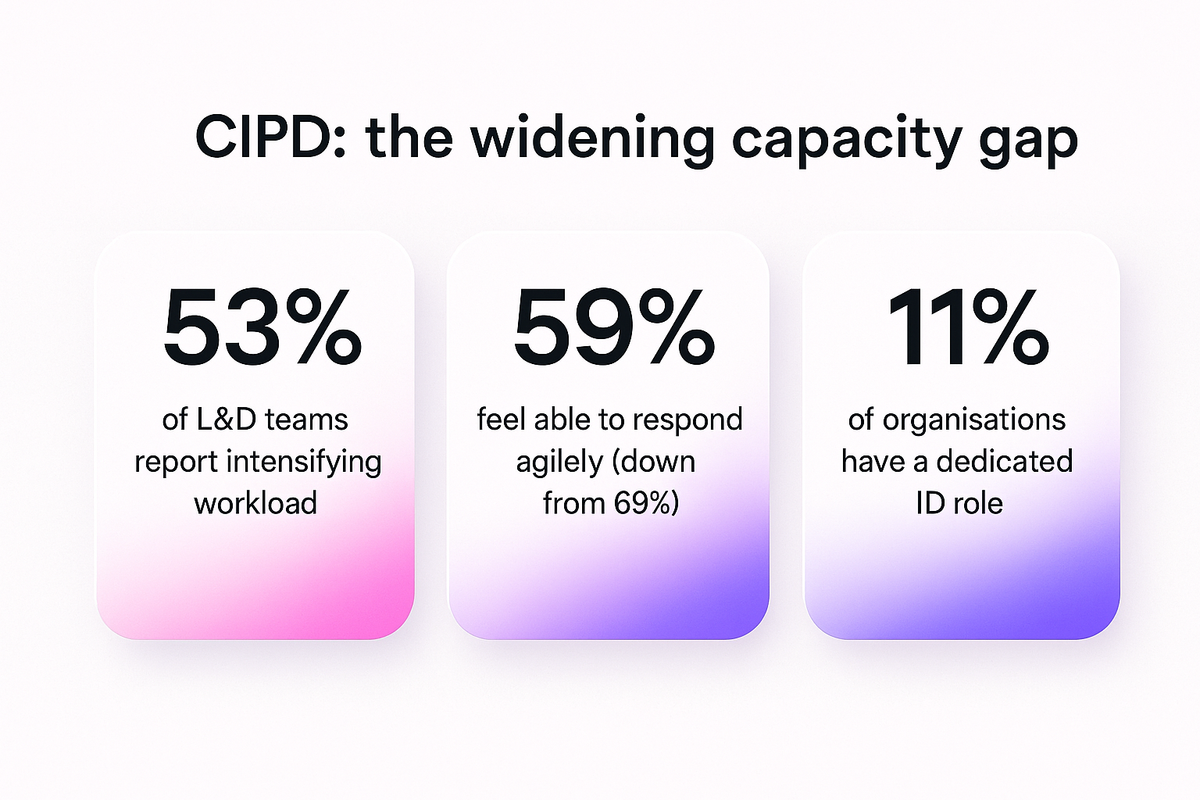
And you're doing it with less. CIPD research finds only 11% of UK organisations have a dedicated instructional designer role and just 7% a digital asset creator role, while roughly a third have cut L&D budgets, headcount or external consultant use. The people expected to service constant regulatory revision are among the scarcest resources in the function. That's not a staffing footnote — it's the structural reason design debt accumulates quietly until an audit forces the reckoning.
The qualifications landscape isn't static — it's churning
Ofqual currently regulates 248 awarding organisations and more than 10,190 active qualifications, with 11.8 million certificates issued in the 2024/25 academic year. That scale alone means constant amendment, withdrawal and replacement is the normal state of the system you design into — not an exception you plan around once and forget.
Ofqual is also consulting on a new regulatory approach for vocational and technical qualifications at levels 2 and 3, with the consultation closing on 2 July 2026. Whatever comes out of that will reshape specifications many providers have only just finished mapping.
Apprenticeship standards are structurally provisional
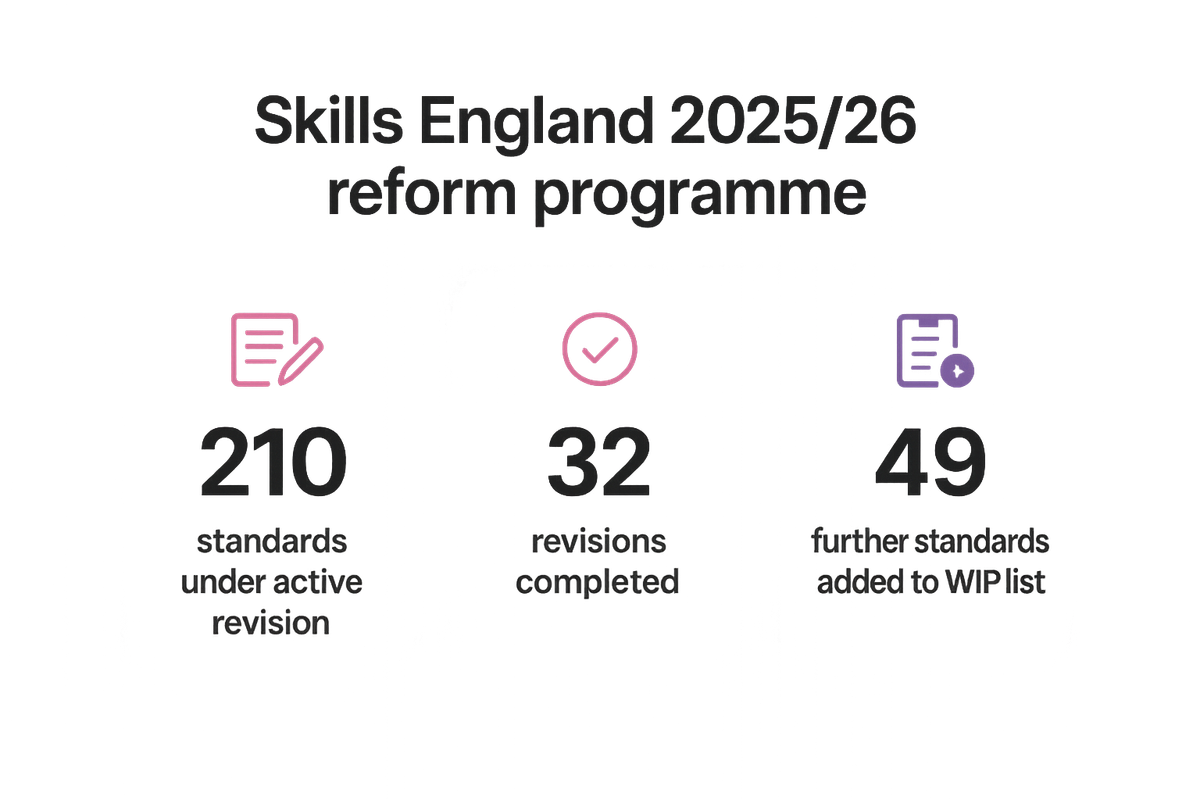
Skills England's Revisions and Adjustments Status Report shows 210 live apprenticeship standards being revised under the 2025/26 reform programme, with 32 completed and a further 49 standards added to the work-in-progress list. That's not a backlog you clear once — it's an ongoing state.
Layer on top of that the new 'apprenticeship units' flexible format, which went live for starts from 28 April 2026, with just over 300 providers approved to deliver them by June 2026. Every provider adopting units is running standard revisions and a new delivery format through the design pipeline simultaneously.
Funding can retire good content for reasons that have nothing to do with quality
This is the part that catches designers out: a course can be well-built, well-evidenced, learner-approved — and still become unviable because the funding rules moved, not the content. Sixteen apprenticeship programmes are set to be fully defunded from September 2026, and Level 7 apprenticeship funding has been restricted since January 2026 to specific learner groups. No amount of instructional design quality protects a course from a funding eligibility change. Build your review cycle around funding announcements, not just content review dates.
Ofsted wants evidence you can demonstrate, not evidence you can file
Ofsted's renewed Education Inspection Framework, in use from November 2025 with further FE and skills-specific guidance due for September 2026, moves away from single-word judgements toward a multi-category report card. Inspectors have been explicitly warned against over-reliance on paperwork — evidence, in Ofsted's own framing, 'will need to be lived, not laminated'.
For instructional designers, that changes what 'compliant' looks like. A scheme of work signed off eighteen months ago and stored in a shared drive no longer counts as proof of currency. Inspectors want to see the standard's latest version reflected in what's actually taught this week — which means your version control and update trail matter as much as the content itself.
The agility gap is your design debt, quantified
CIPD's most recent findings show 53% of L&D teams report workload intensifying despite increased overall resources, and only 59% of practitioners feel able to respond agilely to changing skills needs — down from 69% the year before. Read those two numbers together and you get a fairly precise proxy for how much unreviewed design debt is sitting in a provider's catalogue right now. If your team's agility score is falling, it's not a motivation problem. It's a capacity problem meeting a regulatory pace problem.
Key takeaways
- A 'finished' course is provisional by default: 210 apprenticeship standards are currently under revision, with 49 more added to the work-in-progress list.
- Funding eligibility can retire good content independently of quality — 16 programmes are being defunded from September 2026 and Level 7 funding has already narrowed.
- Ofsted's framework now expects lived, demonstrable currency, not filed documentation — 'laminated' evidence is explicitly called out as insufficient.
- Specialist design capacity is thin: only 11% of organisations have a dedicated instructional designer role, against rising workload and a falling agility score (59%, down from 69%).
- Treat design currency as a recurring regulatory obligation with its own review cadence, not a one-off project closed at sign-off.
Our take
Most providers still manage instructional design like a project: scope it, build it, ship it, move on. That model assumes the regulatory environment holds still long enough for the content to stay valid. It doesn't, and the data says it's getting less likely, not more. The practical shift worth making this quarter isn't a bigger team — most designers don't have that option — it's a shorter, cheaper review cycle built around the actual trigger points: Skills England revision announcements, Ofqual consultation outcomes, and funding eligibility changes, rather than a fixed annual review date that's almost always out of step with when the ground actually moves.
FAQ
How often should apprenticeship materials be reviewed, given how fast standards are revising? There's no fixed cycle that reliably works, because standards move on their own schedule — Skills England currently has 210 live under revision. The more resilient approach is trigger-based review: check materials whenever the relevant standard, funding rule, or qualification specification changes, rather than relying on an annual calendar date.
Does Ofsted's new framework actually require different evidence than before, or just a different judgement format? Both. The multi-category report card changes how judgements are presented, but the more significant shift for instructional designers is the explicit warning against paperwork-based evidence — inspectors are looking for demonstrable, current practice, not a well-organised folder of signed-off documents.
If our funding for a programme is being cut, is that a design failure? No — and it's worth saying clearly. Sixteen apprenticeship programmes are being fully defunded from September 2026 for funding-policy reasons, not content quality. The design implication is to track funding announcements separately from content review, since good design offers no protection against an eligibility change.
With only a small fraction of providers having a dedicated instructional design role, how realistic is it to keep pace with this volume of change? CIPD data puts dedicated instructional designer roles at just 11% of organisations, so most teams are stretched thin by design. The realistic move is prioritisation — track which materials sit against standards currently in revision or at funding risk, and review those first, rather than attempting blanket currency across the whole catalogue at once.