Jobs and Skills Councils Training Package Updates
21 July 2026 · 7 min read

Jobs and Skills Councils Training Package Updates
Jobs and Skills Councils are no longer working to one fixed transition date for training package reform. Since the Training Package Organising Framework took effect on 1 July 2025, changes are landing quarter by quarter — and the Training and Education (TAE) and Foundation Skills (FSK) training packages currently sit outside any JSC's permanent custodianship, under temporary Commonwealth oversight instead.
What is the Training Package Organising Framework, and why does it matter now?
The Training Package Organising Framework is the master rulebook that now governs how every national training package product is structured. It came into effect on 1 July 2025, administered by the Department of Employment and Workplace Relations (DEWR), and it sets out to:
- Reduce over-prescription in units of competency
- Cut duplication across related training packages
- Improve how skills transfer between qualifications and industries
For RTOs, this framework is the reference point every JSC now designs against. It doesn't replace training packages overnight — it reshapes how they're built, product by product, as JSCs work through their portfolios.
Why is there a gap around TAE and FSK training packages?
Here's the catch: not every part of the system has a permanent home yet. TAE and FSK — the training packages underpinning trainer and assessor requirements and foundation skills delivery sector-wide — currently have no permanent Jobs and Skills Council custodian.
DEWR has stepped in with temporary oversight, backed by a time-limited Technical Reference Group, while a longer-term custodianship arrangement is worked out. That's a genuine compliance-relevance gap: these are the training packages that sit underneath trainer/assessor qualifications and LLN-related delivery across almost every RTO's scope, yet they're being managed on an interim basis rather than a fixed roadmap.
What's actually moving right now?
JSC quarterly project updates show this isn't stalled — work is genuinely progressing, just unevenly across packages.
- BSB training package: The January 2026 quarterly update shows new digital capability units in development, including standalone generative AI and cyber security products, developed through a Training Product Trial ahead of formal accreditation.
- MSA07 Manufacturing Training Package: A Qualification Reform Demonstration Project tested removing MSA07 and its four focus qualifications entirely, to rationalise overlapping training products. Findings went to DEWR back in September 2024 — a reminder that reform findings and actual RTO-facing transition can be separated by years, not months.
- AQF Level 7 Vocational Degree: Work is underway testing a bridging qualification structure at this level against industry, education and regulatory requirements across provider types — a sign of further structural change still to come at the qualification-framework level, not just within individual training packages.
The reform pipeline, in practice
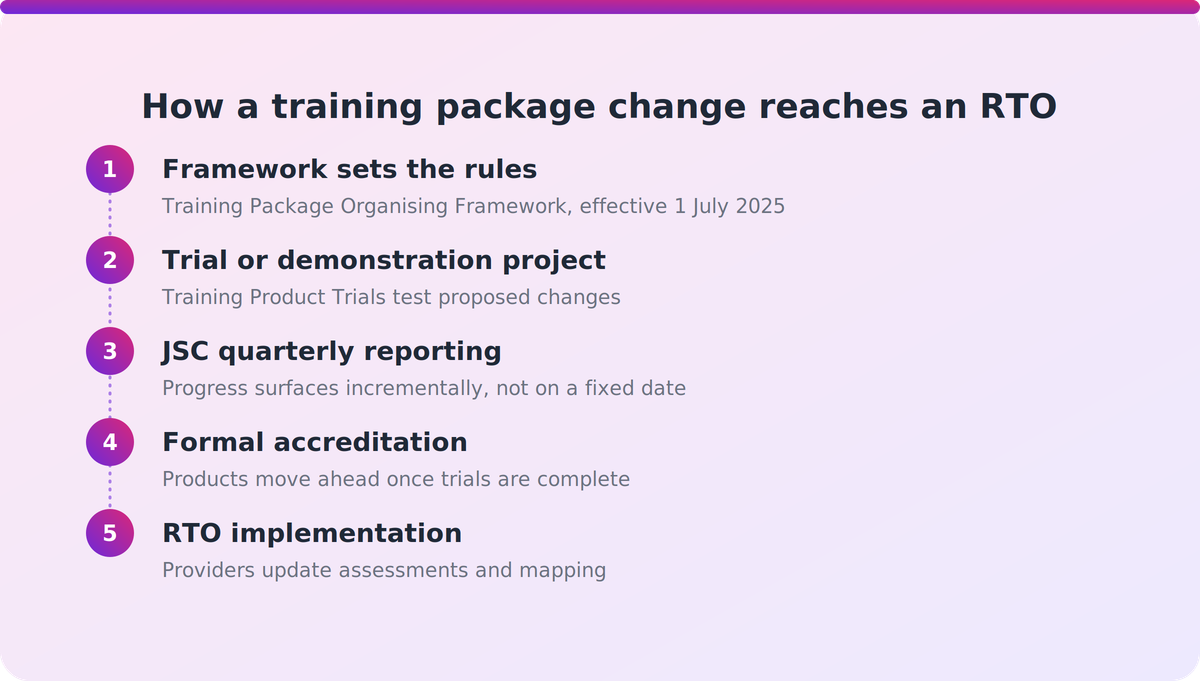
Each of these examples follows a similar shape: a framework rule is set, a trial or demonstration project tests it, findings surface through JSC quarterly reporting, and only then does a product move toward formal accreditation and RTO implementation. There's no single national "go live" date — there's a pipeline, and different products sit at different stages of it at any given time.
Why does leadership at Jobs and Skills Australia matter to RTOs?
Jobs and Skills Australia sits above the JSC network, setting the national workforce planning priorities that feed into training package work. A Commissioner departure was announced on 28 May 2026, adding governance-level uncertainty at the top of the reform chain right as the 2026-27 work plan consultation signals a continued — not reduced — focus on productivity and removing system-wide barriers.
Read together, that points to acceleration rather than a slowdown. RTOs shouldn't expect the pace of training package change to ease just because there's a leadership transition underway at the national level.
What this means operationally for RTOs
The practical shift for compliance and assessment teams is this: transition timelines are emerging incrementally through recurring JSC reporting, not arriving as a single fixed date to plan around. That raises the operational burden of tracking unit of competency changes and keeping assessment mapping audit-ready under the Standards for RTOs 2025.
What this looks like day to day:
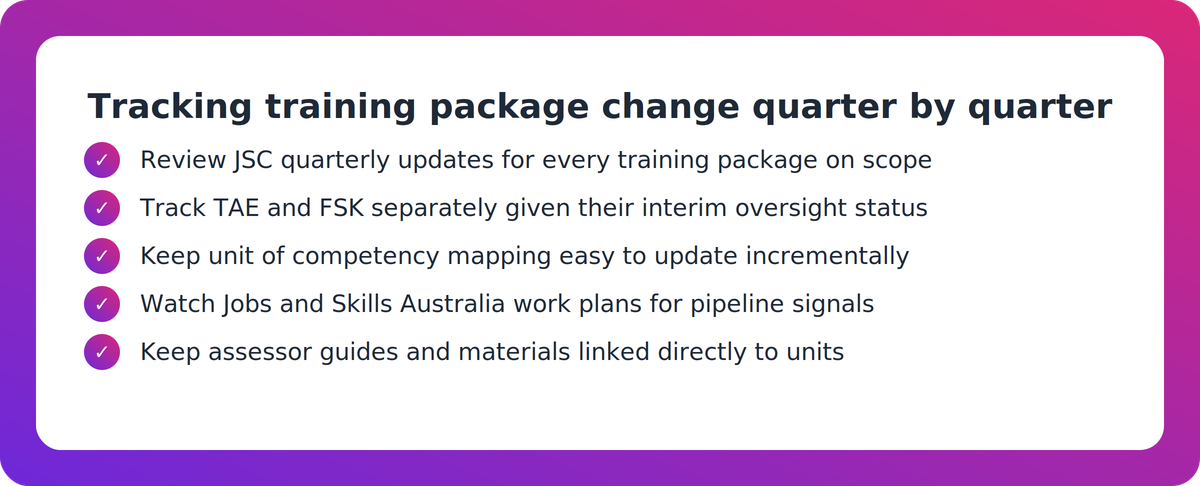
- Quarterly, not annual, monitoring of JSC updates for every training package on scope
- Separate tracking for TAE and FSK, given their interim governance status
- Assessment mapping documentation that can be updated incrementally, unit by unit, rather than rebuilt in one pass
- Assessor guides and training materials that stay linked to the units they support, so a unit change doesn't leave supporting material orphaned
Building for continuous change, not a one-off update
RTOs whose assessment validation and mapping processes were built around periodic, batch-style reviews are the ones most exposed here. A quarterly reform cadence needs a compliance workflow that can absorb small, frequent changes without triggering a full re-validation cycle every time.
Key takeaways
- The Training Package Organising Framework (effective 1 July 2025) now governs how all training packages and units of competency are structured, aiming to cut over-prescription and duplication.
- TAE and FSK training packages sit under temporary DEWR oversight, with no permanent JSC custodian yet — a direct compliance-relevance gap for trainer/assessor and foundation skills requirements.
- Concrete work is underway on BSB (digital capability units, including generative AI and cyber security), MSA07 (qualification rationalisation), and an AQF Level 7 Vocational Degree bridging structure.
- Reform findings and RTO-facing implementation can be separated by years — the MSA07 project reported findings to DEWR in September 2024.
- A May 2026 Jobs and Skills Australia leadership change, alongside a 2026-27 work plan focused on productivity, points to continued momentum rather than a pause.
Our take
A quarterly reform cadence rewards RTOs that treat unit of competency mapping as a living document, not a compliance artefact you file once and revisit at audit time. The TAE/FSK oversight gap is worth watching closely — foundation skills and trainer/assessor requirements touch almost every scope, and interim governance arrangements have a way of running longer than "temporary" suggests. Providers that build assessment and mapping processes able to absorb incremental change will spend audit season checking details, not scrambling to rebuild.
FAQ
What is the Training Package Organising Framework? It's the national rulebook, effective from 1 July 2025 and administered by DEWR, that now governs how all training package products and units of competency are structured, with the aim of reducing over-prescription and improving skills transferability.
Why don't TAE and FSK have a permanent Jobs and Skills Council? No JSC currently holds permanent custodianship of the TAE and FSK training packages. DEWR has taken temporary oversight, supported by a time-limited Technical Reference Group, while longer-term arrangements are determined.
Which training packages are seeing active change right now? JSC quarterly updates show live work on BSB (new digital capability units including generative AI and cyber security products), MSA07 (a qualification rationalisation demonstration project), and a proposed AQF Level 7 Vocational Degree bridging structure.
How long does training package reform typically take to reach RTOs? It can take years. The MSA07 Qualification Reform Demonstration Project reported its findings to DEWR in September 2024, illustrating the lag between reform findings and actual changes RTOs need to implement.
Does the Jobs and Skills Australia leadership change affect training package timelines? It adds governance-level uncertainty, but the 2026-27 work plan consultation signals continued focus on productivity and removing system barriers — suggesting momentum rather than a slowdown in training package redesign.