Jobs and Skills Councils Training Packages: Racing 2026
27 August 2026 · 7 min read

Australia's ten Jobs and Skills Councils are working inside a fixed 2022–2026 funding cycle, and DEWR has confirmed individual JSC work programs are only tranche-funded — some to March 2026, others to June 2026. Add a new DEWR Training Package Assurance Body reviewing every product before endorsement since 1 July 2025, and RTOs now have a shorter, more fragile window to remap units of competency, assessment tools and training materials before scope-of-registration risk kicks in.
Why the Jobs and Skills Council clock is running down
The $402 million JSC program was always designed as a defined-term reform, not an open-ended body. DEWR's own program guidelines set the 2022–2026 envelope, and the January 2026 quarterly update from the Manufacturing Industry Skills Alliance confirms individual councils are now working to hard tranche cut-offs rather than a rolling mandate.
What that means in practice:
- Training product development, consultation and endorsement all have to land inside a shrinking funded window.
- A JSC that hasn't finished consulting on a unit before its tranche lapses has no guaranteed mechanism to pick the work back up.
- RTOs relying on "it'll get sorted eventually" as a delivery strategy are betting against a funding clock, not just a bureaucratic one.
Skills Insight's own 2025–2026 Workforce Plan and similar releases from other councils are effectively public signals of what's coming down the pipeline — and how much runway RTOs have left to act on it.
What the new Training Package Assurance Body actually checks
Since 1 July 2025, every JSC-developed training product has to clear DEWR's Training Package Assurance Body before it's endorsed. This sits outside the JSC's own governance — it's a formal quality gate, not a formality.
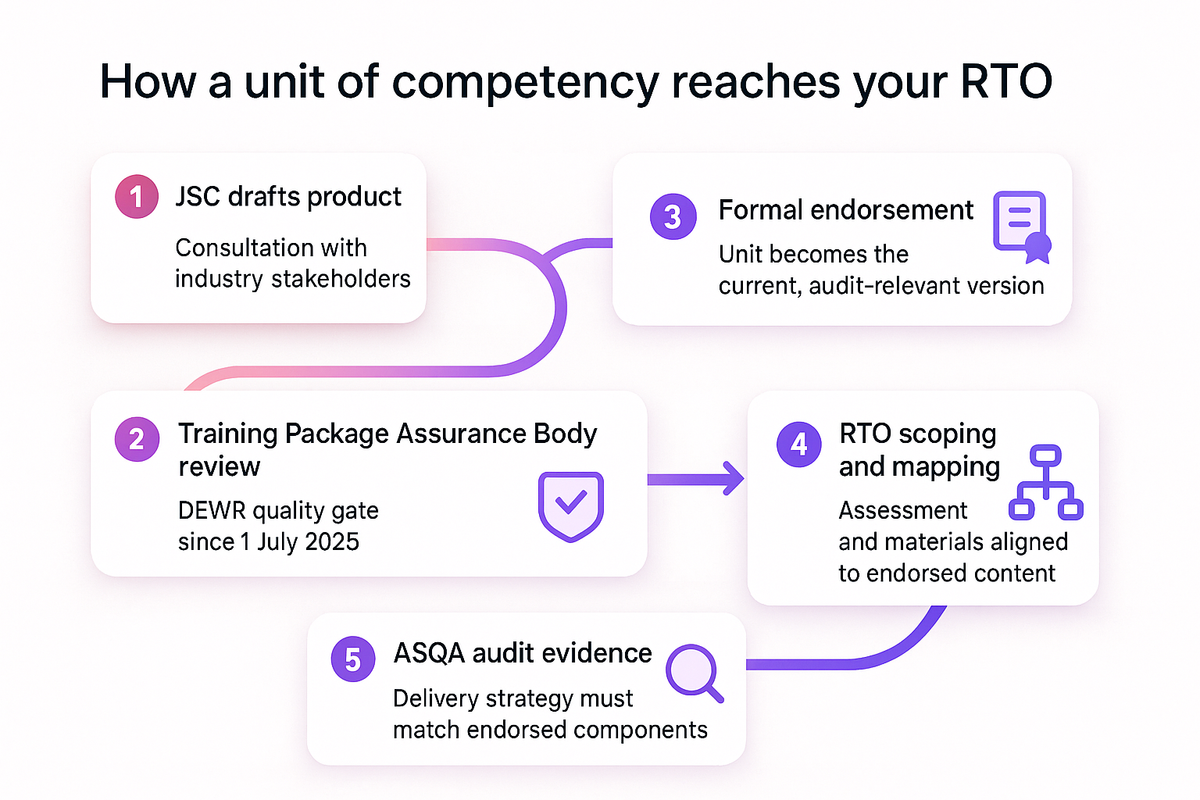
The practical implication for RTOs: a unit of competency that's been drafted, consulted on, and even publicly discussed by a JSC is not the same as one that's endorsed and ready to build a delivery and assessment strategy around. Treating draft content as final is how compliance gaps creep in.
The TAE and FSK gap nobody's talking about
Training and Education (TAE) and Foundation Skills (FSK) — two packages nearly every RTO touches, directly or through trainer and assessor qualifications — currently have no permanent JSC owner. DEWR is holding temporary oversight through a time-limited Technical Reference Group.
For RTOs, this is a governance gap with real consequences:
- No single JSC to track for TAE/FSK-specific updates or consultation windows.
- Uncertainty about who owns the next revision cycle once the Technical Reference Group's mandate ends.
- A higher chance that changes land with less notice than packages under a settled JSC.
Fast-tracking digital skills: the Future Skills Organisation trial
Not every change is slow-moving. Future Skills Organisation is running a Training Product Trial to fast-track BSB digital capability content — generalist Gen AI and cybersecurity units — developing learning and assessment materials ahead of formal accreditation.
It's a useful signal: when a skills need is urgent enough, JSCs will compress the consultation-to-endorsement window dramatically. The Safe and Respectful Workplaces unit, with a public consultation window of just 2 February to 3 March 2026, is another example of a short, easy-to-miss window that directly sets how much time an RTO has to remap before the unit changes underneath its scope.
What this means for your mapping, assessment and validation cycle
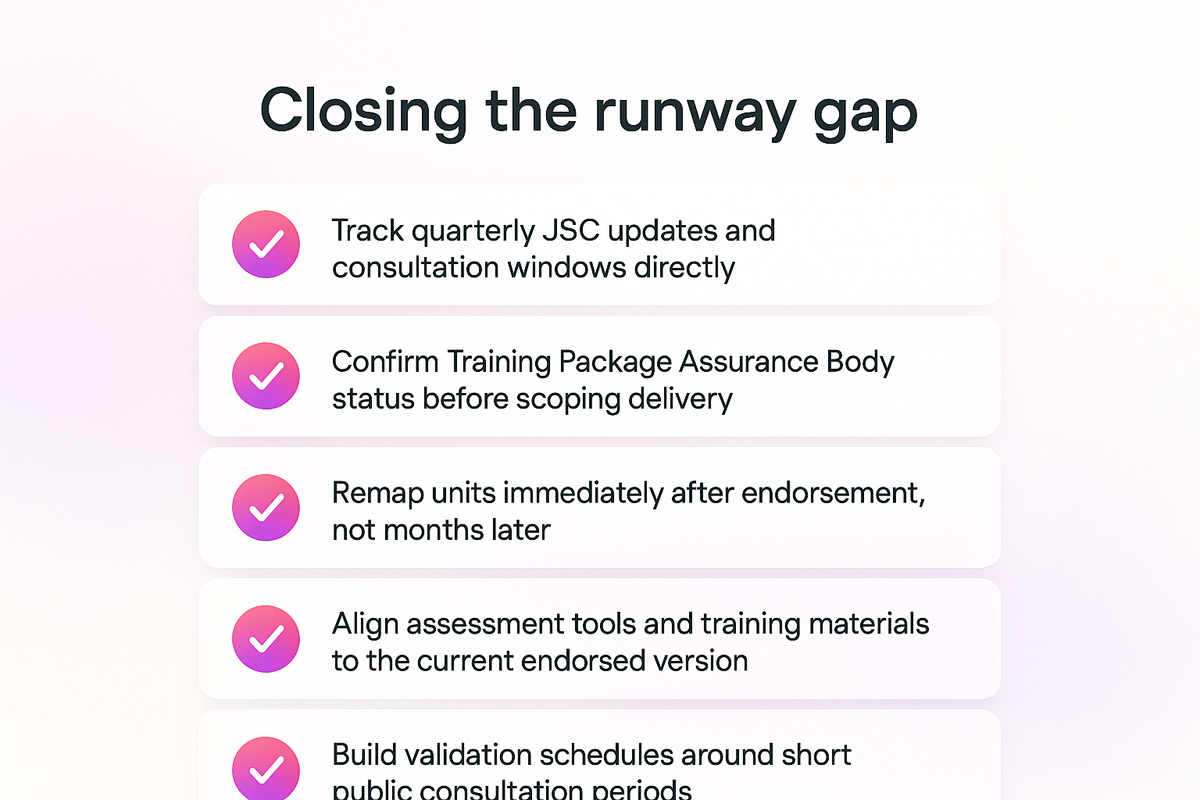
Sector guidance — including eSkilled's 2026 RTO briefings — is blunt about the audit consequence: during an ASQA audit, delivery and assessment strategies must clearly demonstrate alignment with endorsed training package components. Misalignment, even where the intent was right but the timing was off, can trigger non-compliances or scope restrictions.
Compliance-software commentary puts a number on what's at stake: analysis cited by compliance vendors puts potential exposure from non-compliance — fines, legal costs, reputational damage — at up to $14.8 million annually across the sector. Fragmented risk, quality assurance and validation processes are flagged as a growing problem heading into and beyond 2026.
The operational reality for RTOs is straightforward, even if the timing pressure isn't:
- Endorsement date, not draft date, is what starts your compliance clock.
- Unit-of-competency mapping and assessment alignment need to happen close to endorsement, not months later.
- Training materials disconnected from the current assessment version are an audit flag waiting to happen.
- Manual remapping cycles that took weeks under the old training package tempo may simply not fit inside a JSC's compressed 2026 timelines.
This is where tools built specifically for Australian VET compliance earn their keep — platforms like Supahuman VETos are designed around exactly this cycle, generating unit-aligned assessments with coverage mapping and assessor guides built in, so remapping a portfolio doesn't mean starting from a blank page every time a JSC moves.
Key takeaways
- JSC work programs are tranche-funded to hard 2026 cut-offs, not open-ended — expect uneven, compressed release schedules.
- DEWR's Training Package Assurance Body (live since 1 July 2025) means drafted content is not endorsed content — don't build delivery strategies on drafts.
- TAE and FSK sit under temporary DEWR oversight with no permanent JSC home, so trainer and assessor qualification updates may land with less warning.
- Future Skills Organisation's Training Product Trial and the Safe and Respectful Workplaces unit's short consultation window show JSCs can move fast when needed — RTOs need to move with them.
- Compliance exposure is real money, not just theoretical risk — cited estimates run to $14.8 million annually sector-wide from fines, legal costs and reputational damage.
Our take
The JSC reform was built to modernise training package development, but a funded, deadline-driven model has an uncomfortable side effect: it rewards RTOs that treat unit-of-competency changes as a live operational feed, not an annual housekeeping task. The Training Package Assurance Body is a genuine quality improvement, but it also adds a step between drafting and delivery-readiness that RTOs can't see or influence directly. The practical lesson for 2026 and beyond is that mapping, assessment alignment and validation need to become continuous, near-real-time processes rather than periodic projects — because the JSCs setting the pace aren't waiting for anyone's internal review cycle.
FAQ
What is the Jobs and Skills Councils program funding timeline? The JSC program operates under a fixed 2022–2026 funding cycle set by DEWR, with individual JSC work programs tranche-funded to specific cut-offs — some to March 2026, others to June 2026 — rather than continuous funding.
What does the DEWR Training Package Assurance Body do? Since 1 July 2025, it reviews every JSC-developed training product before formal endorsement, acting as a quality gate that sits outside JSC governance. A unit of competency isn't audit-ready until it clears this review and is formally endorsed.
Which training packages currently have no permanent JSC owner? TAE (Training and Education) and FSK (Foundation Skills) have no permanent JSC home. DEWR holds temporary oversight through a time-limited Technical Reference Group.
Why does JSC timing matter for ASQA compliance? ASQA audits require delivery and assessment strategies to clearly align with endorsed training package components. Building against draft or superseded content — rather than the current endorsed version — can trigger non-compliances or scope-of-registration restrictions.
How can RTOs keep pace with faster JSC release cycles? Track quarterly JSC updates and public consultation windows directly, confirm a unit's Training Package Assurance Body status before scoping delivery, and use mapping tools that let assessment and training material updates happen quickly once a unit is endorsed, rather than starting the remapping process from scratch.