Keeping Training Content Current Under NZQA's iQAF
11 August 2026 · 7 min read
NZ's vocational reform didn't hand instructional designers a new rulebook and a matching design budget. It handed them a moving regulatory target — new standards owners, a continuous compliance cycle, and a hardened cultural competency bar — and quietly expected the backlog of content that no longer maps cleanly to get sorted on top of everything else already on your plate.
Why this lands on your desk
You're the one who signs off on whether a learning resource still maps correctly. That job just got harder on three fronts at once. Workforce Development Councils, which many unit and skill standards were built and endorsed under, have been replaced by Industry Skills Boards — so anything mapped to a legacy WDC-endorsed standard may need revalidating against new ownership. NZQA's integrated Quality Assurance Framework (iQAF) has shifted providers from periodic external evaluation to an annual self-review summary report and improvement plan, which means you now need to demonstrate ongoing currency, not a one-off pass before an assessor visits. And with Te Pūkenga disestablished and programmes transferring to regional polytechnics, a chunk of the sector is re-authoring and re-mapping content simultaneously, on a government-set timeframe that has nothing to do with your existing design capacity.
Three regulatory shifts are converging on your content library
Each of these would be manageable on its own. Together, they're a structural backlog.
- The iQAF went live on 19 January 2026. It replaces external evaluation and review with an annual self-review summary report and improvement plan, moving compliance from episodic to continuous (NZQA). The Quality Assurance of Tertiary Education Providers Rules 2026 go further, requiring providers to 'have or create, maintain, keep up to date, and give effect to a quality management system' across all education and training (NZQA) — content currency is now framed as an ongoing obligation, not a project with an end date.
- The Directory of Assessment and Skill Standards rules have dropped the previous five-year maximum review period. That loosens the fixed cycle you may have been designing against, but it doesn't remove the underlying need to keep content aligned to whatever the current standard actually says (NZQA).
- Te Pūkenga was disestablished via legislation passed in October 2025, renamed the New Zealand Institute of Skills and Technology (NZIST), and is operating as a two-year transitional entity while programmes, assets and staff transfer to newly established regional polytechnics from 1 January 2026 (Beehive.govt.nz, community.scoop.co.nz). Workforce Development Councils were replaced by eight Industry Skills Boards from the same date, which now lead standard-setting, qualification development and programme endorsement (Ministry of Education, Careerforce).
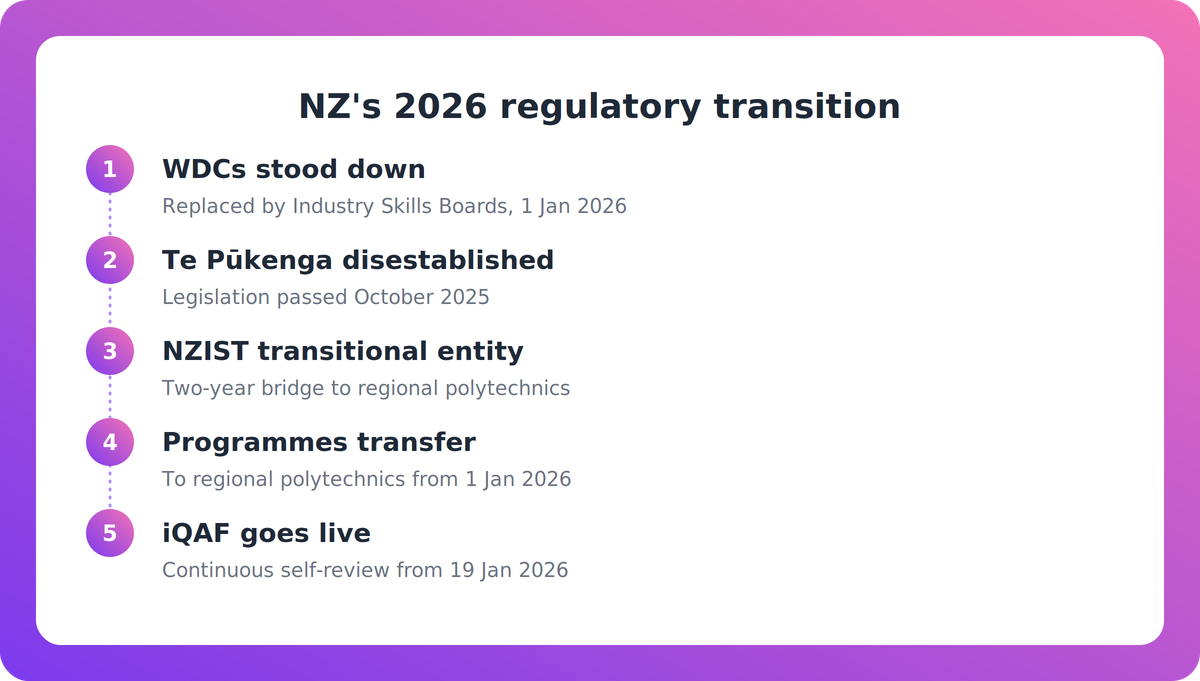
The ripple effects go beyond the classroom. Immigration New Zealand has had to build a 12-month transitional workaround, continuing to honour legacy education evaluation ratings for visa purposes while NZQA's new framework beds in — a reminder that content currency decisions you make now have consequences well outside your building.
Cultural competency has hardened from good practice into a sign-off requirement
This isn't a diversity module you bolt on at the end of a course build anymore. In qualifications such as the New Zealand Certificate in Health and Wellbeing (Advanced Care and Support) Level 4, cultural competency is assessed through specific unit standards — including 28989 (Apply strategies to support cultural diversity) and 32418 (Describe Te Tiriti o Waitangi in a health or wellbeing setting). Graduates are expected to embed bicultural principles honouring Māori as tangata whenua, which means the design brief itself needs to treat Te Tiriti o Waitangi alignment as a core requirement, not a late addition reviewed by someone else after the fact.
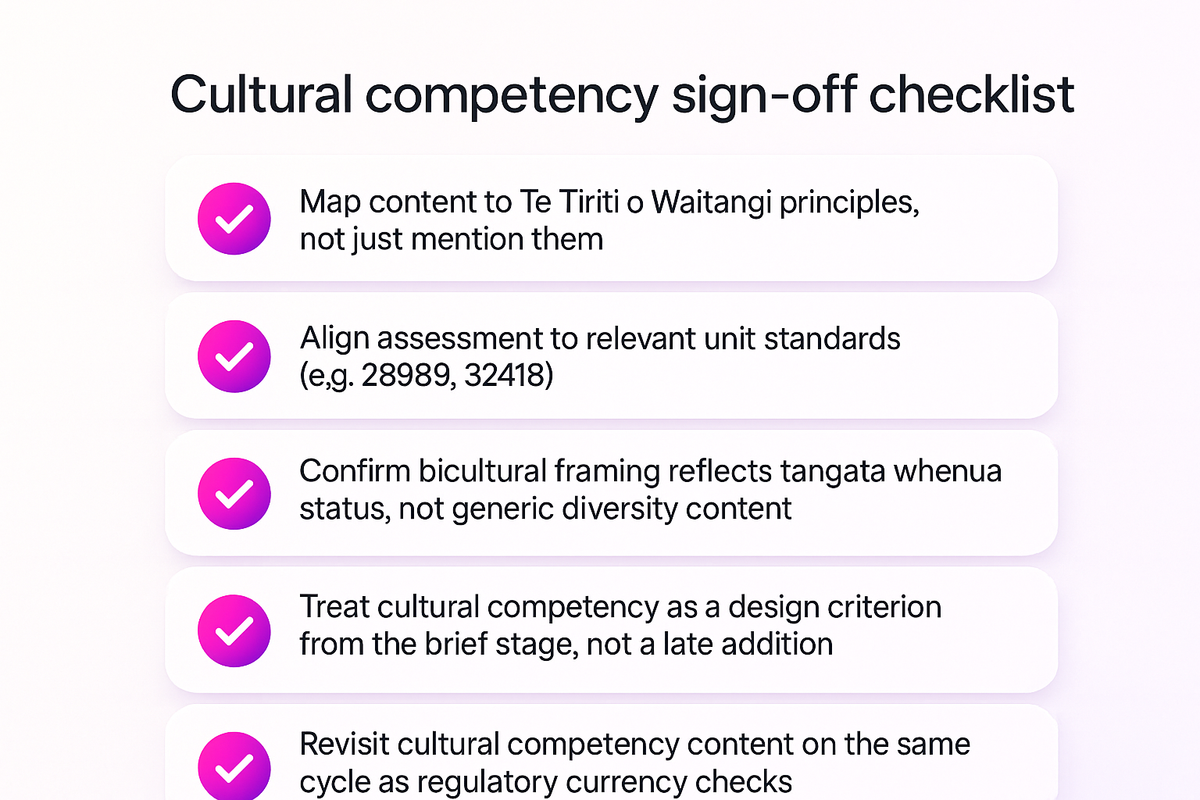
That's a genuine shift in what 'compliant' design means. A resource that mentions cultural diversity in passing won't satisfy an assessor looking for evidence against a specific standard.
The backlog nobody budgeted for
Here's the structural problem: instructional design work is already expensive and slow to produce, and every regulatory shift you don't immediately reflect becomes design debt sitting in your library, waiting to be found by an auditor or a learner asking a question your content can't answer.
There's no NZQA-confirmed figure for how many hours this kind of revalidation work actually takes across the sector — any number circulating informally should be treated as an estimate, not regulator-confirmed data. What is documented is sector-wide commentary, including from BusinessNZ, describing 'constant change in recent years' and its effect on providers' competitiveness. That's the honest picture: nobody has quantified the backlog, but everyone doing this work knows it's real.
The uncomfortable part for instructional designers specifically is that none of this backlog was created by bad design. It was created by good design that got overtaken by regulatory change faster than most design pipelines are built to absorb. A resource mapped correctly in 2024 can be technically out of currency in 2026 without a single word of it being wrong.
Key takeaways
- NZQA's iQAF (live from 19 January 2026) replaces periodic external evaluation with continuous annual self-review, so content currency needs an ongoing process, not a pre-audit scramble.
- Any content mapped to legacy Workforce Development Council standards needs checking against the eight Industry Skills Boards that now own standard-setting and qualification development.
- Te Pūkenga's disestablishment and the transfer of programmes to regional polytechnics via the transitional NZIST entity means large-scale re-authoring is happening across the sector on the same tight timeframe.
- Cultural competency in qualifications like the Health and Wellbeing (Advanced Care and Support) Level 4 is now assessed against specific unit standards (e.g. 28989, 32418) — it belongs in the design brief, not the review stage.
- Nobody has an authoritative figure for how many hours this backlog costs the sector; treat any such claim as an estimate, and plan your own capacity on the assumption that it's larger than your current pipeline can absorb on top of business as usual.
Our take
The design cycle most providers still run — brief, build, review, approve, publish, revisit in a few years — was built for a world where standards moved slowly and evaluation happened periodically. That world is gone. iQAF's annual self-review cadence, the loosened DASS review period, and simultaneous standards-body and provider restructuring all point the same way: content currency is now a continuous obligation, and design capacity that was already stretched thin isn't going to stretch further on its own.
The practical response isn't heroics. It's building a lighter, faster revalidation loop into your existing design process — treating standards mapping, ISB ownership checks and cultural competency alignment as things you check on a rolling basis, not things you re-litigate from scratch each time. Whatever tools or processes get you there, the sector-wide reality is the same: the backlog exists whether or not anyone's budgeted for it, and it's sitting on the instructional design desk either way.
FAQ
What is NZQA's integrated Quality Assurance Framework (iQAF) and when did it start? The iQAF went live on 19 January 2026. It replaces NZQA's previous periodic external evaluation and review process with an annual self-review summary report and improvement plan, shifting quality assurance from episodic checks to a continuous cycle providers must maintain year-round.
Do content items mapped to Workforce Development Council-endorsed standards still hold up now Industry Skills Boards have taken over? Workforce Development Councils were replaced by eight Industry Skills Boards from 1 January 2026, which now lead standard-setting, qualification development and programme endorsement. Content mapped to legacy WDC-endorsed standards should be checked against current ISB ownership rather than assumed to still be current.
What happened to Te Pūkenga, and does it change who owns my content? Te Pūkenga was disestablished via legislation passed in October 2025 and renamed the New Zealand Institute of Skills and Technology (NZIST), which is acting as a two-year transitional entity. Programmes, assets and staff are transferring to newly established regional polytechnics from 1 January 2026, so content ownership and sign-off pathways may be shifting during this window.
Is cultural competency now a mandatory, assessable requirement rather than good practice? In some qualifications, yes. The New Zealand Certificate in Health and Wellbeing (Advanced Care and Support) Level 4 assesses cultural competency through specific unit standards, including 28989 (Apply strategies to support cultural diversity) and 32418 (Describe Te Tiriti o Waitangi in a health or wellbeing setting), requiring graduates to embed bicultural principles honouring Māori as tangata whenua.