Key Person Risk in NZ Vocational Training: A CEO's View
4 August 2026 · 8 min read
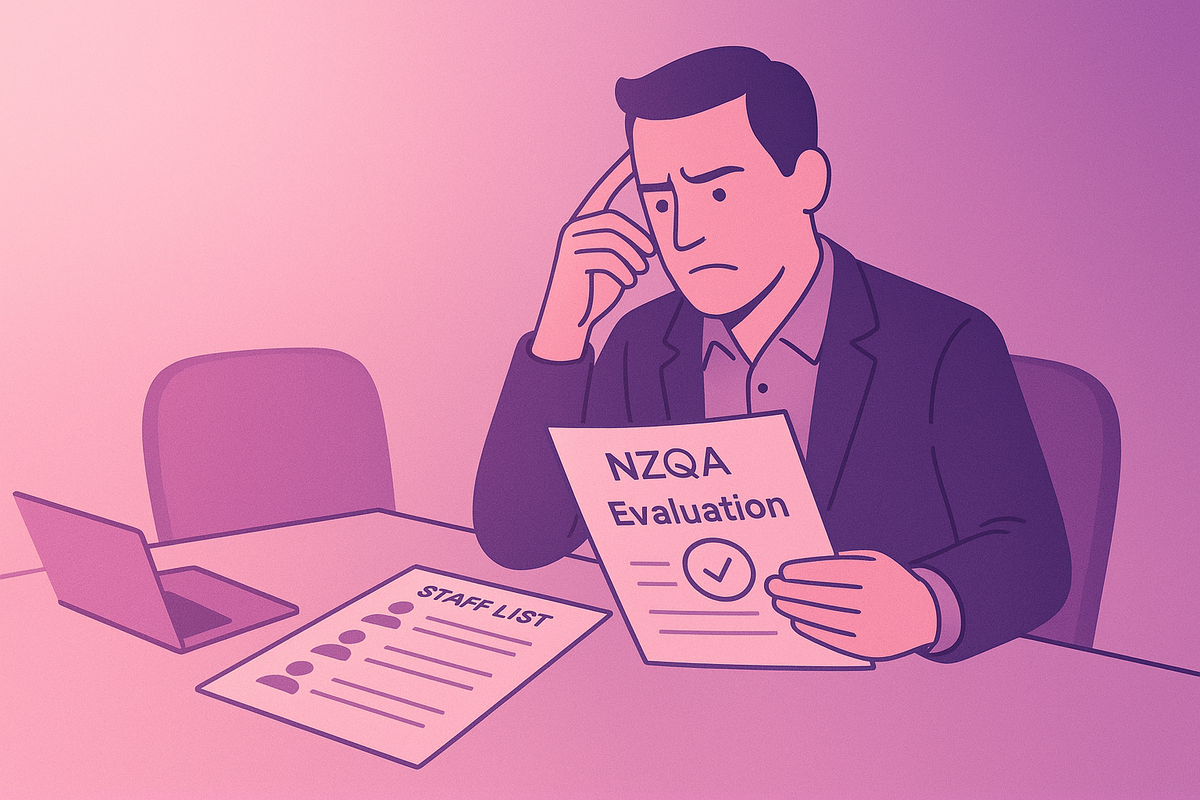
When your best tutor resigns, the damage rarely shows up in this month's numbers. It shows up a year or two later, in a lower NZQA category rating, a stalled enrolment pipeline, or a lapsed accreditation you didn't see coming. That's not a staffing gap — it's a governance risk sitting on your register, unlabelled.
Why This Lands on Your Desk, Not HR's
Most CEOs and GMs treat tutor turnover as an operational problem: find a replacement, cover the timetable, keep students happy. That framing misses what NZQA's own reporting tells us — delivery quality and consistency feed directly into category ratings, and category ratings feed directly into enrolments. A single departure that dents delivery for two or three intakes can register as a commercial problem months after the exit interview is filed away.
It's compounding right now. The 2026 vocational education and training system redesign — disestablishing Te Pūkenga, standing up ten regional polytechnics and Industry Skills Boards from 1 January 2026, and shifting work-based learning divisions into PTEs, polytechnics and wānanga through 2026–2027 — is pulling experienced tutors and compliance staff between organisations at exactly the moment providers most need delivery continuity. Add new PTE rules from 19 January 2026 that raise the bar on demonstrable business resilience, and boards are going to start asking a question you need an answer for: can our delivery capability survive losing one or two key people?
The Regulatory Chain: From Tutor to Category Rating to Pipeline
NZQA's External Evaluation and Review (EER) process isn't a paperwork exercise — its findings are public, and they carry commercial weight. Among NZQA's published EER reports is a case where a provider's enrolments stayed limited following a lower category rating awarded in 2023. The line from delivery quality, to rating, to pipeline, is not theoretical. It's documented.
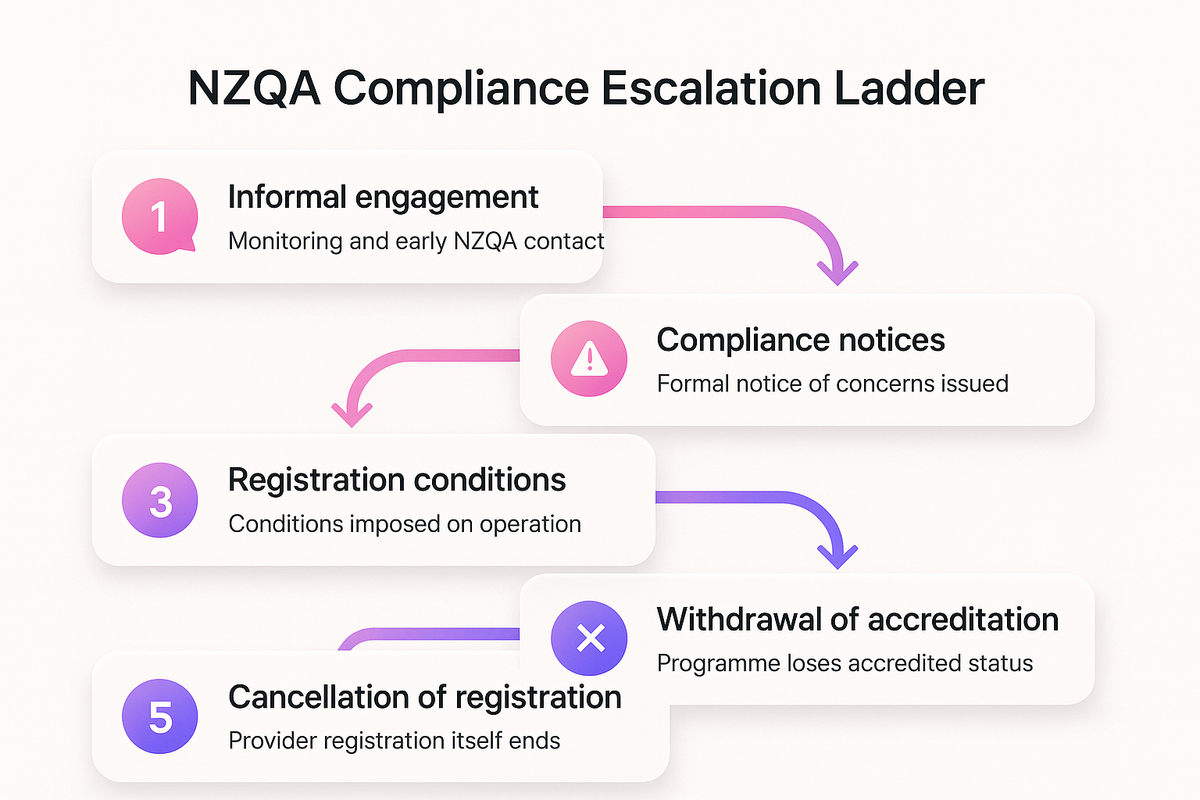
When delivery consistency slips — through inconsistent facilitation, gaps in coached practice, or assessment quality that varies depending on who's teaching — NZQA has an escalation pathway that starts quietly and ends badly:
- Informal engagement and monitoring
- Compliance notices
- Registration conditions
- Withdrawal of accreditation for the affected programme
- Cancellation of registration
Each step up that ladder is a conversation you have to have with your board or owners. A tutor departure that erodes delivery quality is a plausible trigger for step one — and from there, the clock is running.
Use It or Lose It: The Registration Risk Hiding in a Niche Programme
Here's the sharper version of the risk, and it's one many CEOs underweight. NZQA applies a 'use it or lose it' rule: if a programme or micro-credential goes undelivered for 12 months or more, its accreditation lapses. If that programme happens to be your only accredited offering, your registration lapses with it.
Now picture the common failure mode: a niche, high-value programme is delivered by one specialist tutor because nobody else on staff is qualified or industry-credible enough to run it. That tutor leaves. You can't backfill fast enough. The programme goes quiet for a year. What started as a resourcing gap has become a registration event.
This is why tutor dependency belongs on the same risk register as financial covenants and lease renewals, not buried in a staffing plan nobody outside operations reads.
Why You Can't Just Hire Your Way Out
Immigration New Zealand formally lists Vocational Education Teacher on its skill-shortage occupation lists. The Ministry of Education has separately acknowledged a national under-supply against previously projected teacher surpluses. Put those two things together and the message is plain: specialist tutoring capacity is a genuinely scarce, government-acknowledged resource, not a role you post on a job board and fill in six weeks.
For a CEO used to solving capacity problems with a recruitment ad, that's an uncomfortable adjustment. Replacing a strong tutor — someone with both the industry credibility and the assessment competence NZQA expects — is a slow-moving talent market problem, and the current sector reshuffle is only tightening it.
What 'Audit-Ready' Now Means Under the 2026 PTE Rules
The Private Training Establishment Rules 2026, in force from 19 January 2026, replace both the 2025 Registration Rules and the 2022 Enrolment and Academic Records Rules. One of the more consequential shifts: providers move from GAAP-based Annual Financial Returns to a requirement to demonstrate 'adequate internal financial controls'.
On paper, that's a finance and governance change. In practice, it signals a broader shift in what NZQA and your board expect you to be able to show — not just that the numbers add up, but that the organisation has controls robust enough to withstand disruption. Delivery capability is part of that resilience story. If your ability to deliver a core programme rests on one or two irreplaceable people, that's not a strength to quietly hope holds — it's a control gap a diligent board will eventually ask you to close.
TEC has flagged that PTE-level compliance is materially more complex than operating inside an Industry Skills Board or polytechnic structure. Providers absorbing new work-based learning delivery through 2026–2027 are taking on that compliance load and tutor-dependency risk at the same time — which is precisely the wrong moment to discover your delivery model has a single point of failure.
Key takeaways
- NZQA's EER category ratings have a documented link to enrolment outcomes — delivery inconsistency from a tutor departure can become a pipeline problem months later.
- NZQA's compliance ladder runs from informal engagement through to cancellation of registration; delivery gaps are a plausible trigger at the earliest stage.
- The 'use it or lose it' rule lapses accreditation after 12 months of non-delivery — a real registration risk if a niche programme depends on one tutor.
- Vocational Education Teacher sits on Immigration New Zealand's skill-shortage list, and the Ministry of Education has acknowledged a broader teacher under-supply — replacing specialist capability is slow, not immediate.
- The PTE Rules 2026 (from 19 January 2026) raise expectations around internal controls and organisational resilience — delivery capability is increasingly part of that conversation, not separate from it.
Our take
Most providers manage compliance risk and staffing risk in separate meetings, run by separate people, reported to the board in separate line items. That split made sense when the sector was stable. It doesn't hold up during a system-wide restructure where staff mobility, tighter internal-control expectations and 'use it or lose it' accreditation rules all intersect at once.
Our honest view: if you can't answer, right now, which programmes at your organisation depend on a single named person to deliver them, you don't yet have a clear picture of your regulatory exposure — no matter how strong your enrolment numbers look this quarter. That answer belongs in board papers, not in the head of your operations manager.
FAQ
Is tutor turnover actually a board-level risk, or is that overstating it? When a single tutor's departure can stall delivery long enough to trigger NZQA's compliance ladder, or lapse accreditation under the 'use it or lose it' rule, it stops being purely an HR matter. NZQA's own EER findings show delivery quality feeding through to category ratings and enrolments — that's a commercial and regulatory outcome, which makes it a governance question.
How long does a programme need to go undelivered before accreditation is at risk? Under NZQA's rules, a programme or micro-credential that isn't delivered for 12 months or more can have its accreditation lapse. If it's your only accredited offering, registration itself lapses too — which is why a prolonged tutor gap on a niche programme deserves board-level attention, not just an operational workaround.
What changes under the PTE Rules 2026 that CEOs should be across? From 19 January 2026, the Private Training Establishment Rules 2026 replace the 2025 Registration Rules and the 2022 Enrolment and Academic Records Rules. A key change is the move from GAAP-based Annual Financial Returns to a requirement to demonstrate adequate internal financial controls — part of a broader expectation that providers can show organisational resilience, including delivery capability, not just financial reporting.
Why is it so hard to simply hire a replacement tutor quickly? Immigration New Zealand lists Vocational Education Teacher as a skill-shortage occupation, and the Ministry of Education has acknowledged a national under-supply of teaching capacity against earlier projections. That's a government-documented signal that experienced, industry-credible tutors are genuinely scarce — replacing one well is a months-long process, not a same-quarter fix.
Start with one question at your next leadership meeting: for every programme you currently deliver, who is the one person whose absence would stop it — and what would happen to your registration if they left tomorrow?