Leadership Simulation Training Software: AU Buyer Guide
29 September 2026 · 9 min read
The best leadership simulation training software for Australian teams delivers real spoken, face-to-face-style roleplay rather than text-only scripts, scores performance against your own leadership framework instead of a generic rubric, and is deployed in a way that satisfies the Australian Privacy Principles for recorded voice and biometric data — all while staying positioned as practice that supports a manager's judgement, not a substitute for it.
What counts as leadership simulation training software
The category splits into two genuinely different technical approaches, and it pays to know which one you're looking at before you compare features.
- Fully AI-driven simulation — tools like Skillsoft's CAISY, Tavus and Exec generate an AI persona that plays the counterpart in the conversation and produces feedback automatically, with no human operator in the loop.
- Human-in-the-loop avatar simulation — platforms like Mursion pair a digital avatar with a trained specialist operating it in real time, blending simulated pressure with a human's improvisation.
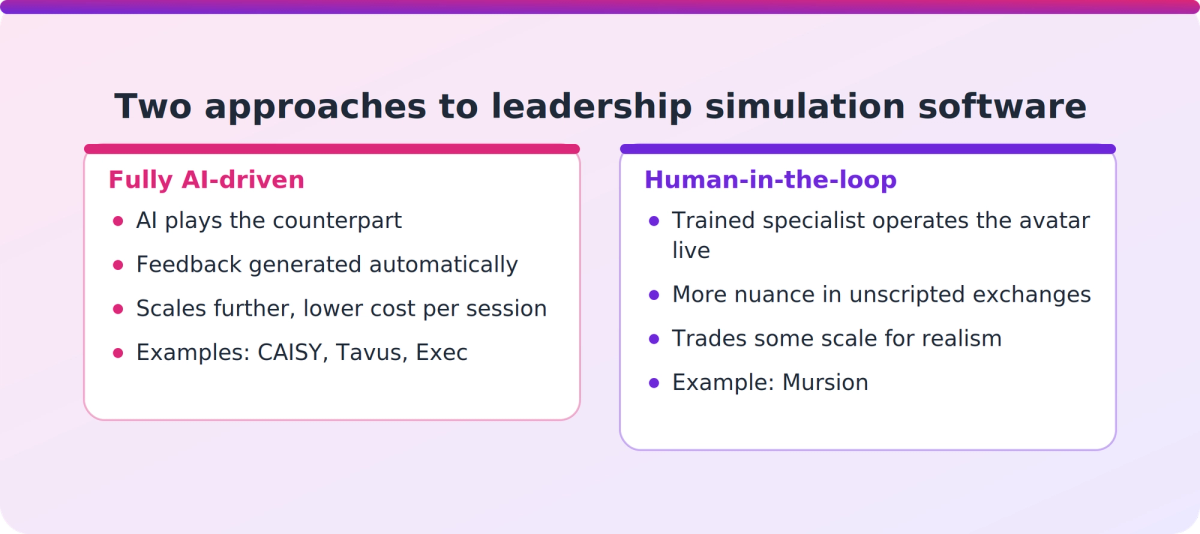
Neither model is inherently better. Fully AI-driven tools scale further and cost less per session; human-in-the-loop tools trade some scale for the nuance a live operator brings to an unscripted, emotionally loaded exchange. Ask any vendor directly which model you're buying — some marketing pages blur the line.
Text roleplay vs voice and video: why fidelity matters
A text chatbot can help a manager rehearse *wording* for a redundancy conversation or a performance conversation. What it can't do is force them to hold their tone steady while an on-screen face pushes back, or manage a pause that runs a beat too long. That's the pressure that makes a conversation genuinely difficult, and it's exactly what text-only tools strip out. Voice and video-based platforms preserve more of that pressure, which is why they're increasingly the default expectation in this category rather than a premium add-on.
Whose framework is the feedback actually scored against
This is where a lot of buyers get caught out. Some tools score a conversation against a generic communication rubric — clarity, empathy, structure — regardless of what the organisation actually trains its leaders on. Others, such as Elevate Leadership's approach, train the AI on the buyer's own leadership content so the scoring reflects the framework participants were taught, not a stock model. If your leadership programme has its own language for feedback, escalation or psychological safety, ask the vendor how (and whether) that gets built into the scoring — not just the scenario.
Does the software replace a manager's coaching, or sit alongside it
Across the category, vendors and industry guidance are consistent on this point: AI roleplay is a complement to human coaching, not a replacement for it. The AI handles scalable, low-stakes first-pass practice and immediate feedback; managers and coaches still own targeted coaching, behaviour-change reinforcement and any actual judgement call about a person's readiness or conduct.
That distinction matters more in Australia than a nice-to-have. Many of the conversations this software is bought to rehearse — performance issues, conduct complaints, conversations that touch on bullying or workload — sit inside the psychosocial hazard obligations set out in Safe Work Australia's model Code of Practice on managing psychosocial hazards at work, which several states have adopted or adapted. Practising the conversation well is genuinely useful. But the decision about how to actually handle a live psychosocial risk, complaint or conduct issue has to stay with a trained, accountable person — no simulation tool changes that.
Is recording a manager's voice or face for AI feedback compliant here
Yes, but only if it's handled properly. The Privacy Act 1988 (Cth) and the Australian Privacy Principles apply to any personal information an AI tool collects, uses or generates — including the voice and video recorded to run or train the system. The OAIC's October 2024 guidance on commercially available AI products sets out expectations here; it isn't binding law, but it's influential in how regulators and buyers now assess AI vendors.
Voice and facial video are biometric data, and Australian privacy guidance is clear that biometric collection generally needs voluntary, specific, informed and current consent. Importantly, the standard employee-records exemption under the Privacy Act does not cover requiring staff to consent to biometric data collection — so a vendor can't wave this away as "normal HR data." Before signing anything, ask for:
- A clear APP-aligned collection notice covering exactly what's recorded and why
- A genuine, opt-in consent process for voice and video capture
- Written data retention timeframes
- A plain answer on whether recordings are used to train the vendor's underlying AI model
Some buyers also use Australia's Voluntary AI Safety Standard, from the National AI Centre and the Department of Industry, Science and Resources, as an additional (non-mandatory) governance checkpoint alongside the OAIC's guidance.
How customised can scenarios actually be
A generic scenario library — "give difficult feedback," "manage an underperformer" — is fine for a demo but weak for real transfer. The more useful question is whether the vendor can build scenarios around your actual roles, industry and situations quickly, rather than adapting your training to fit their pre-built library. Ask to see a scenario built from your own leadership documentation, not a canned example.
A buyer's checklist for evaluating leadership simulation software
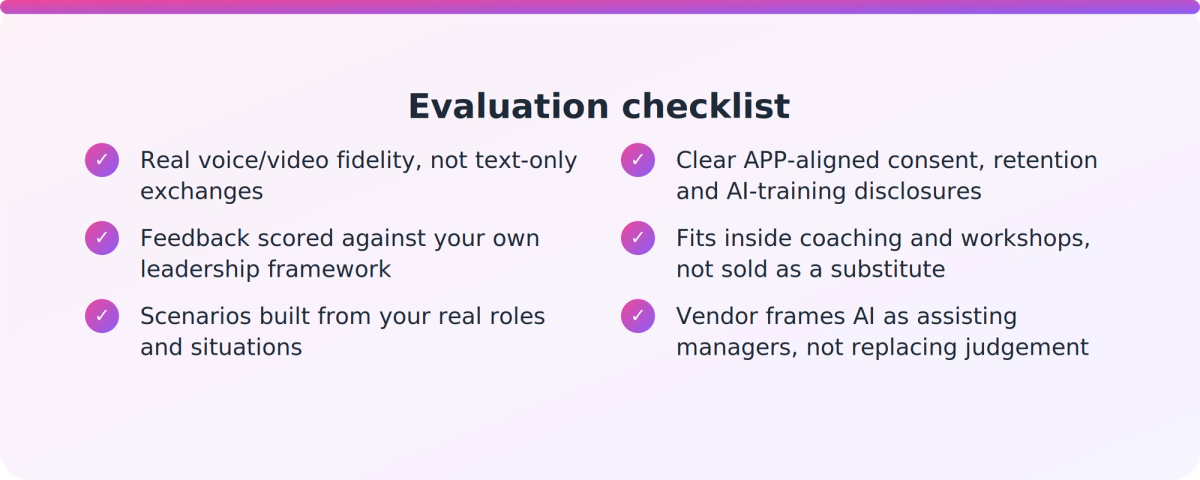
Weigh options against these, in roughly this order of importance:
- Fidelity — real spoken, video-level practice, or text exchanges that omit tone and pressure?
- Feedback alignment — scored against your leadership framework, or a generic rubric?
- Scenario customisation and speed — built from your real roles and situations, or drawn from a stock library?
- Privacy and compliance posture — clear APP-aligned consent, retention and AI-training-use disclosures?
- Fit within a broader programme — does it sit inside coaching and workshops, or get sold as a standalone substitute for them?
- Framing of the human role — does the vendor say AI assists managers, or oversell it as a replacement for coaching judgement?
- Evidence beyond marketing — checkable client use, not just aggregated review-site scores (there's currently no independent efficacy certification for this category in Australia, so self-reported ratings deserve scrutiny).
Where a tool like Nova fits into this picture
Worth naming honestly: Supahuman's Nova engine includes a comparable AI voice roleplay mechanic — a "Talk it out" format that gives an AI persona a voice and character to play a counterpart in a live exchange, with in-the-moment coaching rather than grading. Scenarios are generated specific to the provider's own context rather than pulled from a generic library, and the coaching is explicitly formative and judgement-free, which keeps it aligned with the principle above: it supports rehearsal, and a qualified human still owns any real assessment or competency decision.
This capability is proven in production with Australian vocational education and training providers operating under ASQA and the Standards for RTOs 2025 — a reasonable fit for RTOs building coached practice into leadership or management units within training package delivery. It isn't currently marketed or evidenced as a standalone corporate executive-leadership product outside that VET delivery context, so a corporate L&D team evaluating this category purely for leadership-team development should weigh it alongside the purpose-built vendors above.
Key takeaways
- Know whether you're buying fully AI-driven simulation (CAISY, Tavus, Exec) or human-in-the-loop avatar simulation (Mursion) — the trade-offs in scale, cost and nuance differ.
- Voice and video fidelity matters: text-only roleplay strips out the tone, pace and visible pressure that make a conversation genuinely difficult.
- Push vendors on whether feedback is scored against your own leadership framework or a generic communication rubric.
- Recording voice or face for AI feedback is workable under the Privacy Act 1988 and the Australian Privacy Principles, but requires genuine, specific consent — the employee-records exemption doesn't cover biometric data.
- No independent efficacy certification exists for this category yet in Australia, so weigh real client evidence and privacy disclosures over self-reported review scores.
Our take
The demo is almost never the differentiator in this category — most vendors can produce a slick AI conversation on stage. The differences that matter show up later: whether the feedback actually reflects how your organisation talks about leadership, and whether the vendor can show you a straight answer on consent and data retention rather than a vague privacy page. Buyers who treat this as a compliance and framework-fit decision, not a features race, tend to end up with tools their leaders actually keep using.
FAQ
What software actually lets leaders rehearse a difficult conversation out loud, in real time, rather than just typing responses into a script? Voice and video-based AI roleplay platforms — fully AI-driven tools like Skillsoft's CAISY, Tavus and Exec, or human-in-the-loop platforms like Mursion — let a leader speak and respond live to an AI or avatar counterpart, preserving tone, pace and pressure that text-only chatbots strip out.
Is recording a manager's voice or face for AI feedback compliant with Australian privacy law? It can be, but only with proper handling. The Privacy Act 1988 (Cth) and the Australian Privacy Principles apply to voice and video used to run or train AI tools, and biometric data generally needs voluntary, specific, informed and current consent — the standard employee-records exemption does not cover requiring staff to consent to biometric collection.
Does AI roleplay replace manager coaching and human judgement, or work alongside it? Across the category, vendors and industry guidance consistently frame AI roleplay as a complement to human coaching. The AI provides scalable first-pass practice and immediate feedback; managers and coaches retain the targeted coaching, reinforcement and any accountable judgement calls, particularly on conduct or psychosocial issues.
How customised can the scenarios be to our own leadership model, industry and real workplace situations? This varies by vendor. Some tools rely on generic scenario libraries; others, including approaches like Elevate Leadership's, build scenarios and scoring from the buyer's own leadership content. Ask any vendor to demonstrate a scenario built from your actual role and industry context before buying.
Is there an independent certification that proves a leadership simulation tool works? No — there's currently no independent, universally recognised certification testing the learning efficacy of this software category in Australia. Third-party review scores cited in vendor comparisons are self-reported marketing data, not a formal industry standard, so weigh real, checkable client evidence more heavily.