Learner Progress Tracking Is Now the Head of Training's Job
16 September 2026 · 8 min read

NZQA no longer sends an outside auditor to catch the learner you missed. From 2026, provider-led self-review replaces External Evaluation and Review, putting the job of spotting a trainee headed for withdrawal on your own systems. National withdrawal rates are rising — so any gap in that visibility is now yours to explain, not an auditor's periodic finding.
Why this lands on your desk
You don't own NZQA's audit calendar any more, but you now own the evidence trail. Under the new NZQA rules taking effect from 19 January 2026, providers must build and maintain their own quality management system, run an annual organisational self-review, and produce it to NZQA on request — with no scheduled visit forcing the exercise. That shifts the work from "get ready for the auditor" to "know, continuously, whether it's working."
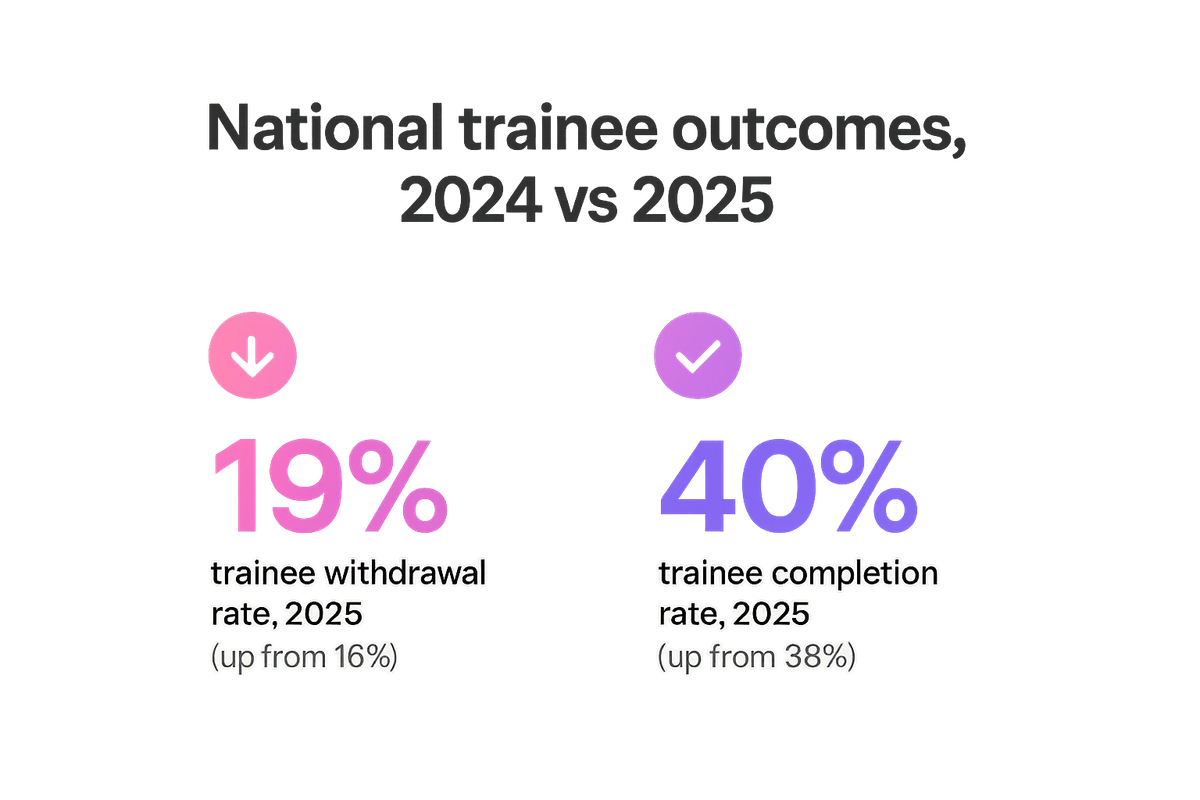
Withdrawal is the number that lands hardest on your desk because it's the number a Head of Training is expected to move. Education Counts data shows trainee withdrawal climbed from 16% in 2024 to 19% in 2025, while completions moved only slightly, from 38% to 40%. Vocational Education Minister Penny Simmonds has named apprentice completion — currently below half — as an urgent problem for the sector. That pressure doesn't land on the CEO's desk first. It lands on yours, because you own the trainers, the timetables and the intervention points where a learner either gets caught or doesn't.
What the withdrawal numbers are actually telling you
The gap between withdrawal and completion widened, not narrowed. Three points follow from the same underlying issue:
- More learners are leaving before finishing than a year ago.
- Completions have barely shifted, so the extra withdrawals aren't converting into faster or different outcomes — they're just leaving.
- A rising withdrawal rate alongside flat completions suggests learners in trouble are being noticed too late to bring back, or not noticed until they've already gone.
None of this tells you why a specific learner withdrew. What it does tell you is that whatever early-warning system exists across the sector right now isn't catching enough people early enough to change the outcome.
From audit to ongoing proof: what the 2026 rules actually ask of you
The practical shift is from periodic to continuous. Previously, External Evaluation and Review gave you a known date to prepare for and a report to respond to afterwards. The replacement model — self-review and ongoing monitoring — asks you to hold that evidence permanently, ready to produce whenever NZQA asks, not just when a review is scheduled.
For a Head of Training, this changes what "good" looks like day to day:
- Under the old model, you could demonstrate quality with a strong file built in the weeks before a visit.
- Under self-review, you need a system that is telling you the truth about learner progress in week three of a course, not just in the annual report.
That's a genuine change in workload character, not just paperwork volume. It rewards visibility you already have running, and penalises visibility you have to reconstruct after the fact.
Why pass/fail dashboards hide the learners you most need to see
The Tertiary Education Strategy 2025–2030 pushes providers toward "distance travelled" or "value added" measures, specifically because completion and withdrawal data can mask what's actually happening to a learner. A binary dashboard shows you learners who finished and learners who left. It says nothing about the learner who is behind schedule, resubmitting work, missing sessions intermittently, but still moving — until, three weeks later, they're not.
The strategy names this as a persistent problem for Māori, Pacific and disabled learners specifically, where completion gaps have proven stubborn under the metrics currently in use. If your reporting only distinguishes "completed" from "withdrawn," you are structurally unable to see the learner in the middle — which is precisely where intervention still has a chance of working.
Consistency across trainers is a moderation problem too
National external moderation principles require that assessor judgements be reliable "regardless of who does the assessing or when the assessment occurs." That standard is written for grading, but it describes exactly the risk you carry with progress flags too.
If one trainer flags a learner as at-risk after two missed sessions and another waits until a formal warning is due, your organisation doesn't have an early-warning system — it has several inconsistent ones, and the learners who fall through are the ones assigned to the trainer with the higher tolerance. With trainer shortages and workload pressure already stretching your team, informal, trainer-by-trainer judgement calls are the first thing to slip.
The evidence base and the org chart are both moving under you
Two more things make this harder right now, not easier. Ako Aotearoa and the two Centres of Vocational Excellence are closing by the end of 2025 due to funding changes, thinning the national research you could otherwise draw on for engagement and retention practice. At the same time, the 2026 restructuring — Te Pūkenga's disestablishment, work-based learning shifting to Industry Skills Boards, and polytechnics still confirming reporting lines — creates real risk that learner progress history gets lost in the handover between owning bodies, right when continuity of support matters most.
Neither of these is something you can fix. Both are reasons to make sure your own visibility into learner progress doesn't depend on any external body, this year or next.
Key takeaways
- Under NZQA's move to self-review and ongoing monitoring from 19 January 2026, a Head of Training must be able to produce evidence of early identification and support continuously, not just prepare a file before a scheduled review.
- National withdrawal rates rose from 16% (2024) to 19% (2025) while completions moved only from 38% to 40% — a widening gap that suggests learners are being caught too late, not too rarely.
- Binary completion/withdrawal dashboards can't show the "distance travelled" measures the Tertiary Education Strategy 2025–2030 calls for, and specifically mask progress gaps among Māori, Pacific and disabled learners.
- National moderation principles demand reliable judgement regardless of who assesses — the same logic should govern how consistently at-risk learners get flagged across your trainer team.
- The closure of Ako Aotearoa and the Centres of Vocational Excellence, plus the 2026 restructuring of work-based learning and polytechnics, both reduce external support and increase the risk of losing learner progress continuity during handovers.
Our take
Self-review will only do what NZQA intends if it reflects something that's actually happening week to week, not a document assembled to satisfy a rule. The providers who do well under this model won't be the ones with the tidiest annual self-review report — they'll be the ones where a trainer noticing a learner slip triggers the same response whether it happens in week two or week twelve, and whether the trainer has been there five years or five weeks.
That's a delivery and culture problem before it's a systems problem. No dashboard fixes inconsistent trainer judgement on its own — but a dashboard that never gets looked at until the withdrawal has already happened isn't visibility either. The honest test for your own operation this quarter is whether you'd know a specific learner was drifting before they told you, or a trainer did, three weeks after the fact.
FAQ
What exactly changes for training providers under NZQA's 2026 rule changes? From 19 January 2026, NZQA's rules replace External Evaluation and Review with a self-review and ongoing monitoring model. Providers must build and maintain a quality management system, run an annual organisational self-review, and be able to produce it to NZQA on request, rather than working toward a scheduled external visit.
How bad is the national withdrawal problem, really? Education Counts data shows trainee withdrawal rose from 16% in 2024 to 19% in 2025, while completions moved only from 38% to 40% over the same period. Vocational Education Minister Penny Simmonds has separately flagged that fewer than half of apprentices currently complete their training.
What are "distance travelled" measures and why do they matter for equity gaps? The Tertiary Education Strategy 2025–2030 introduces distance travelled, or value-added, measures to capture learner progress that a simple complete/withdraw split can't show. The strategy specifically names uneven completion outcomes for Māori, Pacific and disabled learners as a persistent challenge that binary metrics have failed to resolve.
What happens to learner progress data during the 2026 restructuring? With Te Pūkenga's disestablishment, the shift of work-based learning to Industry Skills Boards, and polytechnics still confirming their reporting lines, there's a genuine risk that learner progress records and support continuity are lost in the handover between owning bodies during 2026. Providers that keep their own independent visibility over learner progress are less exposed to that churn.