Why Learner Progress Data Always Arrives Too Late
26 August 2026 · 7 min read

By the time a progress report lands on your desk, the learner it describes has usually already fallen behind. That's not a technology problem or a trainer problem — it's a structural one, and New Zealand's quality assurance settings are about to make it a lot more visible.
Why this lands on your desk
You own the training and assessment strategy. You're the one who has to explain, in a self-review or a funding conversation, why a cohort's completion rate dropped and what you did about it before it became a statistic. Historically, the answer could lean on periodic checkpoints — Training Achievement System (TAS) reporting, moderation cycles, an External Evaluation and Review (EER) every few years. That rhythm is disappearing.
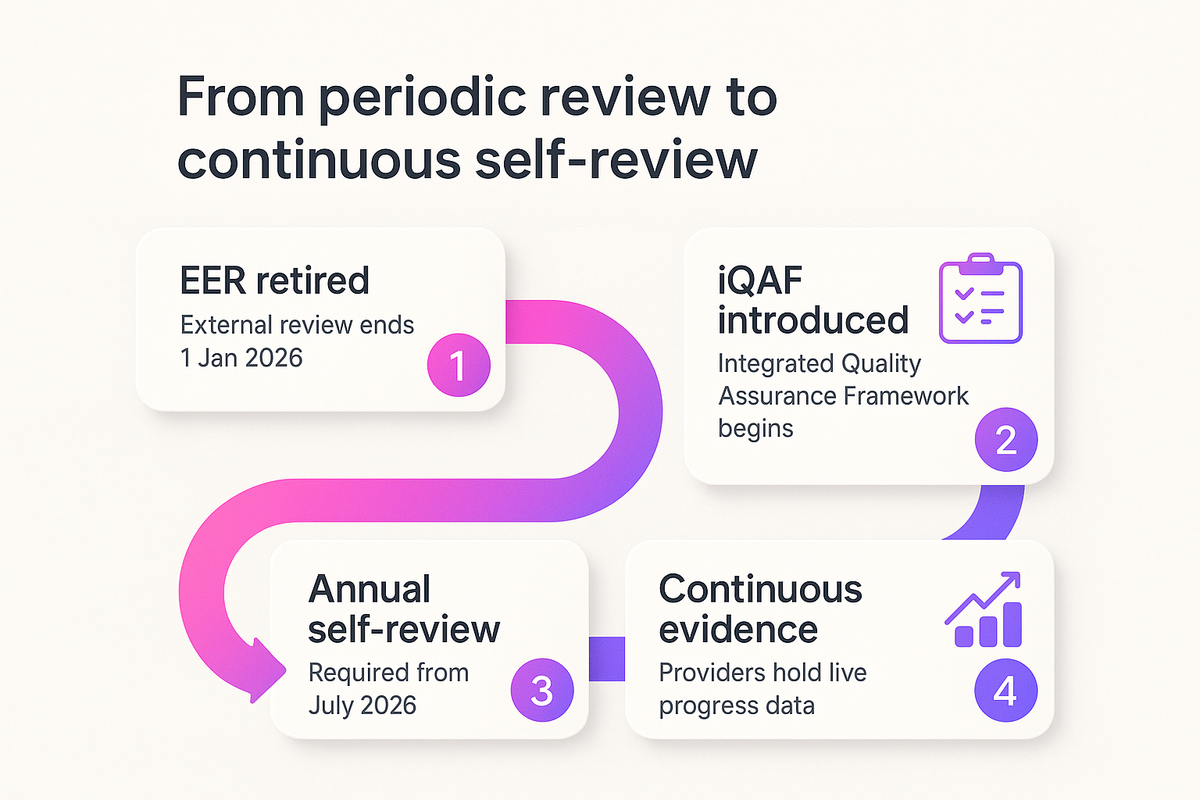
NZQA is discontinuing EER from 1 January 2026, replacing it with the integrated Quality Assurance Framework (iQAF). From July 2026, tertiary education organisations must submit an annual organisation self-review. NZQA has been explicit about the intent behind this: it wants to "take full advantage of the data and systems across agencies so we can use these individual insights and have a better shared view of performance." Read plainly, that's a shift from an external body checking your evidence periodically, to you being expected to hold live evidence of learner progress continuously, and prove it once a year rather than once every few.
That expectation is landing at the worst possible moment for trainer capacity. The disestablishment of Te Pūkenga into ten regional polytechnics and Industry Skills Boards from 1 January 2026 has come with more than 150 role cuts across institutes of technology and polytechnics, and reports of significant burnout among remaining staff. Fewer trainers means fewer people positioned to notice a learner quietly disengaging — which is exactly the signal the new framework assumes you're tracking.
The completion numbers behind the pressure
This isn't an abstract governance shift. Vocational Education Minister Penny Simmonds said in November 2025 that she was concerned fewer than half of trainees complete their apprenticeships, calling incomplete training "a waste for those individuals that start and don't complete." National figures back the concern: qualification completions fell 6.9% in 2025, to 16,090 completions, even as the three-year qualification completion rate rose to 54%. Overall trainee and apprentice numbers also declined.
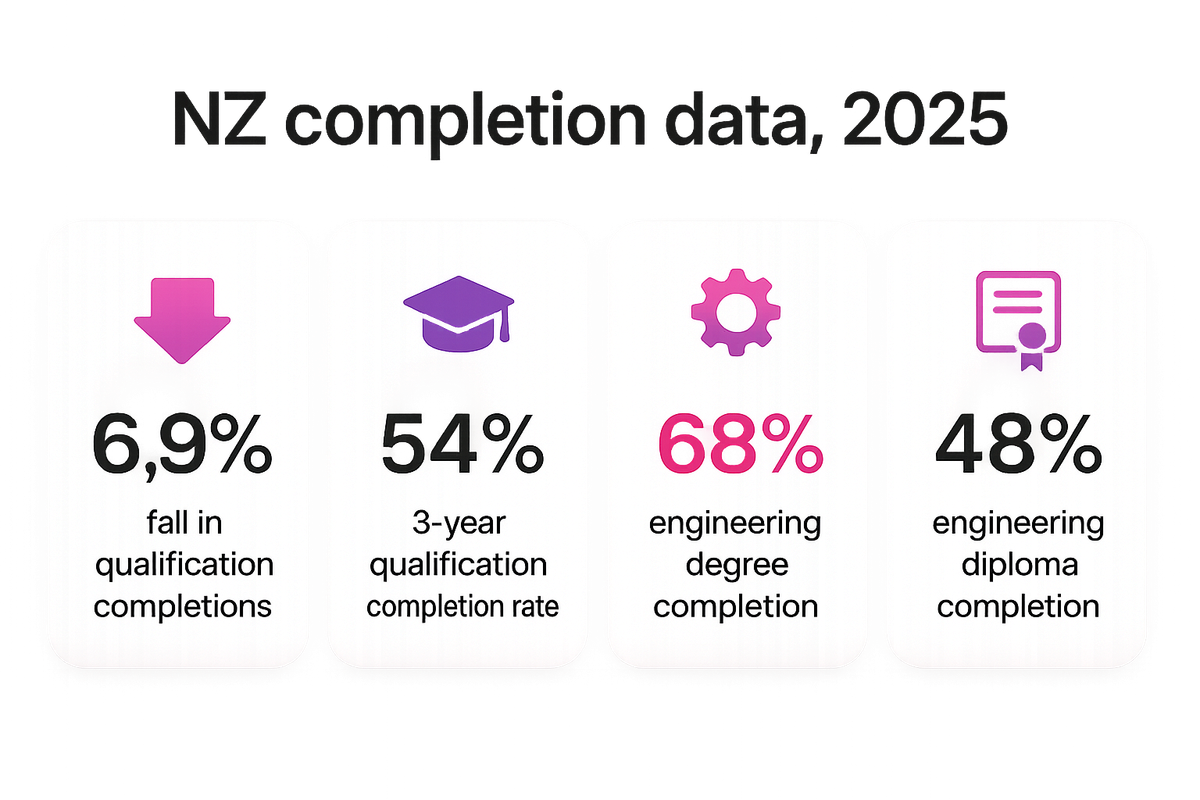
Those two figures moving in different directions is the point. A rising three-year completion rate looks reassuring in a board pack, but it's an average of learners who started years ago — it tells you nothing about who in this year's cohort is drifting right now. Engineering sector data shows why granularity matters: 68% completion at degree level versus 48% at diploma level. A sector-wide or even provider-wide average can hide a diploma cohort that's in real trouble behind a healthier degree cohort.
Why annual and cycle-end reporting can't catch it in time
Annual self-review and three-year completion rates are lagging indicators by design — useful for demonstrating accountability after the fact, useless for intervening while it still matters. If the first time you see a learner's disengagement is at a TAS checkpoint or a moderation sample, you're looking at a symptom that's already weeks or months old.
Funding settings now assume you can act earlier than that. From 1 January 2025, Fees Free support for final-year apprentices only reimburses eligible fees, up to $12,000, on completion — not on enrolment, not on attendance. Apprenticeship Boost has narrowed to first-year apprentices in targeted shortage sectors. Both levers are built on the assumption that providers can identify a learner at risk of not finishing well before the final stretch, when there's still time to change the outcome. If your visibility only improves at reporting time, you're structurally unable to use these levers as intended.
What live visibility actually requires
None of this means throwing out TAS processes or moderation — they're still how you demonstrate assessment quality and consistency across trainers, and iQAF hasn't removed that obligation. What it changes is the cadence underneath them. A few practical shifts worth testing this quarter:
- Treat engagement signals (missed sessions, stalled assessment submissions, slipping practical hours) as a weekly review item for at-risk cohorts, not an end-of-block one.
- Break completion data down by programme level, not just by provider — the degree-versus-diploma gap in engineering shows why an averaged figure can mask a struggling group.
- Build the annual self-review file progressively, from evidence you're already generating in delivery, rather than reconstructing it in the weeks before submission.
- Be explicit with your team about which learners are flagged and why, so a stretched trainer roster isn't relying on memory or informal handover to catch someone slipping.
None of this fixes the underlying capacity problem. Fewer trainers covering more learners will always mean some signals get missed. But the providers most exposed under iQAF won't be the ones with imperfect capacity — they'll be the ones with imperfect visibility into what that capacity is missing.
Key takeaways
- NZQA is retiring EER from 1 January 2026 in favour of the integrated Quality Assurance Framework, with annual organisation self-review required from July 2026 — shifting the evidence burden onto providers, continuously.
- Fewer than half of apprentices complete, per the Vocational Education Minister's November 2025 comments, while qualification completions fell 6.9% in 2025 even as the three-year completion rate rose to 54% — averages that can hide in-cohort risk.
- Engineering completion data (68% degree vs 48% diploma) shows why progress tracking needs to be granular by programme level, not just sector-wide.
- Te Pūkenga's disestablishment has come with 150+ role cuts and reported burnout across institutes of technology and polytechnics, reducing the trainer capacity providers rely on to catch at-risk learners early.
- Fees Free and Apprenticeship Boost settings now reward early intervention, not end-of-cycle reporting — completion-linked funding assumes you can see risk before the final stretch.
Our take
The sector conversation about iQAF has mostly focused on what the annual self-review document needs to contain. That's the smaller problem. The bigger one is that most training teams still generate progress evidence in bursts — around TAS, around moderation, around reporting deadlines — rather than as a continuous by-product of delivery. Regulators moving to continuous self-review is really a bet that providers can make that shift. Some will do it by tightening internal reporting rhythms. Others are starting to look at where AI-supported coaching and practice can surface engagement and competency signals directly from how learners are performing in role plays, simulations and guided practice, week to week, rather than waiting for a formal assessment point. Tools like Nova, built by Supahuman, are one example of that direction — but the discipline of watching learner progress continuously, not periodically, is the part every Head of Training needs regardless of what generates the evidence.
FAQ
Does EER still apply to my organisation in 2026? No. NZQA is discontinuing External Evaluation and Review from 1 January 2026 and replacing it with the integrated Quality Assurance Framework, with annual organisation self-review required from July 2026.
What is NZQA actually looking for under the new framework? NZQA has said it wants a better shared view of performance by drawing on data and systems across agencies, pointing toward risk-informed, assessment-focused monitoring rather than periodic EER-style categorisation.
Why did completions fall in 2025 if the three-year completion rate went up? Qualification completions fell 6.9% in 2025 to 16,090, while the three-year completion rate rose to 54% — the two measures track different cohorts over different timeframes, so a rising long-run average can coexist with a weaker current year.
How does the Te Pūkenga restructuring affect my ability to track learner progress? The disestablishment into ten regional polytechnics and Industry Skills Boards from 1 January 2026 has coincided with over 150 role cuts and reported burnout across institutes of technology and polytechnics, directly reducing the trainer capacity available to notice and support learners before they fall behind.