LLN Assessment Design: From Checkbox to Compliance
8 September 2026 · 7 min read

LLN Assessment Design: From Checkbox to Compliance
Under the Standards for RTOs 2025, language, literacy, numeracy and digital (LLND) screening now has to happen before a prospective student enrols, not somewhere in week one of training. At the same time, the Training Package Organising Framework is forcing foundation skills into the structure of the unit of competency itself, which means bolting an LLN module onto finished training materials is no longer good enough.
What actually changed on 1 July 2025?
The Standards for RTOs 2025 came into force on 1 July 2025, and Performance Indicator 2.2.2a is doing most of the work here. It requires RTOs to review a prospective student's LLND capabilities against the specific requirements of the training product before enrolment is finalised — not after the first class, not during induction week.
That timing shift matters more than it sounds. Under the old approach, plenty of RTOs treated LLN screening as something you did once a learner was already committed, largely to satisfy a compliance file rather than to genuinely inform whether the qualification was a fit. Performance Indicator 2.2.2a closes that gap by making the review a gate, not a formality.
Why LLN is now LLND
Digital literacy has been formally folded into the acronym, so the sector standard is now LLND rather than LLN. That's not cosmetic. It means assessment design has to map against:
- The Australian Core Skills Framework (ACSF), for language, literacy and numeracy, and
- A digital literacy skill framework, to capture capabilities like navigating an LMS, submitting evidence online, or using workplace digital systems.
An RTO whose pre-enrolment tool only tests reading and numeracy is no longer covering what the Standards for RTOs 2025 actually ask for.
How the Training Package Organising Framework changes unit design
The Training Package Organising Framework (TPOF), also in effect from 1 July 2025, introduces a new Application of Skills and Knowledge (ASK) unit format on training.gov.au. This restructures how foundation skills are documented inside units of competency, rather than leaving them to be inferred by whoever happens to be writing the training material.
Practically, this means:
- Foundation skills requirements are meant to be visible in the unit's structure, not just implied by task descriptions.
- Assessment design has to start from what the unit actually specifies, rather than a generic LLN overlay applied after the fact.
- Trainer interpretation is being narrowed as a source of foundation-skills coverage — the unit itself should carry more of that evidence.
For RTOs still running assessment tools built years before TPOF, this is a genuine re-mapping exercise, not a light edit.
What auditable evidence does ASQA now expect?
Operational guidance circulating in the sector (including a widely referenced compliance checklist from LLND Architect) sets out what auditors are looking for in practice. At minimum, that's:
- A documented LLN benchmark for each qualification.
- A contextualised pre-enrolment suitability review tool — generic, off-the-shelf screening isn't enough.
- Documented timing showing the LLND review happened before enrolment was finalised.
- Assessment results benchmarked explicitly against the qualification's requirements, not against a general literacy scale in isolation.
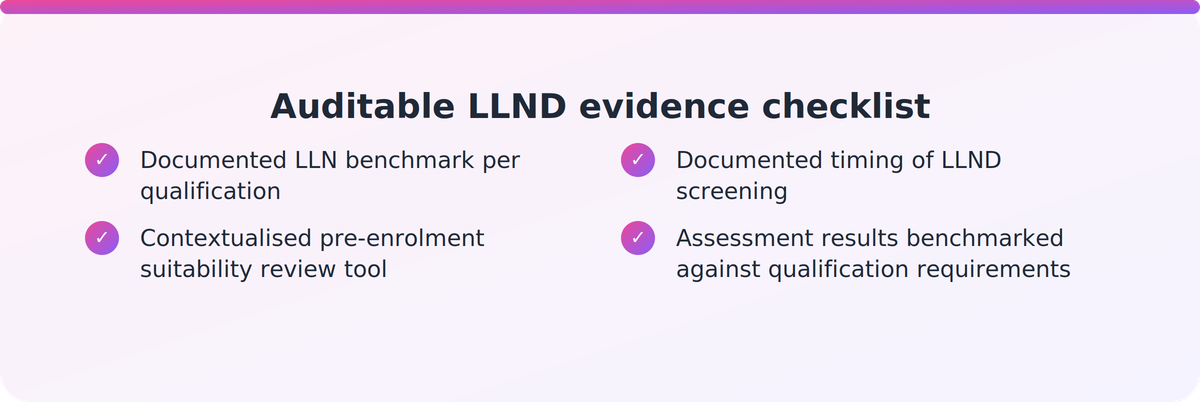
If any one of those four is missing or undocumented, that's the kind of gap a Standards for RTOs 2025 audit is now built to find.
Embedding beats bolting on
Industry guidance, including practice notes from Precision RTO Resources, is consistent on one point: LLN support works better woven into learning content, practice activities and assessment preparation for the actual vocational task, rather than delivered as a standalone module a learner completes before or after the "real" assessment.
That's a design philosophy as much as a compliance requirement. A carpentry apprentice practising measurement conversions inside a costing exercise is getting numeracy support that's directly relevant to the unit. A generic numeracy quiz sitting outside the unit isn't doing the same job, even if it technically satisfies a screening checkbox.
For RTOs supporting ESOL learners, workplace-based cohorts, or mixed-mode delivery across classroom and distance, this embedding has to happen multiple times over — the same unit often needs genuinely different contextualisation for different learner groups, not one assessment stretched to cover everyone.
The 2026 complication: proving the work is genuine
ASQA's 2026 risk priorities put academic integrity and AI-generated content authenticity near the top of the agenda. That creates a real tension for embedded-LLN design: the more contextualisation and scaffolding you build in, the more you also need a defensible way to verify that what a learner submits is actually their own competent work.
Direct observation and viva voce remain the practical answer here — embedding foundation skills support into assessment doesn't remove the need for a trainer to genuinely watch, question and judge. A July 2026 feature on the Supahuman VETos platform via EduGrowth made a similar point: mapping, drafting, TAS management, validation prep and contextualising for ESL or low-literacy learners are the kind of repeatable, structured work that AI can reasonably support — but professional judgement of competency stays explicitly with the trainer. AI can speed up the paperwork trail; it can't sign off on whether someone can actually do the job.
Key takeaways
- Performance Indicator 2.2.2a under the Standards for RTOs 2025 requires LLND screening before enrolment is finalised, not once training has begun.
- "LLN" is now "LLND" — assessment design needs to map to both the ACSF and digital literacy skill frameworks.
- The Training Package Organising Framework's new Application of Skills and Knowledge unit format is pushing foundation skills evidence into the unit itself, reducing reliance on trainer interpretation.
- Auditable evidence now expected includes a documented LLN benchmark, a contextualised pre-enrolment tool, documented screening timing, and results benchmarked against qualification requirements.
- Embedded LLN design still needs verification — direct observation and viva voce matter more, not less, as ASQA scrutinises content authenticity into 2026.
Our take
The direction of travel here is sensible even if the workload is heavy: foundation skills support that lives inside the actual vocational task will always beat a bolt-on module, and pulling LLND screening forward to pre-enrolment protects learners from being set up to fail. But there's a real risk that RTOs respond to the compliance pressure by producing more paperwork rather than better design — a benchmark document and a screening tool that exist to satisfy an auditor, disconnected from what actually happens in the classroom or on the job. The RTOs that get genuine value from this shift will be the ones that treat unit-level foundation skills mapping and assessment contextualisation as the same design task, done once per learner cohort, rather than two separate compliance exercises stapled together after the fact.
FAQ
What does Performance Indicator 2.2.2a actually require? Under the Standards for RTOs 2025, Performance Indicator 2.2.2a requires an RTO to review a prospective student's language, literacy, numeracy and digital capabilities against the specific requirements of the training product before their enrolment is finalised.
Why is LLN now called LLND? Digital literacy has been formally added to the traditional LLN scope, reflecting that RTOs must assess a learner's digital capabilities alongside language, literacy and numeracy, mapped against both the Australian Core Skills Framework and digital literacy skill frameworks.
What is the Training Package Organising Framework's effect on foundation skills? The Training Package Organising Framework, in effect from 1 July 2025, introduces the Application of Skills and Knowledge unit format on training.gov.au, which encodes foundation skills requirements directly within units of competency rather than leaving them to be added into training materials afterwards.
What evidence should an RTO have ready for an audit of LLND compliance? At minimum: a documented LLN benchmark per qualification, a contextualised pre-enrolment suitability review tool, documented evidence of when the LLND screening occurred, and assessment results benchmarked against the specific qualification's requirements.
Does embedding LLN into assessments reduce the need for trainer observation? No. With ASQA's 2026 focus on academic integrity and AI-generated content authenticity, embedded LLN design still needs to be paired with genuine verification methods such as direct observation and viva voce to confirm the work submitted reflects the learner's own competence.