LLN Assessment Software for RTOs: A Buyer's Guide
1 October 2026 · 7 min read
No. ASQA does not require RTOs to buy a particular LLN tool or put every person through one. Under the Standards for RTOs 2025, you must review each prospective student's LLN proficiency and digital literacy in the context of the training product. You choose how to do that and how to evidence it. Software is one option, not an obligation.
What does ASQA actually require for LLN and digital literacy?
The 2025 Standards for RTOs took effect on 1 July 2025. They have three elements: the Outcome Standards, the Compliance Standards and the Credential Policy (DEWR).
ASQA's 2025 Standards FAQs set out the practical position:
- Providers must review each prospective student's LLN and digital literacy against the training product.
- Providers decide how to do and evidence that review. Options include buying a tool, building one, or gathering evidence that the student already holds an appropriate level.
- RTOs aren't required to buy a specific tool, and the Standards don't prescribe a framework.
- You have to analyse your own training products to work out what levels students need.
- The requirement covers every training product, including standalone short courses such as HLTAID009.
A caution on clause numbers. Vendors often cite "Standard 2.2" for the pre-enrolment review. We couldn't verify that against the legislative instrument, so read the text yourself before you repeat it in a policy.
The ACSF (learning, reading, writing, oral communication and numeracy) is the usual benchmark for describing performance. ASQA doesn't mandate it. One consultancy claims ASQA requires ACSF levels. That conflicts with ASQA's FAQ, so treat it as unverified.
Which job are you buying for: screening or resource generation?
"LLN assessment software" covers two different jobs, and vendors blur them.
- Screening individual learners before enrolment. This checks a person's LLN and digital literacy, records the result and triggers a decision or support.
- Building assessment resources that suit varied LLN and ESOL needs. This shapes the language, scenarios and support in the assessments and learning materials themselves.
They solve different problems. A screening tool tells you about a learner. A resource platform changes what you hand the learner. Many RTOs need both, and few products do both well. Decide which gap hurts first, then shop for that.
What should LLN assessment software for RTOs do?
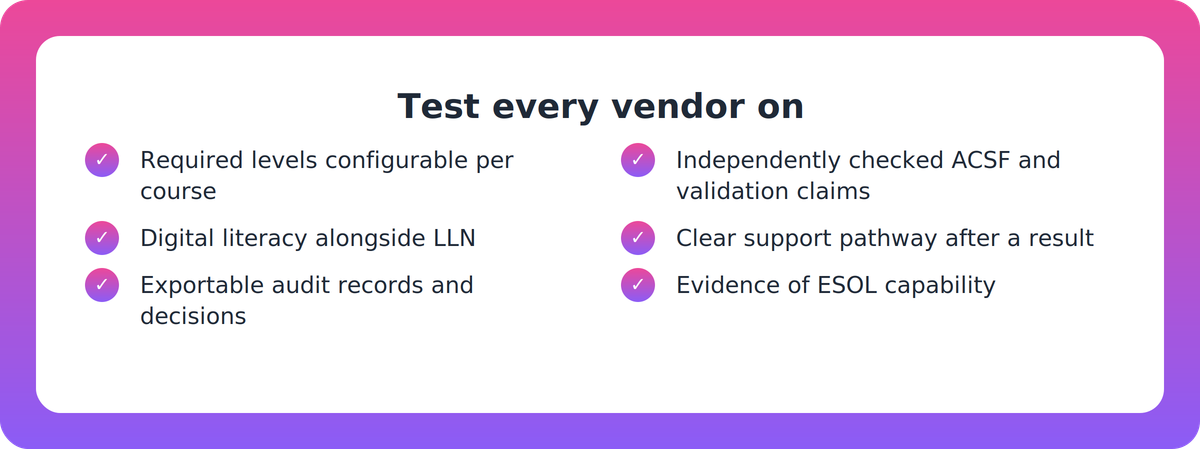
Use these criteria to compare vendors on evidence rather than labels.
- Fit to the training product. Can you configure required levels per course or unit? This matches ASQA's expectation that you analyse the product's demands.
- Digital literacy alongside LLN. The requirement covers both, so a tool that only does LLN leaves a gap.
- Audit evidence. Look for retained, exportable records of screening, results and the decisions that followed, plus a documented outcome or support plan.
- Framework mapping and validation. How do results map to ACSF levels, and how was the tool validated? Check vendor validation claims independently.
- A support pathway. Does a result lead to foundation skills support, reasonable adjustments or referral?
- ESOL readiness. See the next section.
- Human accountability. A qualified person must review results and make the decisions. Software informs the call; it doesn't make it.
- Pricing and scope. Ask what's included, how it's priced, and what the vendor says it doesn't yet cover.
How do you judge ESOL readiness?
Be sceptical here. Many tools cover only reading, writing and numeracy. eSkilled's tool, for example, covers ACSF Levels 1–2 for those areas.
We found no authoritative source on what an ESOL-specific tool must include. So the burden sits with you. Ask each vendor:
- Does it assess speaking and listening, or only written skills?
- How does it handle ACSF Pre-Level 1?
- What evidence supports its ESOL capability beyond a marketing page?
- What happens when a learner's result points to a need the tool can't assess?
Check the answers against the ACSF documentation itself, such as the Department's ACSF page.
How do you check a vendor's ACSF and validation claims?
The market is wide. 360RTO sells a downloadable workbook kit that it says assesses up to ACSF Level 3/4. eSkilled offers automatically graded online quizzes inside an LMS. A 2022 ACER report for DEWR lists bksb, RUReady, LLN Robot and CSPA as commercial online tools.
Most of what's public is vendor claims, not independent evaluation. There's no official certification or scorecard for LLN software. So:
- Ask for the validation method in writing, and who carried it out.
- Run a sample of your own learners, including some you expect to be borderline.
- Export a record and check it would stand up in an audit.
- If you deliver under VET Student Loans, check official Department guidance first. One vendor says only approved tools such as CSPA or FSAT can determine academic suitability. We couldn't verify that.
Where does an AI resource platform like VETos fit?
It fits the second job, not the first. VETos is an AI workspace for Australian RTOs and TAFEs that generates assessment tools, assessor guides and mapping documents. Its public pages mention built-in support for LLN, ESOL and accessibility in learning content design, and list LLN among its ASQA-friendly outputs. Industry Profiles shape examples, scenarios and language to a sector.
The gaps matter just as much. The pages we reviewed don't describe learner LLN or ESOL screening, ACSF-level mapping or reasonable adjustment workflows. If you need pre-enrolment screening, you'd likely pair it with a separate tool, or ask Supahuman directly what's covered.
As with any AI assistance, a qualified person stays accountable. The platform's own material describes a human in the loop, but you still validate and compliance-check every output.
A practical next step
Before you book a single demo, write down which job you're buying for and the required levels for your three biggest courses. Then send every vendor the same eight questions from the criteria list above. Compare their answers side by side. You'll learn more from the gaps than from the feature lists.
Key takeaways
- ASQA requires a documented review of LLN and digital literacy per prospective student, not a specific tool or framework.
- Separate the two jobs: screening learners, and building resources suited to varied LLN and ESOL needs.
- Weigh audit-ready records, digital literacy coverage, configurable levels and a clear support pathway.
- Treat ESOL, ACSF and validation claims as unverified until the vendor shows evidence.
- A qualified person owns the decisions. AI and software assist; they don't replace validation or judgement.
Our take
The label "LLN assessment software" hides more than it tells you. We'd start from your training products and the evidence you need to hold, not from a vendor shortlist. Be wary of any tool that promises compliance in a box, because ASQA hasn't certified one. The best purchase is the one you can explain to an auditor in two minutes.
FAQ
Does my RTO have to buy an LLN assessment tool?
No. ASQA says RTOs aren't required to buy a specific LLN or digital literacy tool, or to put every person through one. You must review each prospective student's LLN and digital literacy in the context of the training product, and be able to evidence how you did it.
Is the ACSF mandatory?
No. The ACSF is the usual benchmark for describing performance, but ASQA doesn't mandate it and the 2025 Standards don't prescribe a framework. If a vendor or consultant says otherwise, check ASQA's FAQs.
Is learner screening the same as generating LLN-appropriate assessments?
No. Screening reviews an individual prospective learner and records the outcome. Resource generation builds assessments and materials that suit varied LLN and ESOL needs. Many RTOs need both, and few products cover both.
How do I judge whether a tool is ESOL-ready?
Ask about speaking and listening coverage, how it handles ACSF Pre-Level 1, and what evidence supports the claim. Many tools only cover reading, writing and numeracy. We found no authoritative source on ESOL tool requirements, so verify directly with the vendor and in the ACSF documentation.
Can I rely on a vendor's validation claims?
Not without checking. Most public claims are vendor-supplied, and there's no official certification or scorecard for LLN software. Ask for the validation method in writing, trial it with your own learners and test the exported audit records.