LMS Instructional Design Constraints: A Guide for RTOs
15 September 2026 · 7 min read

Your LMS was never built to teach — it was built to store, sequence and report on content. Yet in most RTOs, it quietly makes curriculum decisions instructional designers should own: what counts as a module, how feedback works, what 'complete' means. Under the 2025 Standards for RTOs, that's a compliance risk, not just a design shortcut.
Why this lands on your desk
You're the one who has to produce evidence of practice, not policy, when ASQA audits against the 2025 Standards for RTOs, which commenced 1 July 2025. Audits in 2026 assess whether systems actually operate in real delivery and assessment contexts — not whether a policy document exists on a shared drive.
You also own the LMS integration decisions that determine whether a unit like CHCDIV002 gets genuinely contextualised treatment, or gets bolted onto whatever generic template the platform makes fastest to build. And you're accountable for keeping content current against constant training package change, while budgets and design cycles stay exactly as slow and expensive as they've always been. Learner completion and engagement now sit against pre-training assessment and fit-for-purpose design — not just LMS-reported click data. That's a different bar, and it's yours to clear.
The LMS is not a neutral pipe
Academic work on learning management systems has a term for what most instructional designers already suspect: the hidden curriculum. LMS platforms have been described as ideological structures that script pedagogy through their defaults — linear progression, time-limited assessment, centralised oversight — often without anyone in the organisation naming the influence out loud.
A 2026 study in Learning, Media and Technology goes further, finding that LMS design directly constrains faculty autonomy and reshapes feedback practices, redistributing responsibility away from learners and toward the platform's built-in oversight mechanisms. A separate 2026 Springer Nature study looked specifically at LMS deployment enablers, barriers and challenges across VET institutions, including Australian settings — giving instructional designers in this sector a peer-reviewed reference point rather than just a gut feeling that the platform is steering the design.
None of this means your LMS is badly built. It means it was built to do something — manage delivery at scale — and that something is not the same job as designing a learning experience against regulatory and cultural intent.
The regulatory shift: outcomes, not paperwork
The 2025 Standards for RTOs move ASQA's attention from written policy to demonstrated outcomes in real delivery and assessment settings. That shift has a specific consequence for instructional design: the Outcome Standards include a named trainer and assessor competency clause — Part 3, Division 2, Standard 3.2(c) — which makes educator and design capability itself a compliance object, not an assumed input.
Practically, that means a module that looks compliant because it follows the LMS's standard shape — intro video, reading, quiz, tick — is no longer enough. Auditors in 2026 are testing against these Standards, not legacy practice. If your design evidence is really evidence of the platform's template rather than evidence of learning, that's now visible.
Training package churn and the debt this creates
Sector workforce research names constant training package change as a core, structural driver of compliance workload and content maintenance burden. Every time a unit of competency updates, someone has to rebuild the content that sits behind it.
This is where LMS defaults compound the problem rather than solve it. When a curriculum is built as one long linear sequence inside a generic template, updating a single unit often means unpicking the whole thing — not swapping a component. Design debt isn't just an inconvenience; it's the reason the same outdated scenario or case study is still sitting in a course two training package versions later, because pulling it out means rebuilding around it.
Cultural competency is the sharpest test case
Cultural competency in VET isn't a generic add-on — it's delivered through nationally recognised, assessable units: CHCDIV002 (Promote Aboriginal and/or Torres Strait Islander cultural safety) in the CHC Training Package, and AHCOCM303 (Follow Aboriginal and/or Torres Strait Islander cultural protocols) in the AHC Training Package. Both demand contextualised design — treatment that reflects the specific learner cohort, industry context and community relationships involved, not a templated module dropped in because the LMS made it the path of least resistance.
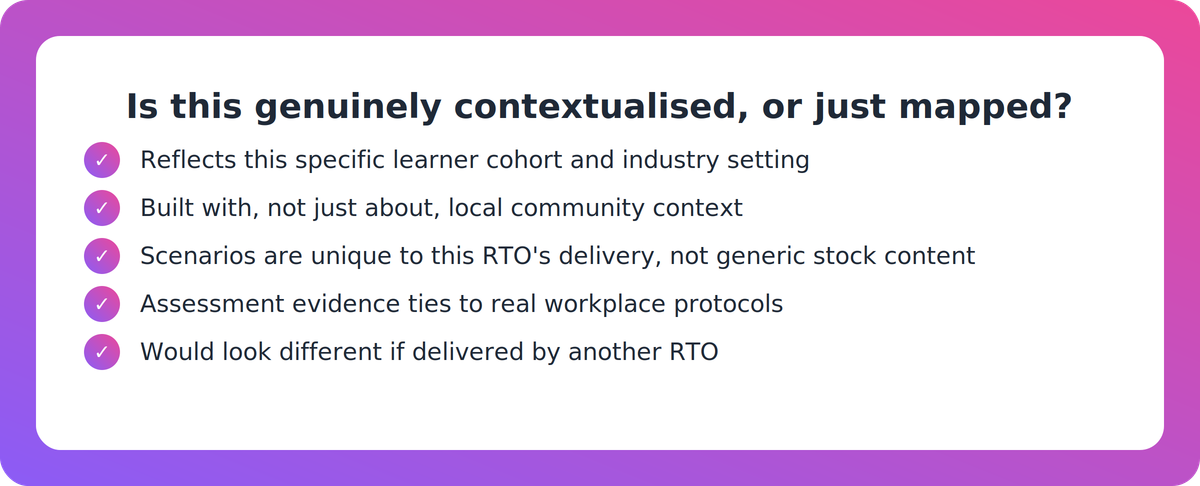
A generic e-learning shell can technically map to these units and still fail their actual intent. That gap between 'mapped' and 'contextualised' is exactly the kind of shallow compliance evidence the outcomes-based Standards are now built to catch.
Design first, fit the platform second
Here's the uncomfortable part: many instructional designers weren't trained to notice any of this. A 2026 review of Australian university learning-design programs found that LMS or authoring-tool competency — Canvas, Moodle, whatever your RTO runs — isn't formally assessed anywhere in the curriculum. Designers often learn platform constraints reactively, on the job, rather than being taught to design around them from day one.
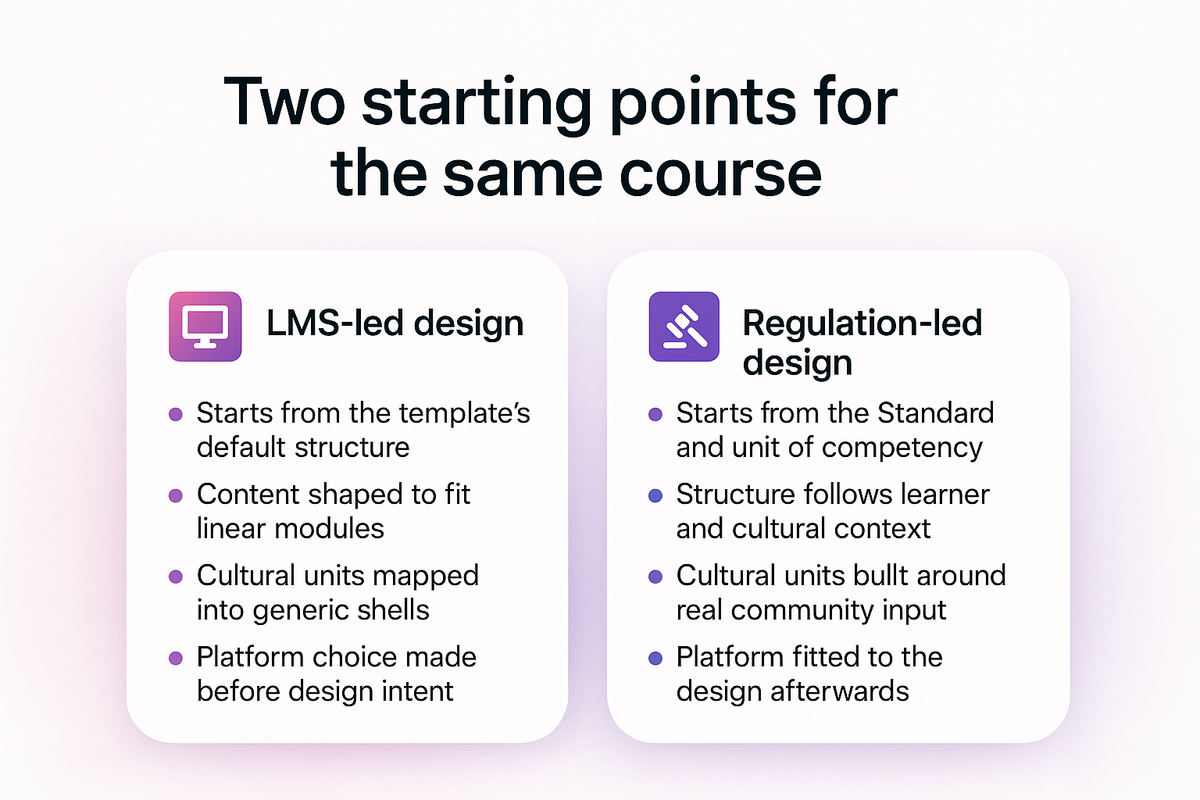
The sharper practice for 2026 is to reverse the usual order. Start from what the Standard and the unit of competency actually require — the evidence of practice, the cultural context, the assessment intent — and only then decide how the platform will carry it. Sometimes that means building outside the default template. Sometimes it means accepting a workaround. But the platform should be the last decision, not the first.
Key takeaways
- The 2025 Standards for RTOs, in force since 1 July 2025, judge instructional design on demonstrated outcomes in real delivery contexts — not on policy documents or LMS activity logs.
- Research describes LMS platforms as functioning like a hidden curriculum, scripting pedagogy and feedback through their defaults, often invisibly to the people using them.
- Constant training package change is a named, structural driver of design debt — and linear, template-locked LMS builds make that debt harder to pay down, not easier.
- Cultural competency units such as CHCDIV002 and AHCOCM303 require genuinely contextualised design, which generic LMS templates are structurally poor at supporting.
- Australian learning-design education doesn't formally teach LMS or authoring-tool competency, so many designers inherit platform constraints reactively rather than designing around them deliberately.
Our take
The instinct to let the platform lead is understandable — it's faster, and the module deadline doesn't care whether your design is philosophically sound. But 'faster to build' and 'faster to defend at audit' have started to pull apart under the 2025 Standards, and that gap is only going to widen as ASQA's 2026 audits bed in. The RTOs that come out ahead here won't be the ones with the newest LMS. They'll be the ones whose instructional designers treated the platform as a tool to be argued with, not a template to be filled in.
FAQ
Does the LMS itself need to be ASQA-compliant, or is it the content and evidence that matters? ASQA's Standards for RTOs assess evidence of practice and outcomes in real delivery and assessment contexts — the platform is a delivery mechanism, but the design, feedback loops and evidence it produces are what's actually being audited.
How do I know if a unit like CHCDIV002 has been genuinely contextualised versus just templated? Ask whether the content, scenarios and assessment reflect the specific learner cohort, industry and community context it's being delivered into. If it would look identical dropped into any RTO's CHC delivery, it hasn't been contextualised — it's been mapped.
Why does training package churn create so much design debt specifically inside LMS-built courses? Sector workforce research names constant training package change as a core structural pressure. When content is built as one linear, template-locked sequence, a single unit update often forces a rebuild of the whole course rather than a swap of one component.
Is 'design first, platform second' realistic given how tight design timelines already are? It front-loads more thinking, not necessarily more hours — because the real cost is usually paid later, when a template-locked course has to be unpicked to meet an updated unit of competency or an audit finding. Deciding structure against the Standard first tends to reduce that downstream rebuild cost.