LMS Integration Is a Design Problem, Not an IT Task
29 September 2026 · 6 min read
A broken LMS integration in New Zealand's vocational sector is almost never really about integration. It's a design decision that was never anchored to a standard, a review cycle, or a cultural framework — and the LMS is simply where that gap finally shows up, usually during a self-review or an NZQA monitoring visit.
Why this hits your desk
You already carry the tension between speed and rigour. Content needs to go live, but every learning outcome you host now has to trace back to a specific entry on the Directory of Assessment and Skill Standards — and since 1 January 2026, that directory is owned by eight newly formed Industry Skills Boards, not the Workforce Development Councils you may have mapped against last year. Get the mapping wrong and it isn't a broken hyperlink. It's a compliance gap with your provider's name on it.
At the same time, NZQA's integrated Quality Assurance Framework, live from 15 January 2026, requires providers to show "adequate and effective processes for the ongoing review of the programme" and for "monitoring the quality of outcomes for learners." That means the structure of your LMS content — how it's versioned, how outcomes are tagged, how review dates are tracked — is now part of the evidence an assessor will actually look at, not just the delivery mechanism sitting underneath it.
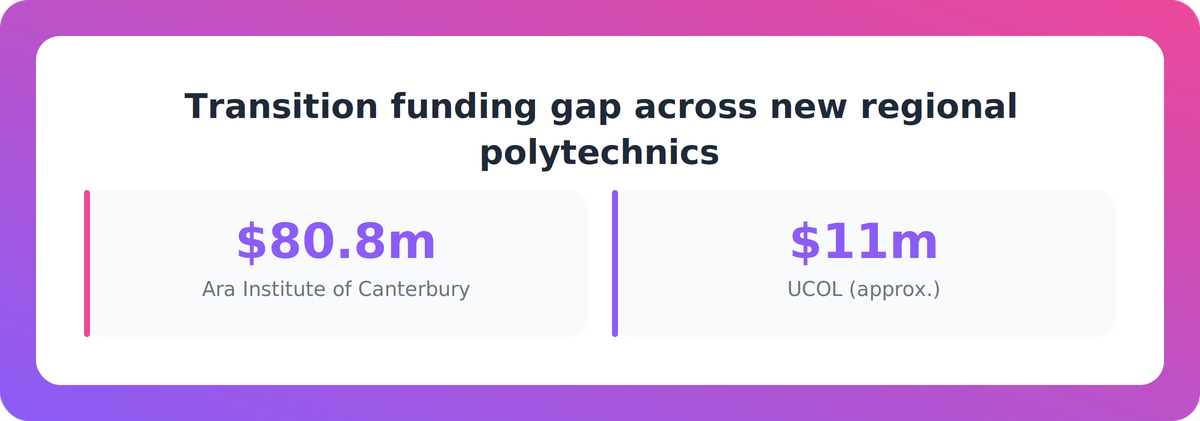
And you're doing all this with wildly uneven resourcing. The ten regional polytechnics re-established after Te Pūkenga's dissolution didn't get equal transition funding: Ara Institute of Canterbury received NZ$80.8 million, while UCOL received roughly NZ$11 million. Same compliance bar, very different capacity to rebuild content properly.
The compliance trail now runs through your course structure
Under the Programme Approval, Recognition, and Accreditation Rules 2026, no vocational programme can be offered without endorsement from the relevant Industry Skills Board, and content must map to standards listed on the DASS. That's a straightforward requirement in principle. In practice, it means every module, assessment, and resource you load into the LMS needs a clean, traceable line back to a live standard — not a standard you mapped against six months ago that has since been superseded.
The complication: ISBs are still in an early build phase through the first half of 2026, establishing governance, standards, and endorsement processes. That's a genuine rework risk. If you hard-code content structure too rigidly against standards that are still being finalised, you're building debt into the LMS on day one.
iQAF turns your LMS into an audit artefact
The old Evaluative Quality Assurance Framework is gone, replaced by a simpler compliant/non-compliant model that still demands an up-to-date quality management system and annual self-review. One overlooked detail: as EER category ratings are phased out, any provider material still referencing an old EER category — including legacy LMS content — now needs an accompanying compliance statement under Rule 10. That's not a footnote. It's a direct reminder that outdated design assets carry real regulatory exposure, sitting in your course shells whether anyone remembers to check or not.
Capacity to fix this varies wildly across the sector
If you're at a provider that came out of the Te Pūkenga transition with strong funding, you have room to rebuild LMS content properly this year. If you're not, you're facing the same NZQA expectations with a fraction of the design hours. That gap isn't going to show up in the Rules — it'll show up in how much rework debt gets carried forward, and who's still patching legacy structures come the next self-review.
Cultural competency has to be structural, not cosmetic
The Education and Training Act 2020 commits the sector to culturally responsive education reflecting the Crown's Te Tiriti o Waitangi obligations, and NZQA's Te Hono o Te Kahurangi offers a distinct evaluative quality assurance pathway for organisations working through kaupapa Māori and mātauranga Māori — now referenced directly within the 2026 Rules for standard listing and programme approval. Treating the LMS as a neutral pipe that content simply flows through will miss this. It has to be a design choice made when you first structure a course, not a layer added afterwards.
Building for a standard that might still move
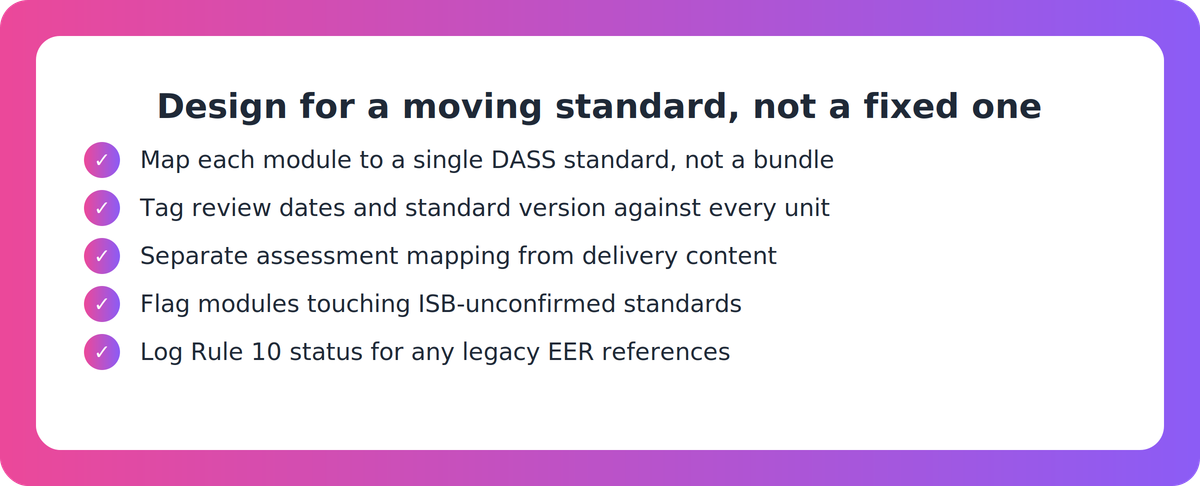
Given ISBs are mid-build, the safer instructional design pattern for 2026 is modular: build content in units that map to individual standards rather than monolithic courses that assume a fixed structure. That way, when an ISB finalises or revises a standard, you're re-pointing a module, not rebuilding a qualification.
Key takeaways
- Every LMS learning outcome must trace to a live DASS entry owned by the relevant Industry Skills Board — not the Workforce Development Council mapping you may have used last year.
- Under iQAF, LMS content structure is part of the evidence NZQA examines for ongoing programme review and learner outcome monitoring, not just a delivery layer.
- Legacy content still referencing old EER categories needs a Rule 10 compliance statement — check your course shells now.
- Transition funding across the ten new regional polytechnics is uneven (NZ$80.8 million for Ara vs roughly NZ$11 million for UCOL), so design capacity to fix this properly varies sharply by provider.
- Te Tiriti and Te Hono o Te Kahurangi obligations mean cultural competency needs to be built into course structure from the start, not retrofitted.
Our take
The instinct under pressure is to treat the LMS as the last step — content gets designed, then it gets "integrated," as if that's a technical handover. In this regulatory moment, that instinct will cost you. The Rules, the DASS mapping, and the Te Tiriti obligations aren't sitting beside your LMS structure; they're supposed to be legible inside it. Instructional designers who build modular, clearly tagged, versioned content — with review dates and standard references baked in rather than bolted on — are the ones who'll sail through a monitoring visit while others scramble to explain why half their course shells still reference a category that no longer exists. Given how unevenly resourced the sector is right now, that discipline matters more for the providers with less capacity, not less.
FAQ
Do I need to remap all existing LMS content to the new DASS listings immediately? Any programme currently offered needs ISB endorsement and a traceable link to a listed standard under the Programme Approval, Recognition, and Accreditation Rules 2026. Since ISBs are still finalising standards through the first half of 2026, prioritise mapping for programmes due for review or renewal first, and build modular structures so re-mapping later doesn't mean a full rebuild.
What happens to LMS content that still references an old EER category? Under Rule 10 of the Quality Assurance of Tertiary Education Providers Rules, any provider material — including legacy LMS content — still referencing a superseded EER category now needs an accompanying compliance statement. Worth an audit of course shells and resource banks this quarter.
How do I design against standards that Industry Skills Boards might still change? Build in modules that map to individual standards rather than fixed monolithic courses. That limits rework to the affected module if an ISB revises a standard mid-year, rather than forcing a rebuild of the whole qualification structure.
Is cultural competency now a formal requirement in LMS content design, or is it discretionary? It's statutory. The Education and Training Act 2020 commits providers to culturally responsive education under Te Tiriti o Waitangi, and NZQA's Te Hono o Te Kahurangi pathway is referenced directly within the 2026 Rules for standard listing and programme approval — meaning it needs to be structural in your design, not an add-on module.