Measuring Learning Effectiveness: Beyond Completion Rates
9 September 2026 · 7 min read

Measuring Learning Effectiveness: Beyond Completion Rates
Australian L&D teams are quietly retiring completion rates as their top-line success measure. Buyer research and industry commentary for 2026 point to the same gap: finishing a course tells you nothing about whether someone can perform differently on the job. The fix most often cited is repeated, coached practice — not another dashboard.
What's actually changing in 2026 buyer expectations
Compono's *Corporate LMS Australia 2026* buyer's guide describes a market moving away from basic compliance tracking toward platforms that build capability. Organisations are now expected to tie training directly to performance and engagement outcomes, not just record that someone logged in and clicked through.
The same research flags two things as now-standard procurement requirements alongside performance-linked measurement:
- Local data sovereignty for learner data
- Alignment with the Australian Signals Directorate's Essential Eight
That pairing is telling. Buyers aren't just asking "did people finish the training" — they're asking whether the platform can prove impact securely and locally, treating measurement as a governance issue as much as a learning one.
Why "finished the course" stopped being enough
Australian commentary from Karstens (2026) draws on LinkedIn's Australian workforce data, which identifies AI literacy, communication and adaptability as the fastest-growing skills locally in 2025. The argument that follows is blunt: L&D teams should be measuring demonstrated skills and workplace application, not "activity-based measures such as the number of courses delivered."
That's a meaningful reframe. A completion rate answers "did they attend." It says nothing about whether a salesperson handles an objection better, a team leader gives clearer feedback, or a support agent de-escalates a difficult call. Skillshub's 2026 trend forecast names this directly as an industry-wide priority: stronger measurement and impact stories that move beyond completion rates to show behaviour change and business outcomes.
What the regional data shows
Measurement investment appears to be rising alongside the critique of completion rates. A Learning Technologies Group survey covering Australia and New Zealand found 91% of L&D leaders now say they measure programme impact, and 84% of ANZ respondents saw budget increases in 2025.
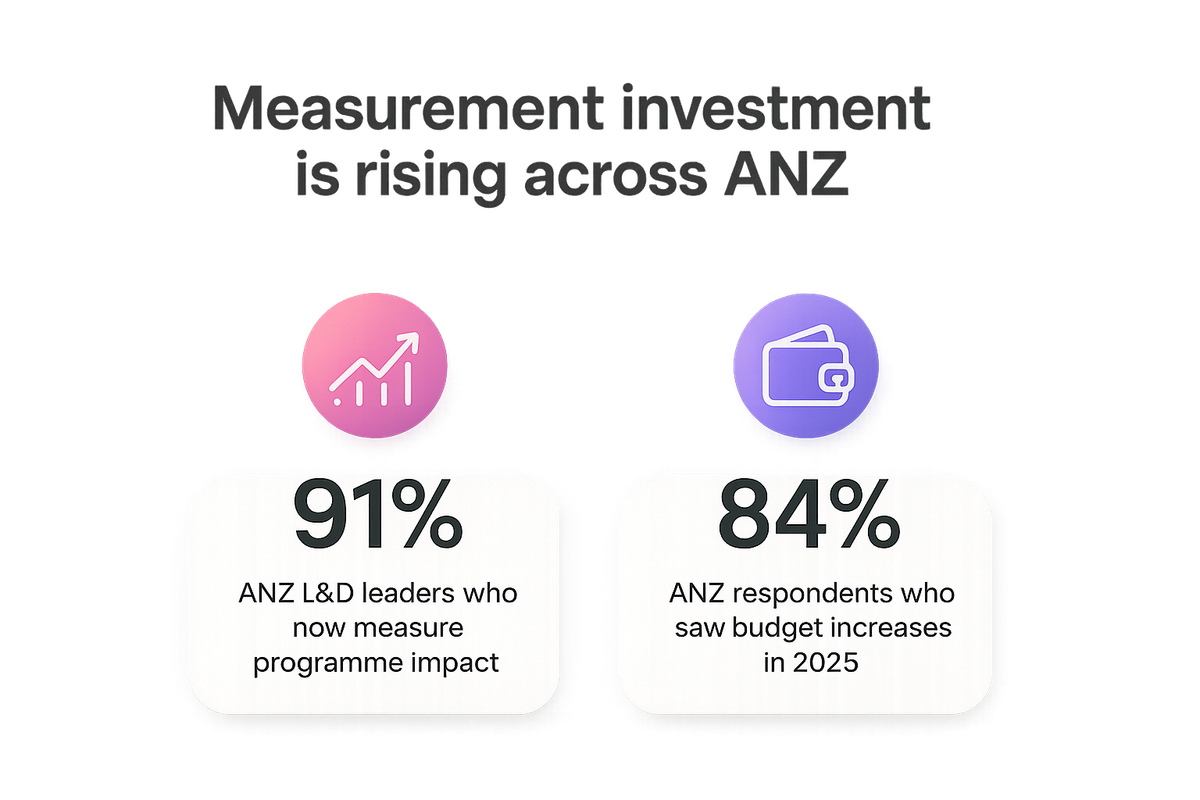
That figure blends Australian and New Zealand respondents, so it should be read as regional context rather than an Australia-only statistic. Still, it's a useful signal: budgets are growing at the same time buyers are demanding sharper proof of what that spend actually changes.
International practitioner sources add a comparative data point worth noting cautiously. A US-origin ATD benchmark links comprehensive training measurement to markedly higher income per employee. It's not an Australian figure, and it shouldn't be quoted as one — but directionally it supports the same case: organisations that measure properly tend to get more out of training spend.
The AQF parallel: proof of competency, not proof of enrolment
Here's a comparison Australian RTOs will recognise immediately, even if the framing is new for corporate L&D. The Australian Qualifications Framework and the Standards for RTOs 2025 don't accept attendance as evidence of learning. A learner has to demonstrate competency against units of competency in a training package before an RTO can issue a qualification. Sitting in the room isn't sufficient — showing you can do the task is.
Corporate L&D is now being nudged toward the same evidentiary bar. The Standards for RTOs 2025 didn't create this shift in the corporate sector, but the logic is identical: proof of applied skill matters more than proof of enrolment. For providers who already work across both vocational and corporate training, that's not an unfamiliar standard — it's the one they've been held to for years.
What proof of applied skill actually looks like
If completion rates are out, what replaces them? A few consistent themes show up across the sources:
- Pre-training baselining. Measure the skill or behaviour before training starts, so "improvement" means something specific rather than assumed.
- Business-language ROI. Frame impact in terms a finance team recognises — reduced onboarding time, fewer errors, lower rework — rather than learner satisfaction scores alone.
- Repeated, realistic practice. Commentary on reframing corporate learning as a "behaviour change engine" argues that one-off content rarely shifts behaviour; it's the repetition and feedback loop that does.
- Applied assessment, not just knowledge checks. A quiz at the end of a module proves recall. It doesn't prove someone can run the actual conversation, negotiation or safety procedure under pressure.
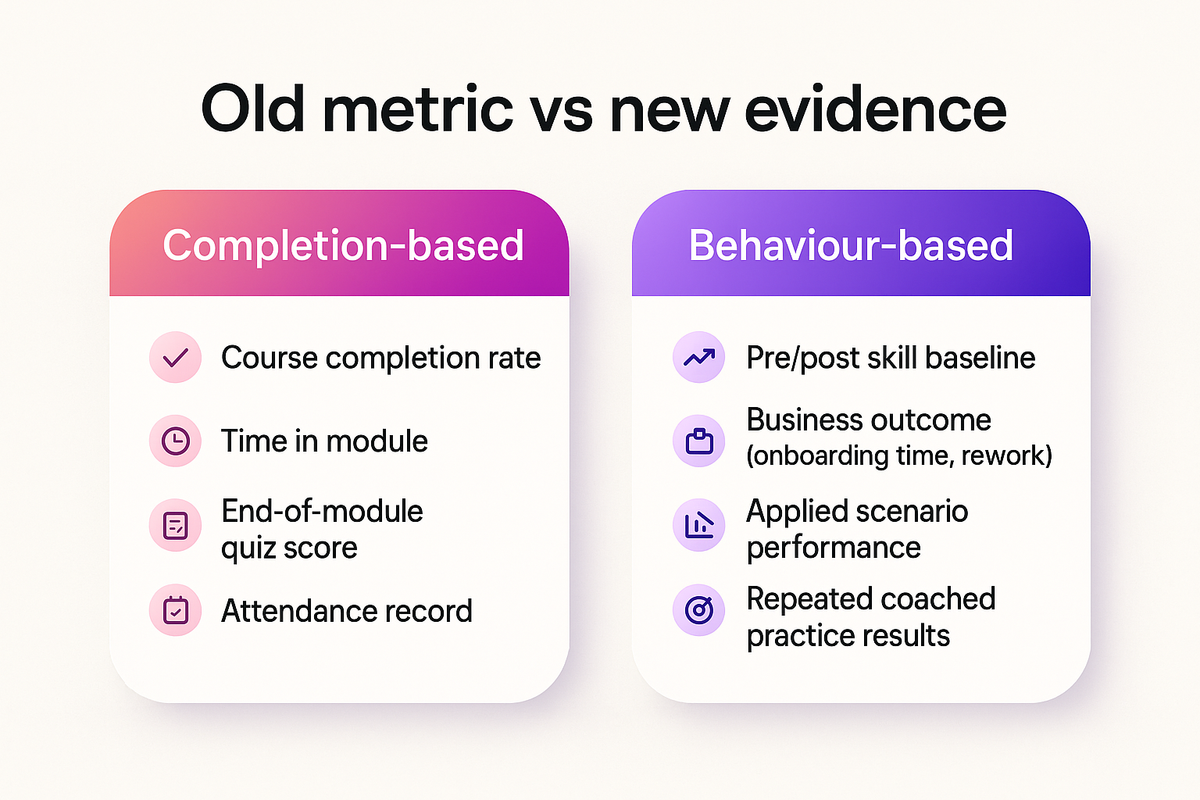
That last point is where a lot of traditional corporate training falls down. Building a realistic role play, simulation or coached scenario has historically meant scripting, hiring facilitators or actors, and iterating over weeks — expensive enough that most teams settle for a slide deck and a multiple-choice quiz instead. If the industry genuinely wants behaviour-based evidence rather than attendance records, the practice environments have to get cheaper and faster to build, or the shift stays aspirational.
Key takeaways
- Australian buyer research (Compono, 2026) shows corporate learning platforms are now expected to prove performance impact, not just log completions.
- Local data sovereignty and alignment with the ASD Essential Eight are becoming standard procurement checkboxes alongside outcome measurement.
- Karstens (2026) cites LinkedIn's Australian workforce data on AI literacy, communication and adaptability as the skills L&D should actually be tracking, not course counts.
- A regional ANZ survey found 91% of L&D leaders say they measure programme impact and 84% saw budget growth in 2025 — investment and scrutiny are rising together.
- The shift mirrors the competency-based logic already built into the AQF and the Standards for RTOs 2025: evidence of applied skill beats evidence of attendance.
Our take
The honest problem behind this trend isn't that L&D teams don't want better metrics — it's that most training content was never designed to produce measurable behaviour change in the first place. Static modules and one-off workshops don't lend themselves to before-and-after skill measurement, because there's no repeated practice to measure against. If Australian buyers are serious about tying training to performance outcomes, the design brief has to change before the measurement framework does: fewer static modules, more scenarios people actually run through more than once, with feedback each time. That's a harder thing to build cheaply than a video and a quiz, which is probably why it's taken this long to become the standard expectation rather than the exception.
FAQ
Why are Australian L&D teams moving away from completion rates? Because completion only proves attendance, not capability. Compono's 2026 buyer research and Karstens' 2026 commentary both report that Australian buyers now expect training to be tied to demonstrated skills and performance outcomes, not course-delivery counts.
What metrics are replacing completion rates? Sources point to pre-training baselining, business-language ROI (reduced onboarding time, lower rework), and applied skill assessment through realistic practice or simulation, rather than knowledge-check quizzes alone.
Is the 91% and 84% data from the LTG survey Australia-specific? No. That figure covers Australia and New Zealand combined, so it's useful as regional context on rising measurement investment, not as an Australia-only statistic.
How does this relate to the AQF and the Standards for RTOs 2025? The AQF and the Standards for RTOs 2025 already require demonstrated competency against units of competency rather than mere attendance. Corporate L&D is now being pushed toward the same evidentiary standard — proof someone can do the task, not proof they sat through training.
What skills are Australian employers prioritising in 2025–26? Karstens' 2026 commentary, citing LinkedIn's Australian workforce data, names AI literacy, communication and adaptability as the fastest-growing skills locally in 2025.