Micro-Credentials and the AQF: From Short Course to Credit
7 October 2026 · 6 min read
Micro-credentials sit outside the AQF today, and a new label doesn't change that. ATEC's May 2026 discussion paper signals an updated AQF Pathways Policy that could make credit recognition for short courses concrete. Until it lands, nationally recognised skill sets and units of competency are the clearest route for RTOs.
Where do micro-credentials sit in the AQF today?
Nowhere, formally. The AQF doesn't have a micro-credential qualification type.
The National Microcredentials Framework (Department of Education, March 2022) gives the baseline definition. A microcredential is assessed learning or competency with a minimum volume of learning of one hour, and it is less than an AQF award qualification. The definition also covers learning that is additional to, alternate to, complementary to or a component part of an AQF award qualification.
That's a definition, not a regulated product. It tells you what the word means. It doesn't tell anyone whether your short course earns credit towards a Diploma or a degree.
What has ATEC actually signalled?
The live policy pathway is credit recognition. ATEC's discussion paper, *A More Joined-up Tertiary System* (26 May 2026), notes that higher education providers increasingly offer short courses and microcredentials. It says the government intends to bring forward an updated AQF Pathways Policy for Commonwealth, state and territory ministers.
The update is meant to respond to AQF Review recommendations 9, 11 and 13. Recommendation 9 calls for guidelines to recognise shorter form credentials, including microcredentials, for credit.
This follows the 2019 Review of the AQF (the Noonan review). It proposed revising the Pathways Policy so shorter form credentials could count towards AQF qualifications. It did not propose new AQF qualification types.
So the model is credit, not a new rung on the ladder. A micro-credential stays outside the AQF unless it earns credit into something inside it.
What does a credit-bearing test look like in practice?
Universities are already drawing the line. The University of Western Australia's Micro-credentials Policy (version 05, approved 19 August 2026) is the only item the research turned up from the last 90 days, so treat it as one example, not a sector-wide rule. It is still instructive:
- A micro-credential must have an indicative AQF level.
- It must be credit-bearing.
- Short courses, executive education and professional development not approved to generate credit are excluded.
If your RTO is building pathways into higher education, expect a similar test. Level, volume and assessment evidence will matter more than the name on the certificate.
Why are skill sets and units of competency still the clearest route for RTOs?
Because they are already nationally recognised. The Department of Employment and Workplace Relations (DEWR) positions VET micro-credentials, such as skill sets, as building blocks towards full qualifications. They help people move between jobs and industries. Reform of VET qualifications and micro-credentials was a key outcome of the 2022 Jobs and Skills Summit.
There's also a regulatory angle. A secondary summary by Claire Field reports that ASQA told the AQF Review consultation that short courses could only be regulated if they were nationally recognised and offered by registered providers. We haven't verified that against ASQA's original submission, so check it before quoting it. The direction is still plain enough: the defensible short-form product for an RTO is one anchored to units of competency from a training package.
<!-- visual anchor -->
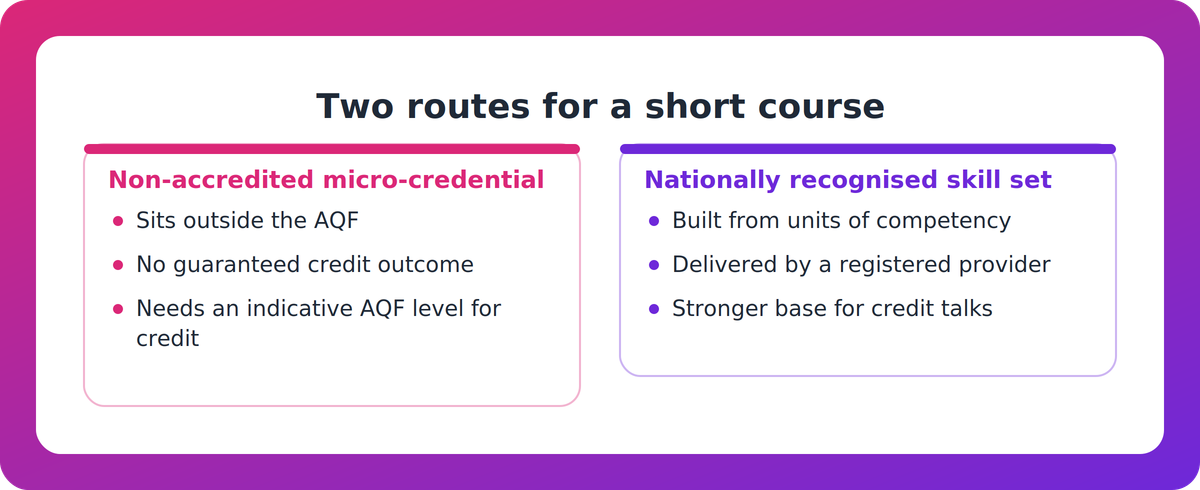
Non-accredited micro-credential vs nationally recognised skill set
The practical differences for an RTO are these:
- Non-accredited micro-credential: sits outside the AQF and has no guaranteed credit outcome.
- Skill set from units of competency: sits within the national training system and is delivered by a registered provider, which makes it the stronger base for a credit conversation.
What should RTOs do now?
The final Pathways Policy outcome isn't confirmed, and nothing here should be treated as settled until ATEC or the ministers say so. You can still prepare.
- Audit your short-course catalogue. Separate what's built on units of competency from what's standalone.
- Package skill sets deliberately. Group units into coherent skill sets that map to a real job outcome, not a random bundle.
- Prove coverage unit by unit. Every element, performance criterion and foundation skill should trace to assessment evidence. Credit conversations with universities and auditors both start there.
- Keep materials and assessment aligned. Learners shouldn't meet one thing in the content and a different thing in the task.
- Document the learner context. Be clear about the industry, the learner group and the delivery mode the assessment was built for.
Steps 3 and 4 are where most of the hours go when done by hand. It's the kind of work purpose-built tooling, such as Supahuman VETos, is designed to take on. The point stands either way: rigorous mapping is what lets a short course hold up when someone asks for credit.
Key takeaways
- Micro-credentials remain outside the AQF. The reform path is credit recognition, not a new qualification type.
- ATEC's 26 May 2026 discussion paper signals an updated AQF Pathways Policy responding to AQF Review recommendations 9, 11 and 13.
- The National Microcredentials Framework defines micro-credentials but doesn't regulate them.
- Universities such as UWA already require an indicative AQF level and approved credit, which separates credit-bearing micro-credentials from ordinary short courses.
- For RTOs, skill sets and units of competency, backed by solid coverage mapping, are the clearest route today.
Our take
The sector has spent years debating what to call short courses. The more useful question is what evidence sits behind them. Whatever the Pathways Policy says, whoever grants credit will want to see the level, the volume and proof that the assessment covers what it claims. RTOs that already work from units of competency have a head start, and those with clean, auditable mapping have a bigger one. We'd rather see providers prepare for that test now than wait for the policy wording.
FAQ
Are micro-credentials part of the AQF?
No. Non-accredited micro-credentials sit outside the AQF. The 2019 AQF Review recommended recognising shorter form credentials for credit towards AQF qualifications, not creating new AQF qualification types.
What is the National Microcredentials Framework?
It's a Department of Education framework from March 2022. It defines a microcredential as assessed learning or competency with a minimum volume of one hour, and less than an AQF award qualification. It provides a baseline definition rather than a regulated qualification type.
What is the AQF Pathways Policy update?
ATEC's 26 May 2026 discussion paper says the government intends to bring forward an updated AQF Pathways Policy for ministers. It is meant to address AQF Review recommendations 9, 11 and 13. The final outcome hasn't been confirmed.
What's the safest short-course route for an RTO?
Nationally recognised skill sets and units of competency from training packages. They sit within the national training system, are delivered by registered providers, and give you a clearer basis for any credit conversation.