Micro-Credentials NZ: Assessment Rules Just Got a Deadline
11 August 2026 · 6 min read

Micro-Credentials NZ: Assessment Rules Just Got a Deadline
From 19 January 2026, NZQA's new Listing and Operational Rules put an automatic expiry clock on any micro-credential left unawarded for three years or unreviewed within its cycle, while NZQA has stepped back from judging equivalency altogether. Providers now carry that quality-assurance and re-authoring workload alone, against a legislated 2028 deadline for standards transition.
What changed under NZQA's 2026 listing rules?
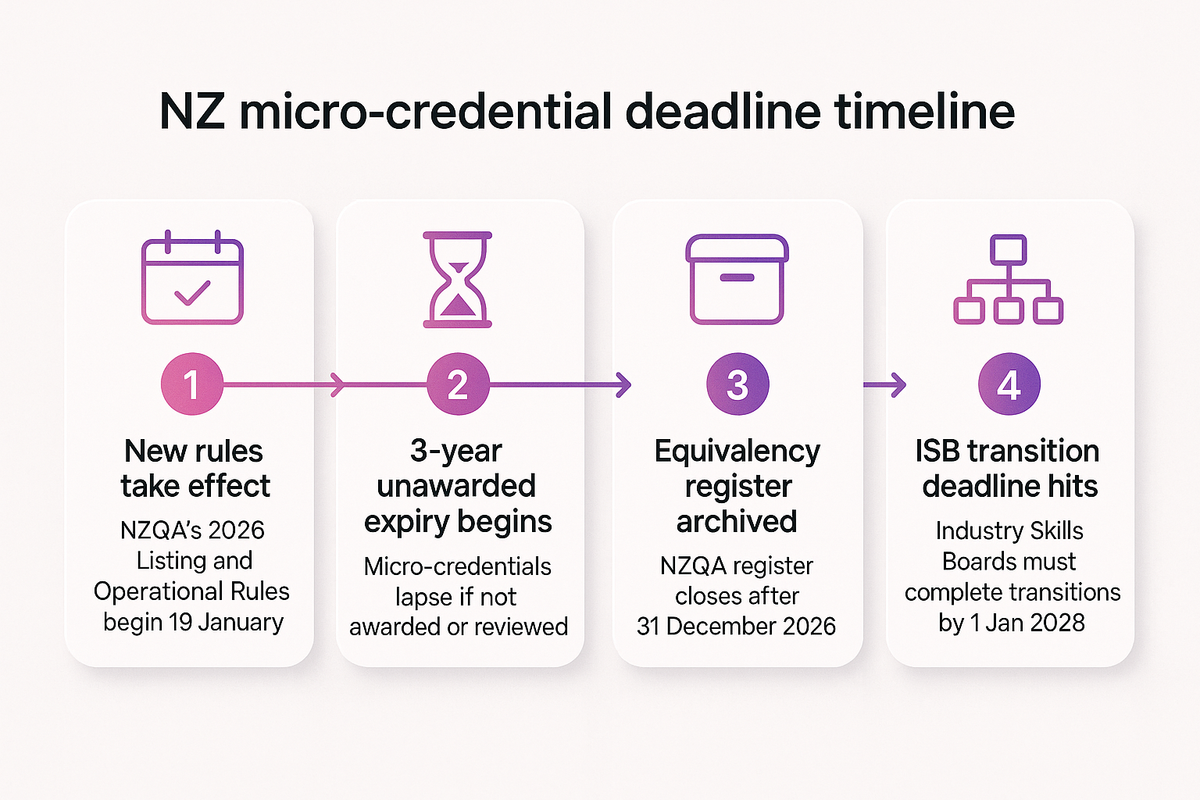
The Qualification and Micro-credential Listing and Operational Rules 2026 came into force on 19 January 2026, and they change the shape of ongoing compliance for every listed micro-credential.
- No fixed maximum review period — but a new automatic expiry if a micro-credential isn't awarded for three consecutive years, or isn't reviewed within its listed review window.
- Currency is now an active task. A micro-credential that sits unused, or slips past its review date, doesn't quietly linger — it lapses.
- No central equivalency backstop. NZQA has stopped assessing level and credit equivalency for non-NZQA-approved micro-credentials against the NZ Qualifications Framework (NZQF), and will archive its equivalency register after 31 December 2026.
That last point matters more than it sounds. Any provider that previously leaned on NZQA's equivalency judgement to justify credit value or standard alignment now has to make — and defend — that call itself.
Why did the standards map get redrawn overnight?
The Education and Training (Vocational Education and Training System) Amendment Act 2026 disestablished Te Pūkenga and, from 1 January 2026, established 10 regional polytechnics alongside new Industry Skills Boards (ISBs), replacing the former Workforce Development Councils.
That's not a rebrand. It's a change of who owns standards, who arranges work-based assessment, and who a provider's mapping documentation needs to point to.
- ISBs took over training agreements and responsibility for arranging work-based assessment from 1 January 2026.
- TEC's consultation sets a hard deadline: all transitions must be completed by 1 January 2028.
- ISBs will be unable to enrol, manage or assess learners after 31 December 2027 — a fixed cliff-edge, not a soft target.
Every unit standard and micro-credential mapping that referenced the old structure needs revisiting before that window closes. For a PTE, ITP or Wānanga running dozens of micro-credentials across several ISBs, that's a lot of documents to re-check on a deadline that isn't moving.
Does funding pressure make this worse?
Yes — and the timing compounds it. The Tertiary Education Strategy 2025–2030 ties TEC funding decisions from 2027 to demonstrated alignment with labour market needs and outcome measures, including completion rates and skills relevance. TEC is due to issue implementation guidance by March 2026.
In practice, that means assessment redesign isn't just a compliance exercise anymore. Get it wrong, or get it done too slowly, and it can show up in the outcome data that funding decisions are increasingly built on.
Is completion volume adding to the load?
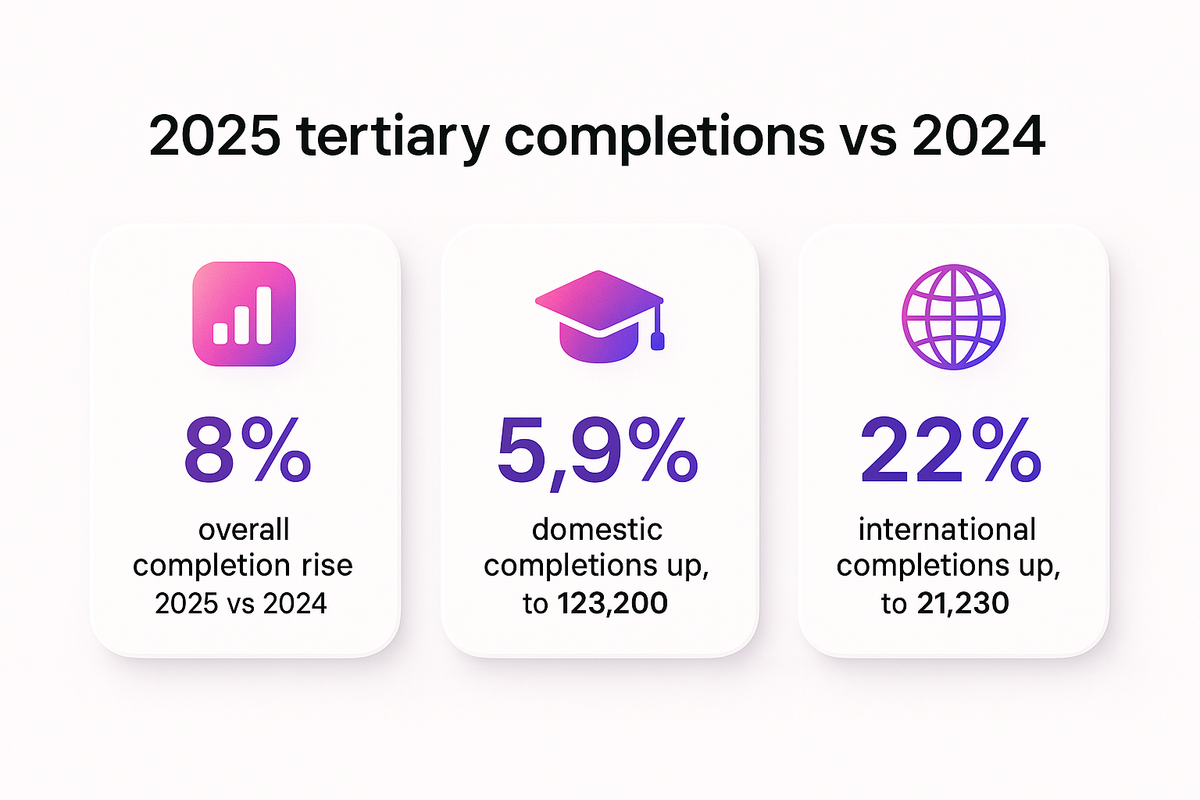
Ministry of Education and Education Counts data reported via Scoop show provider-based tertiary qualification completions rose 8% in 2025 compared with 2024 — domestic completions up 5.9% to 123,200, and international completions up 22% to 21,230.
More learners finishing means more assessment volume moving through moderation and review cycles, right as the review requirements themselves are tightening. It's a workload increase layered on top of a regulatory reset — not sequential, but simultaneous.
What does this mean for assessment teams day to day?
Put the pieces together and the practical task list for any provider running micro-credentials looks like this:
- Audit every micro-credential against its review date and awarding history before the three-year expiry trigger applies.
- Re-map assessment content to the new ISB and regional polytechnic standards ownership structure.
- Build (and document) your own equivalency judgement process, since NZQA's register won't be there as a fallback after 31 December 2026.
- Align assessment evidence to the outcome measures TEC flagged for the 2025–2030 strategy, ahead of the March 2026 guidance.
- Do all of the above across rising completion volumes, not a stable baseline.
That's a lot of unit-standard-by-unit-standard re-authoring, assessor guide updates and cross-checking to run manually inside a compressed window — particularly for teams also managing ESOL, LLN, workplace and distance-delivery variants of the same content.
Key takeaways
- NZQA's 2026 Listing and Operational Rules (effective 19 January 2026) introduce automatic expiry for micro-credentials unawarded for three years or unreviewed within their cycle.
- NZQA has withdrawn from assessing equivalency for non-approved micro-credentials against the NZQF and will archive its equivalency register after 31 December 2026 — providers now own that judgement.
- Te Pūkenga's disestablishment and the 1 January 2026 creation of regional polytechnics and Industry Skills Boards reset standards ownership, with a legislated deadline of 1 January 2028 for ISB transitions to complete.
- The Tertiary Education Strategy 2025–2030 links TEC funding from 2027 to outcome measures, with implementation guidance due by March 2026.
- Tertiary completions rose 8% in 2025 (domestic completions up 5.9% to 123,200; international up 22% to 21,230), adding volume on top of the regulatory transition.
Our take
What's striking about this round of change isn't any single rule — it's that four separate clocks (expiry, equivalency, standards ownership, outcome-linked funding) all start ticking in roughly the same 24-month window. That's a design problem as much as a compliance one. Providers who treat this as a single one-off audit will find themselves back in the same position in three years, when the next batch of micro-credentials hits its expiry trigger. The providers who come out ahead will be the ones who build a repeatable process for keeping assessment content, mapping and moderation evidence current — not a scramble that resets to zero each cycle.
FAQ
When do NZQA's new micro-credential rules take effect? The Qualification and Micro-credential Listing and Operational Rules 2026 came into force on 19 January 2026. They remove fixed maximum review periods but introduce automatic expiry for micro-credentials not awarded for three consecutive years, or not reviewed within their listed review period.
Will NZQA still check equivalency for my micro-credential? No, not for non-NZQA-approved micro-credentials. NZQA has stopped assessing level and credit equivalency against the NZQF for these, and will archive its equivalency register after 31 December 2026. Providers need their own process for justifying credit value and standard alignment.
What happened to Te Pūkenga and Workforce Development Councils? The Education and Training (Vocational Education and Training System) Amendment Act 2026 disestablished Te Pūkenga and replaced Workforce Development Councils with new Industry Skills Boards, alongside 10 regional polytechnics, from 1 January 2026. ISBs took over training agreements and work-based assessment arrangements from that date.
Is there a deadline for the Industry Skills Board transition? Yes. TEC's consultation sets 1 January 2028 as the completion date for ISB transitions, and ISBs will be unable to enrol, manage or assess learners after 31 December 2027.
How does the Tertiary Education Strategy 2025–2030 affect assessment work? From 2027, TEC funding decisions will be linked to outcome measures such as completion rates and labour market alignment. TEC is due to release implementation guidance by March 2026, which will shape how providers need to demonstrate outcomes through their assessment evidence.