Micro-Credentials NZQF: NZQA's 2026 Currency Clock
10 August 2026 · 6 min read

New Zealand's micro-credential rules change on 19 January 2026: NZQA moves from fixed review periods to a rolling expiry clock, so a micro-credential can lapse if it hasn't been awarded for three years or reviewed on schedule — no matter how large the rest of a provider's catalogue is.
What actually changes on 19 January 2026
NZQA's 2026 Rules package comes into force on that date, stemming from the Education and Training (Vocational Education and Training System) Amendment Act 2025. The Act also shifts sector terminology — Te Pūkenga becomes polytechnics again, and Workforce Development Councils become Industry Skills Boards.
Two rule sets carry the practical weight for anyone delivering NZQF-listed micro-credentials:
- The Qualification and Micro-credential Listing and Operational Rules 2026 — removes the previous maximum review-period ceilings and introduces an expiry-status mechanism.
- The Micro-credential Approval and Accreditation Rules 2026 — keeps the core obligation that providers run "an effective process for regular review of the micro-credential that assesses its currency and content and updates it accordingly."
Read together, these rules turn ongoing currency into the thing NZQA actually checks — not how many micro-credentials sit in a provider's NZQF listing.
The old cadence: a set-and-forget review window
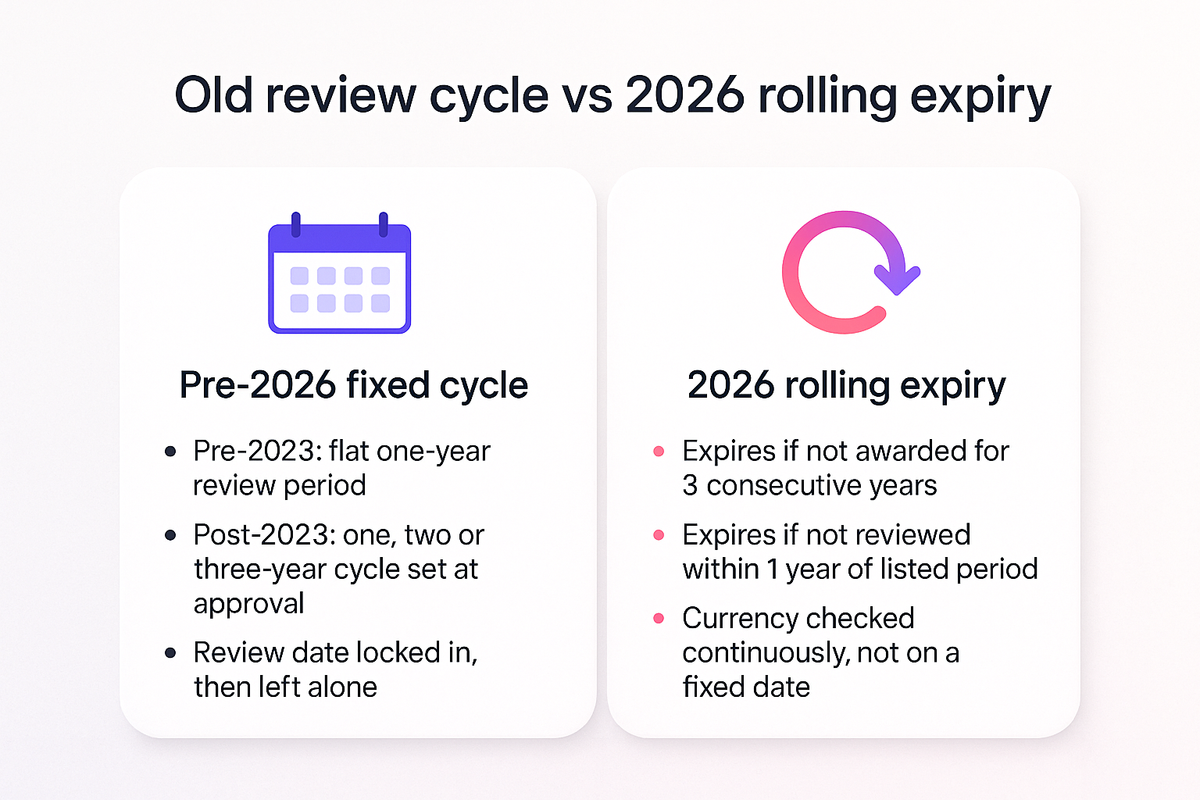
Until now, review timing was fixed and predictable. Micro-credentials approved before 2023 carried a flat one-year review period. Those listed after 2023 could sit on a one, two or three-year cycle, agreed at approval and then largely left alone until the clock ran out.
That model rewarded volume. A provider could build a wide micro-credential library, set review dates years apart, and treat currency as a periodic paperwork exercise rather than a constant discipline.
The new mechanic: a rolling expiry clock
The 2026 rules abolish that fixed cadence in favour of continuous monitoring. Under the new expiry-status mechanism, a micro-credential can expire if either of these happens:
- It has not been awarded for three consecutive years, or
- It has not been reviewed within one year of its listed review period.
Either trigger pulls the micro-credential out of currency, regardless of how recently the provider added new material elsewhere in its portfolio. Size no longer buys protection. A five-credential provider that reviews on time is in a stronger compliance position than a fifty-credential provider with three stale entries quietly ageing past their review date.
Why the equivalency-list closure raises the stakes
NZQA is also discontinuing its non-approved equivalency assessment service. The existing equivalency list will be archived after 31 December 2026.
That closure pushes the whole sector in the same direction as the expiry mechanism: away from informally recognised or historically accumulated credentials, and toward micro-credentials that are actively NZQA-listed, NZQF-aligned and demonstrably kept current. There won't be a fallback equivalency pathway to lean on once older content starts to look tired.
The wider rules package tidies up related quality-assurance machinery too — dropping references to external evaluation and review, removing the old sub-contracting rule (now covered under the new Quality Assurance of Tertiary Education Providers Rules), and discontinuing consistency reviews from 1 January 2026. None of these on their own is dramatic, but together they signal a system built around continuous currency rather than periodic sign-off.
What this means for PTEs, ITPs, wānanga and corporate L&D
For Private Training Establishments, Institutes of Technology and Polytechnics, wānanga and corporate learning teams delivering NZQF-listed micro-credentials, refresh speed has moved from a quality preference to a regulatory deadline. In practice, that means:
- Auditing review dates now. Know which micro-credentials sit closest to their one-year review trigger or the three-year no-award clock.
- Treating content refresh as an operating rhythm, not a project you resource once a year.
- Watching award frequency, since a low-enrolment micro-credential is now also a currency risk, not just a commercial one.
- Moving off informal equivalency claims ahead of the 31 December 2026 archive date, in favour of properly listed and reviewed micro-credentials.
Providers whose instructional design still runs on multi-week production cycles will feel this hardest. A micro-credential that takes six weeks to update every time its content, scenario or assessment approach needs a refresh is much closer to breaching its review window than one where updates can turn around in days.
Key takeaways
- NZQA's 2026 Rules package takes effect 19 January 2026, under the Education and Training (Vocational Education and Training System) Amendment Act 2025.
- Fixed review-period ceilings are gone; a micro-credential now expires if not awarded for three consecutive years or not reviewed within one year of its listed review period.
- The Micro-credential Approval and Accreditation Rules 2026 still require an effective, ongoing process for assessing and updating currency and content.
- NZQA's non-approved equivalency assessment service is being discontinued, with the existing list archived after 31 December 2026.
- PTEs, ITPs, wānanga and corporate L&D teams delivering NZQF-listed micro-credentials should audit review dates and award frequency now, ahead of the January deadline.
Our take
This rule change quietly rewrites what "good" looks like for a micro-credential portfolio. Breadth used to buy some cover — a big catalogue felt like a hedge against any single credential going quiet. Under a rolling expiry clock, breadth is closer to exposure: every additional micro-credential is another review date to track and another award-frequency risk to manage. The providers who cope best will be the ones who can turn scenario, assessment and content updates around in days rather than months, because that's now the difference between staying NZQF-listed and quietly losing currency on credentials nobody noticed had gone stale.
FAQ
When do NZQA's 2026 micro-credential rules take effect? The Qualification and Micro-credential Listing and Operational Rules 2026 and the Micro-credential Approval and Accreditation Rules 2026 come into force on 19 January 2026, under the Education and Training (Vocational Education and Training System) Amendment Act 2025.
What causes a micro-credential to expire under the new rules? A micro-credential can move to expiry status if it hasn't been awarded for three consecutive years, or if it hasn't been reviewed within one year of its listed review period.
What happened to the old fixed review-period system? It's been removed. Previously, micro-credentials approved before 2023 had a fixed one-year review period, and those listed after 2023 could run on a one, two or three-year cycle. The 2026 rules replace both with continuous currency monitoring.
What's happening to NZQA's equivalency assessment service? NZQA is discontinuing its non-approved equivalency assessment service, and the existing equivalency list will be archived after 31 December 2026, pushing the sector toward actively NZQA-listed and NZQF-aligned micro-credentials.
Who does this affect? Any Private Training Establishment, Institute of Technology and Polytechnics, wānanga or corporate Learning & Development team delivering NZQF-listed micro-credentials is subject to the new currency and review requirements.