Migrant Workplace Communication Training NZ: Closing the Gap
5 October 2026 · 7 min read
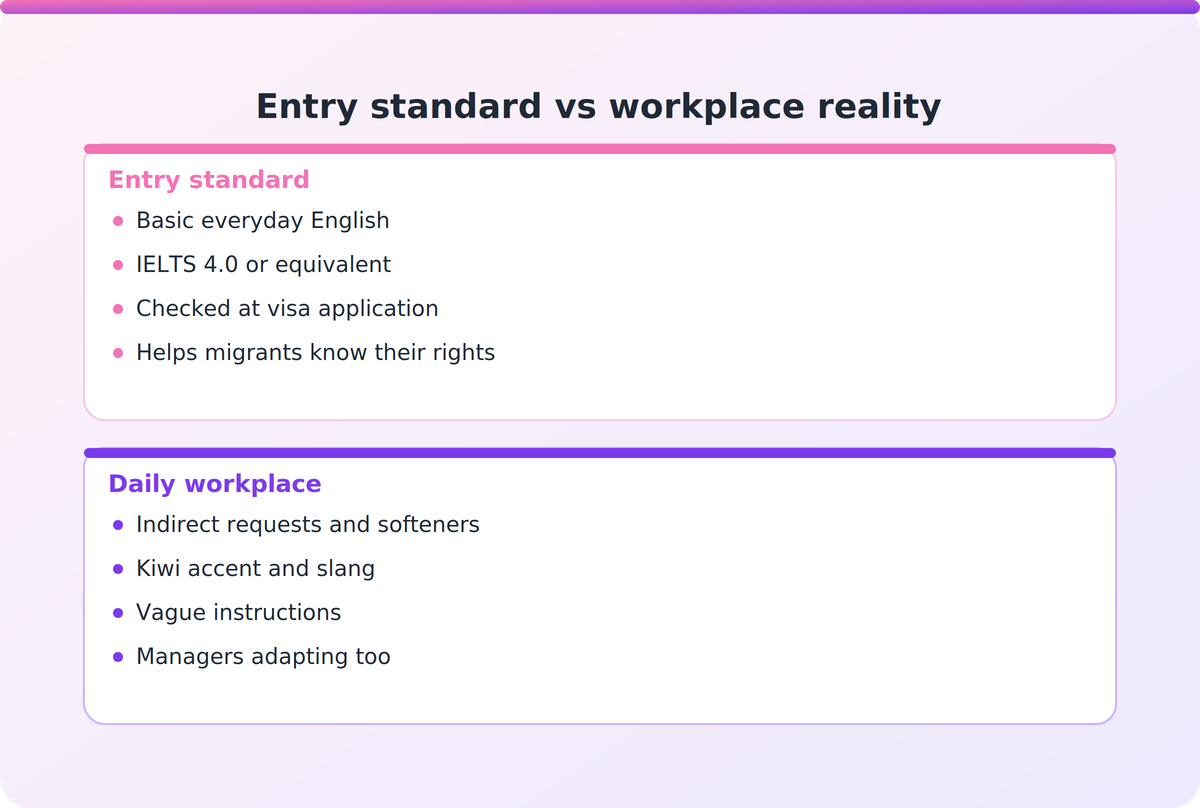
New Zealand now asks skill level 3 AEWV applicants to show basic everyday English (IELTS 4.0 or equivalent). That gets people in the door. It doesn't teach anyone what "would you mind fixing this?" really means on a busy Tuesday. The real gain comes from practice-based communication development after arrival, for migrant staff and their managers.
What changed on 1 June 2026?
From 1 June 2026, migrants applying for an Accredited Employer Work Visa (AEWV) at skill level 3 must meet an English language requirement. Immigration New Zealand (INZ) applies it even where the employer received a job check token before that date.
Until then, the requirement applied only to skill levels 4 and 5, which make up about 16% of AEWV applications (INZ; 1News, 25 May 2026). The key details:
- The standard: basic everyday English, IELTS 4.0 or equivalent.
- The stated aim: better integration, including helping migrants understand their rights and raise concerns about non-compliant employers (Indian Weekender, 25 May 2026).
- Transition rules: per Fragomen, holders of an AEWV expiring on or before 1 December 2026 are exempt when applying for a further skill level 3 AEWV. So are people who have already provided English evidence.
Minister Erica Stanford has described the entry level as a starting point. Mid-skilled workers who want residence arrive with basic everyday English, then have up to five years to reach the higher level residence requires (1News).
That "up to five years" is the point. The system itself expects English to keep developing after arrival.
Why doesn't an IELTS 4.0 standard close the communication gap?
Because the gap isn't only vocabulary. INZ's own employer guidance describes how New Zealand managers often speak indirectly. "Would you mind fixing this?" can sound like a polite request to a Kiwi colleague. A new migrant employee may expect an instruction and hear an optional favour.
Worktalk, built by INZ with Victoria University of Wellington's Language in the Workplace Project, covers exactly this ground. Its free, research-based quizzes and video cover:
- the Kiwi accent
- softeners ("just", "maybe", "if you get a chance")
- slang
- vague instructions
None of that shows up in a basic English check. A person can meet the entry standard and still miss that a softened sentence was an urgent one.
Is this only a migrant problem?
No, and this is where most workplace programmes go wrong. Worktalk has separate resources for employees and for employers and managers, which frames communication as two-way. INZ's guidance puts the "local expectations" side on employers too.
In practice, managers can:
- Say plainly what is urgent and what is optional.
- Check understanding by asking the person to describe the next step, rather than asking "does that make sense?"
- Notice when a quiet "yes" means "I heard you" rather than "I agree".
- Invite questions in one-on-one settings, not just in team meetings.
These are skills, and skills improve with rehearsal, not with a policy document.
Why does this matter more now?
Retention is becoming more realistic. From 24 August 2026, the Skilled Migrant Category includes:
- a Trades and Technician pathway, and
- a pathway for ANZSCO level 1 to 3 roles with at least 5 years' experience, including 2 years in New Zealand at 1.1 times the median wage.
That changes the return on communication support. If someone may stay for years, a few months of coached practice early on pays off for much longer than it would for a short placement.
There's also a rights dimension. The Employment Monitor 2025 found 22% of migrant workers voiced concerns about their employment rights. Clear two-way communication is part of how those concerns get raised and resolved early.
What does good post-arrival communication development look like?
The honest answer: quantitative evidence on what works is thin. The material we have is mostly official guidance and practice, not controlled research. With that caveat, the common threads in INZ and Worktalk guidance point to a few features:
- Contextual. Practise the conversations the person actually has: handovers, feedback, asking for help, questioning an instruction.
- Repeated. One induction session won't stick. Short, regular practice builds confidence.
- Safe to get wrong. Rehearsing a difficult conversation before it happens with a real supervisor or client lowers the stakes.
- Two-sided. Managers practise softening less and checking more.
Local programmes are emerging. Speech NZ's Migrant Workplace Communication Training was recently covered by the Waikato Independent, where one participant, rejected from over 200 jobs, found full-time work afterwards. That is a single anecdote, not evidence of effect. It does show where demand is coming from.
Where do PTEs and employers fit?
Private Training Establishments (PTEs), Te Pūkenga ITPs and Wānanga already teach many of the people who'll move through these visa settings. Their NZQA-registered programmes can build workplace communication into practical assessment, rather than treating it as a separate English course.
Employers face the same question internally: how do you give every new starter, and every manager, enough realistic practice without hiring a facilitator for each one? That is a design problem as much as a funding one.
Key takeaways
- From 1 June 2026, AEWV skill level 3 applicants must meet a basic English standard (IELTS 4.0 or equivalent).
- Entry-level English doesn't cover indirect requests, softeners, slang or vague instructions, which INZ's guidance identifies as the real friction points.
- The gap is two-way. Managers need to adapt their communication as well as migrant staff.
- New Skilled Migrant Category pathways from 24 August 2026 raise the payoff from sustained support.
- Evidence on what works is thin. Rely on official guidance and the Employment Monitor, and treat local success stories as anecdotal.
Our take
The new rule is a sensible gate, but it's the wrong place to stop. A pass mark can't teach someone to hear urgency in a softened sentence, or teach a manager to say what they mean. We think the providers and employers who treat communication as a practised skill, with realistic rehearsal for both sides, will keep people longer and hear about problems sooner. The case for doing this rests on logic and official guidance more than on hard data, and we'd rather say so than oversell it.
If you're weighing how to give every learner or new starter a realistic place to practise, it's worth asking what that would look like without adding facilitators. That's the question behind much of what we explore at supahuman.com.
FAQ
What English level does the AEWV skill level 3 requirement set?
Basic everyday English, equivalent to IELTS 4.0. It applies to skill level 3 applicants from 1 June 2026, even where the employer received a job check token earlier. Previously it applied only to skill levels 4 and 5.
Who is exempt from the new English requirement?
Per Fragomen, holders of an AEWV expiring on or before 1 December 2026 are exempt when applying for a further skill level 3 AEWV. People who have already provided English evidence are also exempt. Check current INZ guidance for your situation.
What is Worktalk?
Worktalk is a free resource developed by Immigration New Zealand with Victoria University of Wellington's Language in the Workplace Project. It offers research-based quizzes and video for migrant employees and for employers and managers. It covers the Kiwi accent, softeners, slang and vague instructions.
Why do Kiwi managers' instructions confuse new migrant staff?
INZ's employer guidance notes that New Zealand managers often speak indirectly. A phrase like "would you mind fixing this?" can sound like a request when the employee expects an instruction. Clearer, more direct phrasing and check-backs help.
Is there proof that migrant workplace communication training works?
Not much quantitative proof yet. Evidence is mostly official guidance and practice. Local examples, like a Speech NZ participant who found full-time work after rejection from over 200 jobs, are anecdotal and shouldn't be read as proof of effect.