Multi-Campus Training Delivery in NZ After Te Pūkenga
9 September 2026 · 7 min read

New Zealand didn't just restructure its vocational sector — it deliberately un-centralised it, splitting one shared back office into roughly ten regionally governed polytechnics and a transitional entity, at the exact moment NZQA rewrote its quality-assurance rules and staffing fell by close to a tenth. For the COO, that's not a strategy problem. It's an operations problem, and it lands on your desk whether or not you asked for it.
Why this hits your desk
If you run operations at a newly independent or federated polytechnic, you are now responsible for re-standing up enrolment, delivery and reporting processes that used to be centralised under Te Pūkenga — with no guarantee they were ever consistent across your sites to begin with. Legislation passed in October 2025 disestablished Te Pūkenga and created the New Zealand Institute of Skills and Technology (NZIST) as a two-year transitional entity from 1 January 2026, tasked with handing programmes back to regionally governed polytechnics. Some of those polytechnics are joining federations — the Open Polytechnic absorbing Otago Polytechnic and the Universal College of Learning (UCOL) from the same date, sharing online resources, an academic board and other back-office functions. Others — NorthTec, Western Institute of Technology at Taranaki, Whitireia/WelTec, and Tai Poutini Polytechnic — remain inside NZIST while they work toward financial viability, with decisions on their future expected in the first half of 2026. Whichever bucket your organisation falls into, you're being asked to prove your sites can produce the same accurate numbers, on the same day, regardless of how the entity above them is governed.
One back office becomes ten
Under Te Pūkenga, enrolment systems, reporting cadences and compliance sign-off sat inside one structure, however imperfect. That structure is gone. In its place is a federation model for some campuses and a fully independent model for others, each inheriting its own mix of student management systems, local process knowledge and reporting habits. None of this was designed from scratch — it was assembled under time pressure, from whatever each site had running when the transition hit. That's a recipe for the exact failure modes operations teams already know too well: duplicate data entry, disconnected systems, and process knowledge trapped in individual staff members who may or may not still be in the building.
Adding to the governance load, eight new Industry Skills Boards — majority industry-governed — are being established from 1 January 2026 to lead standard-setting and qualification development, replacing Workforce Development Councils. That's a new layer of external relationships and reporting lines for programme and compliance teams to track, on top of everything else moving at once.
The compliance rulebook changed too
NZQA didn't pause its own reform to let the sector catch its breath. A rules overhaul came into force from 19 January 2026, discontinuing External Evaluation and Review and replacing it with new Quality Assurance of Tertiary Education Providers Rules. Alongside that, Private Training Establishment Rules 2026 changed financial-return obligations — non-funded Private Training Establishments (PTEs) now report biennially unless NZQA directs otherwise. Sub-contracting provisions were also relocated within the rules, but the core requirement hasn't softened: all enrolments and academic records must remain with the PTE holding them. If you deliver across sites through any sub-contracting arrangement, that's a direct constraint on where your student data can legally live — not a detail you can leave to whichever campus happens to hold the file.
Every one of these changes touches a process your team already runs. None of them arrived with a transition manual for how to apply them consistently across a newly fragmented set of sites.
Fewer people, same fixed points
Here's the part that should genuinely worry a COO: the people available to manage this complexity have shrunk, not grown. Te Pūkenga's headcount dropped by 855 in 2024 alone, from 10,480 to 9,625. At least 154 further roles, plus one campus, were cut across institutes of technology and polytechnics ahead of disestablishment. Meanwhile, the fixed points in the compliance calendar haven't moved an inch. The Tertiary Education Commission's (TEC) Single Data Return is still required three times a year through the STEO system from any TEC-funded provider. NZQA still requires completed qualifications to be reported within two months of completion. And 2025 funding conditions added more load on top — PTEs must now send Student Services Fees reports to TEC within 14 days of being provided to learners, alongside new learner data-disclosure obligations.
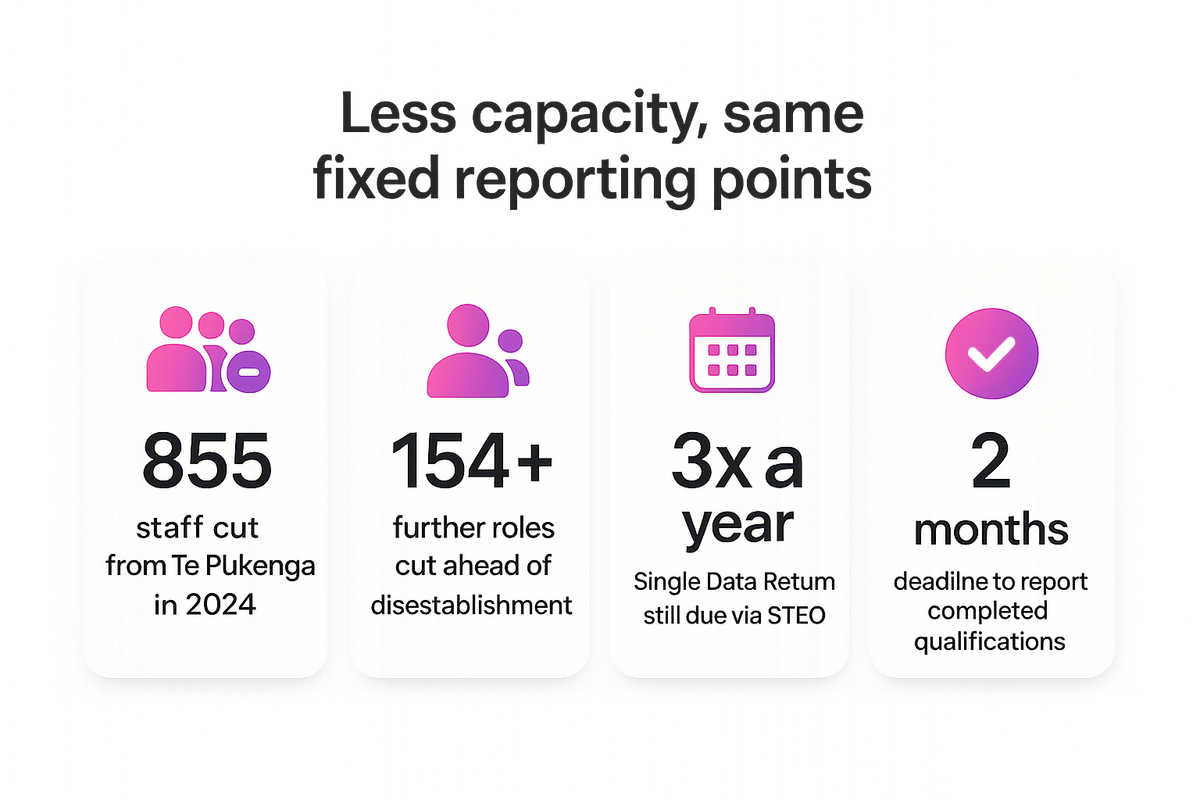
Fewer people, more governance layers, the same unforgiving deadlines. That combination doesn't get solved by working harder in week three of the reporting cycle. It gets solved — or it doesn't — by whether your underlying processes are repeatable regardless of who's rostered on that day.
The audit finding that should worry you
TEC's own monitoring has already surfaced what happens when reporting depends on disconnected systems rather than process: an audit found a provider had failed to report unfunded students enrolled in micro-credentials. That's not a story about bad intent. It's a story about a gap between a student management system and a funding report that nobody caught, because nobody owned the reconciliation. In a single-site, single-system world, that gap is bad enough. Spread across ten independently governed sites with varying levels of system maturity, it's not a risk — it's close to an inevitability, unless someone has deliberately designed against it.
What operational readiness actually looks like now
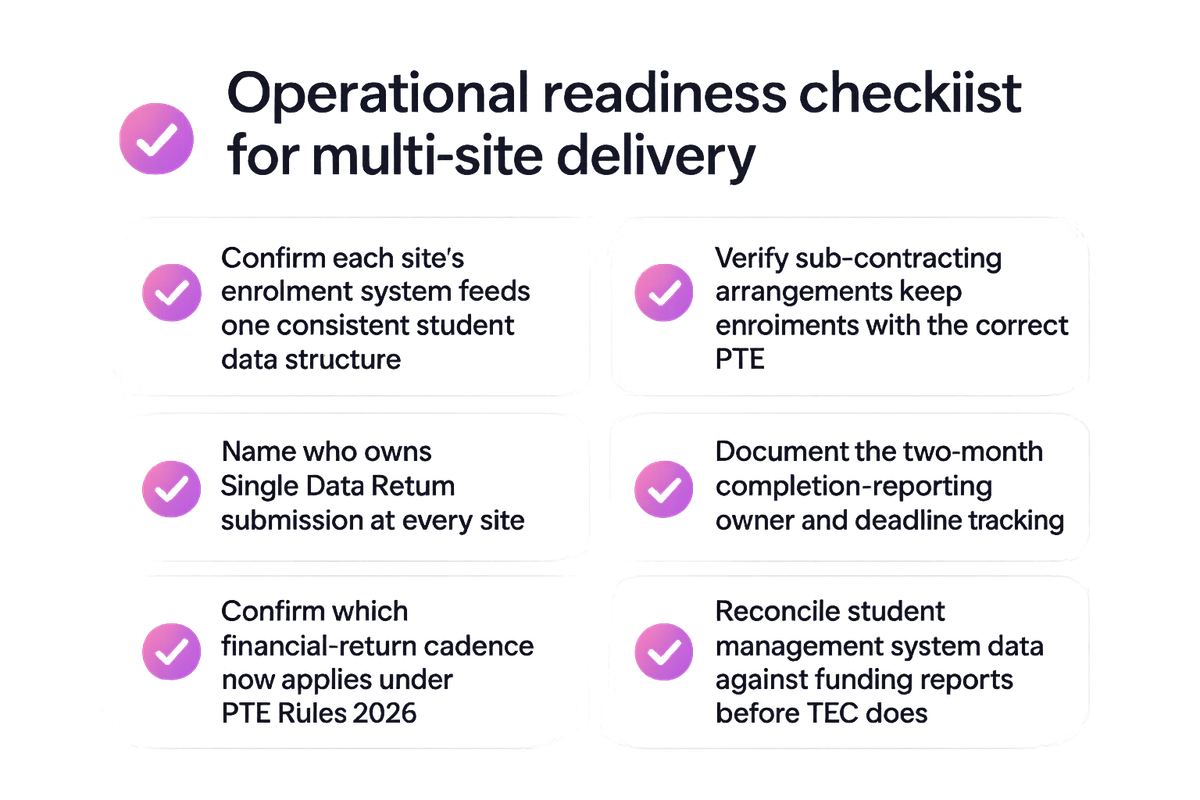
This isn't about buying anything or building something new by next Monday. It's about being honest with yourself about where the gaps sit before NZQA or TEC finds them for you.
Key takeaways
- NZIST's transitional period (2026–2027) and the shift to roughly ten regionally governed polytechnics means your enrolment, delivery and reporting processes may no longer share a common back office — audit each site as if it were a standalone provider.
- NZQA's rules overhaul from 19 January 2026 replaced External Evaluation and Review with new Quality Assurance of Tertiary Education Providers Rules and introduced PTE Rules 2026 — confirm which reporting cadence now applies to your organisation.
- Sub-contracting rules still require enrolments and academic records to stay with the PTE holding them — check this explicitly if any of your delivery runs through partner or satellite arrangements.
- Staffing reductions mean the same Single Data Return and two-month completion-reporting deadlines now rely on fewer people — treat that as a capacity risk to manage, not a fact to absorb quietly.
- TEC's own audit findings show reporting gaps happen at the boundary between student systems and funding returns — reconcile that boundary before an auditor does it for you.
Our take
The strategic case for breaking up Te Pūkenga is a conversation for boards and ministers. The operational case lands squarely with COOs, and it's less glamorous but far more urgent: prove, site by site, that your organisation can still produce accurate, on-time, auditable numbers when the shared infrastructure that used to guarantee that is gone. The providers that come through this transition cleanly won't be the ones with the cleverest governance model. They'll be the ones who treated 2026 as the year to make every site's process repeatable on paper, not just repeatable in one experienced person's head.
FAQ
What replaced External Evaluation and Review for NZQA-monitored providers? From 19 January 2026, NZQA discontinued External Evaluation and Review and introduced the new Quality Assurance of Tertiary Education Providers Rules in its place.
How often do non-funded PTEs need to submit financial returns now? Under the Private Training Establishment Rules 2026, non-funded PTEs report biennially unless NZQA directs otherwise — a change from the previous cadence.
Which polytechnics remain under NZIST after January 2026? NorthTec, Western Institute of Technology at Taranaki, Whitireia/WelTec, and Tai Poutini Polytechnic remain inside NZIST while working toward financial viability, with decisions on their future expected in the first half of 2026.
How often is the Single Data Return due, and what's the risk of getting it wrong? TEC's Single Data Return is required three times a year via the STEO system. A recent TEC audit found a provider had failed to report unfunded students in micro-credentials — a direct illustration of what happens when reporting relies on disconnected systems rather than a repeatable process.