Multi-Site RTO Delivery Consistency: A COO's Guide
1 October 2026 · 7 min read
A second site rarely breaks delivery consistency because people care less. It breaks because the first site ran on one person's memory and local workarounds, and the second site inherits none of it. Under the 2025 Standards for RTOs, multi-site RTO delivery consistency is an operational design problem to solve before opening day, not a compliance clean-up afterwards.
Why this lands on your desk
You own the processes and systems that now have to run identically in two places. When they don't, you are the one explaining why.
The pressure comes from three directions at once:
- Regulation. The 2025 Standards for RTOs have been in full effect since 1 July 2025. ASQA says they focus on the quality of outcomes for students and employers. Outcomes have to be demonstrable wherever training is delivered.
- Reporting. Every additional site adds a data source to reconcile before anything reaches NCVER.
- Cost. Adding a site tends to add headcount in step with enrolments. You decide whether quality, records and reporting scale through repeatable process or through more people firefighting.
What site one was really running on
Most first sites work because of a handful of people. The operations coordinator knows which intake needs a chase-up. The senior trainer knows how that unit is really assessed. Someone keeps a spreadsheet that explains the gaps in the student management system.
None of that is written down, and none of it is a failing. It is how small teams stay fast.
Then you open site two. The new team gets the policy folder and a handover call. They fill the gaps with their own workarounds, and within a term you have two reasonable, well-meant ways of doing the same thing.
That's why "we'll tighten it up once we're running" rarely works. By then the variation is habit.
Consistent practice, not consistent documents
Because the Standards emphasise outcomes, having the same policy folder at both sites proves very little. What you need to show is that the same practice produces the same result.
ASQA has no published statement specifically on multi-site consistency in the material we reviewed, so this is an argument from its general outcomes focus. Commentators from vendors and consultants (industry opinion, not ASQA statements) say audits now look for proof that systems work in practice, and that fragmented records and manual spreadsheets are a primary source of compliance blind spots. That fits the operational risk of running two sites on separate records.
Two parts of the framework matter most to you:
- Credentials. The Standards have three parts: Outcome Standards, compliance requirements (including the Fit and Proper Person Requirements), and a Credential Policy covering trainer and assessor credentials. The credential requirements apply to every trainer at every site. A second site multiplies the number of people whose credentials you must track.
- Practice guides. ASQA says its practice guides include compliance examples, known risks and self-assurance questions. That is the closest official material to a checklist for consistent delivery. It makes a sensible basis for a cross-site self-review routine.
Reporting is where inconsistency becomes visible
Delivery variation is easy to hide for a term. Data variation shows up in the submission.
Every RTO had to report 2025 Total VET Activity AVETMISS data to NCVER by 28 February 2026, and ASQA's provider planner notes that late reporting can lead to penalties. With two sites feeding one submission, one late or inconsistent site puts the whole thing at risk.
The ground is also shifting. ASQA states the Data Provision Requirements Amendment (Data Streamlining) Instrument 2026 takes effect on 1 October 2026. Reporting will be under AVETMISS or the VET Information Standard, depending on arrangements and timeframes. NCVER says all RTOs must report under the new standard by January 2029. One secondary source says 31 December 2028, so confirm your own date with NCVER and ASQA.
Our inference, not a published finding: as reporting moves toward API-based submission, duplicate entry and spreadsheet reconciliation across sites will get harder to sustain.
Software won't rescue you either. NCVER warns that an AVETMISS-compliant system ensures correctly formatted files but may not check all of your data values. Clean data at the point of capture, done the same way at both sites, remains your responsibility.
Expect a different learner mix at site two
NCVER reports 5.1 million students in nationally recognised VET in 2025. Growth was concentrated among younger students (including those in school) and among regional and remote, disability and First Nations students. The number of students in qualifications fell by 108,360 while short courses increased.
We'd treat what follows as an inference. A second site, especially a regional one, is likely to bring a different learner mix and more shorter-duration enrolments. If your process only works for the learners at site one, it isn't yet a process. It's a habit.
A pre-opening test you can run this quarter
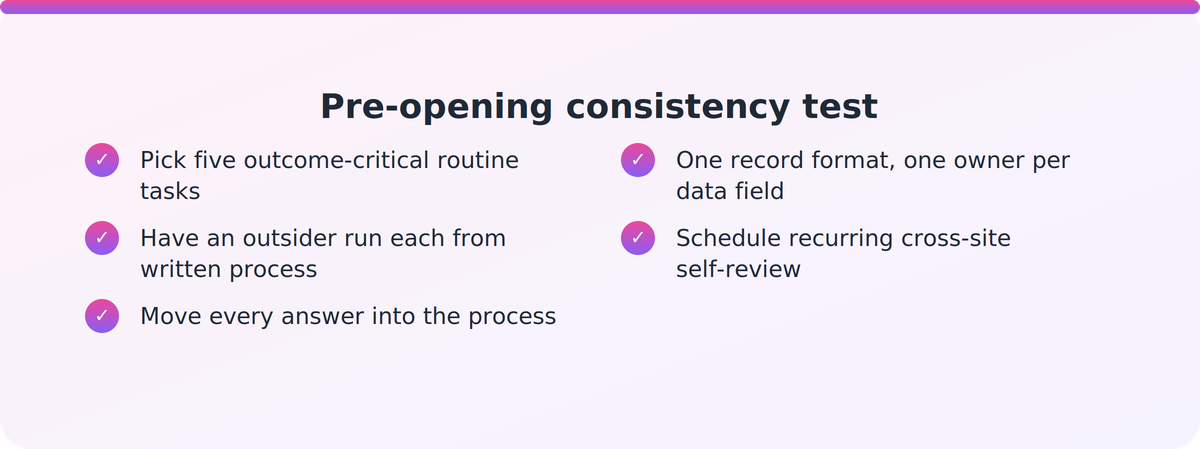
Before site two takes its first enrolment, try this:
- Pick five routine tasks that matter to outcomes: enrolment checks, assessment validation, trainer credential tracking, record storage and AVETMISS data capture.
- Ask someone outside site one to run each task using only what's written down. Note every question they have to ask.
- Move each answer into the process. If it lives in a person, it isn't done.
- Agree one record format and one owner per data field, so both sites capture the same values at the same point.
- Schedule a recurring cross-site self-review using ASQA's practice-guide self-assurance questions as the prompt.
The questions from step 2 are your real risk register.
Key takeaways
- A second site exposes tacit knowledge. It rarely reveals a motivation problem.
- The 2025 Standards for RTOs focus on outcomes, so you need to show the same practice at both sites, not just the same documents.
- The Credential Policy applies to every trainer at every site, so credential tracking grows with each site you add.
- NCVER warns that compliant software may not check all data values. Consistent capture practice is still an operational job.
- Design the common way of working before opening day. Retrofitting it after variation has set in is slower and more expensive.
Our take
The usual advice is to give the second site autonomy and audit it later. We think that gets the order backwards.
Autonomy works well on top of a shared baseline. Without one, you have two RTOs sharing a logo and one registration, and you will find out at the worst possible moment, in an audit or a failed submission.
The uncomfortable part is that building the baseline means making site one's hidden knowledge explicit. That takes your best people's time while they're busiest. It's still cheaper than scaling headcount to paper over the gaps.
FAQ
Does ASQA have specific requirements for multi-site delivery consistency?
Not in the material we reviewed. ASQA has no published statement specifically on multi-site consistency. The argument rests on the 2025 Standards' focus on the quality of outcomes for students and employers, and on ASQA's practice guides. Verify your obligations directly with ASQA.
What's the first thing to standardise across two sites?
Start with whatever depends most on individual memory. For most RTOs that is trainer credential tracking, assessment validation routines and the way AVETMISS data is captured. Test each by having someone outside the original site run it from the written process alone.
When does the VET Information Standard affect our reporting?
ASQA states the Data Streamlining Instrument takes effect on 1 October 2026, with reporting under AVETMISS or the VET Information Standard depending on arrangements and timeframes. NCVER says all RTOs must report under the new standard by January 2029. One secondary source gives 31 December 2028, so confirm your date with NCVER and ASQA.
If our system is AVETMISS-compliant, is our data safe?
Not automatically. NCVER notes a compliant system ensures correctly formatted files but may not check all of your data values. Consistent capture practice across sites is what keeps the values right.
What should I take to the next executive meeting?
Take the list of questions the second site's team couldn't answer from the written process. That is where your consistency risk sits, and it's a concrete place to start.