Non-Compliance Risk Detection for PTE Compliance Managers
17 September 2026 · 7 min read

The four-yearly audit cycle that let you treat "audit-ready" as a seasonal sprint is over. From 1 January 2026, NZQA's integrated Quality Assurance Framework (iQAF) replaces periodic External Evaluation and Review with an annual self-review report and evidence NZQA can call on at any time — your job just changed from passing an audit to never being caught unable to prove one.
Why this lands on your desk now
NZQA has confirmed it is not initiating new EER processes or assuring consistency reviews from 1 January 2026. In their place, providers submit an annual self-review summary report and meet with NZQA to discuss an improvement plan. That is a standing reporting obligation, not a project with a start and end date — and it sits with you.
The proposed scoring model under iQAF is a three-tier rating (Highly Effective, Effective, Not Effective) across four weighted criteria covering programme and micro-credential design, education delivery, assessment practice, and quality management systems. NZQA has signalled this is expected to draw on evidence it already holds, not evidence you assemble reactively when a review is scheduled. If your assessment records, moderation history or self-review documentation are stale, missing, or buried in someone's inbox, that is no longer an audit-week inconvenience. It is a live input to your provider's rating.
Add to that five NZQA rule sets that changed simultaneously on 19 January 2026, and terminology shifts as Workforce Development Councils become Industry Skills Boards and Te Pūkenga transitions to regional polytechnics. Nobody sends you one consolidated notice. Tracking all of it and reflecting it accurately in policies and TAS documentation is squarely your accountability, without a single source of truth handed to you.
From audit sprint to standing obligation
Under the old Evaluative Quality Assurance Framework, the rhythm was familiar: build a case every few years, survive the EER, exhale, repeat. Compliance managers who inherited this model often designed their evidence systems around it — folders that get tidied before a visit, spreadsheets updated in a scramble, sign-offs chased in the weeks before an assessor arrives.
iQAF removes the scheduled trigger. There is no fixed date to work backwards from, no four-year runway to plan a rectification sprint. Instead there is a continuous legal condition of registration under the Education and Training Act 2020 (sections 342–361) and the Private Training Establishment Rules: PTEs must comply with NZQA rules made under section 452 at all times, not at review time.
Five rule sets changed on the same day
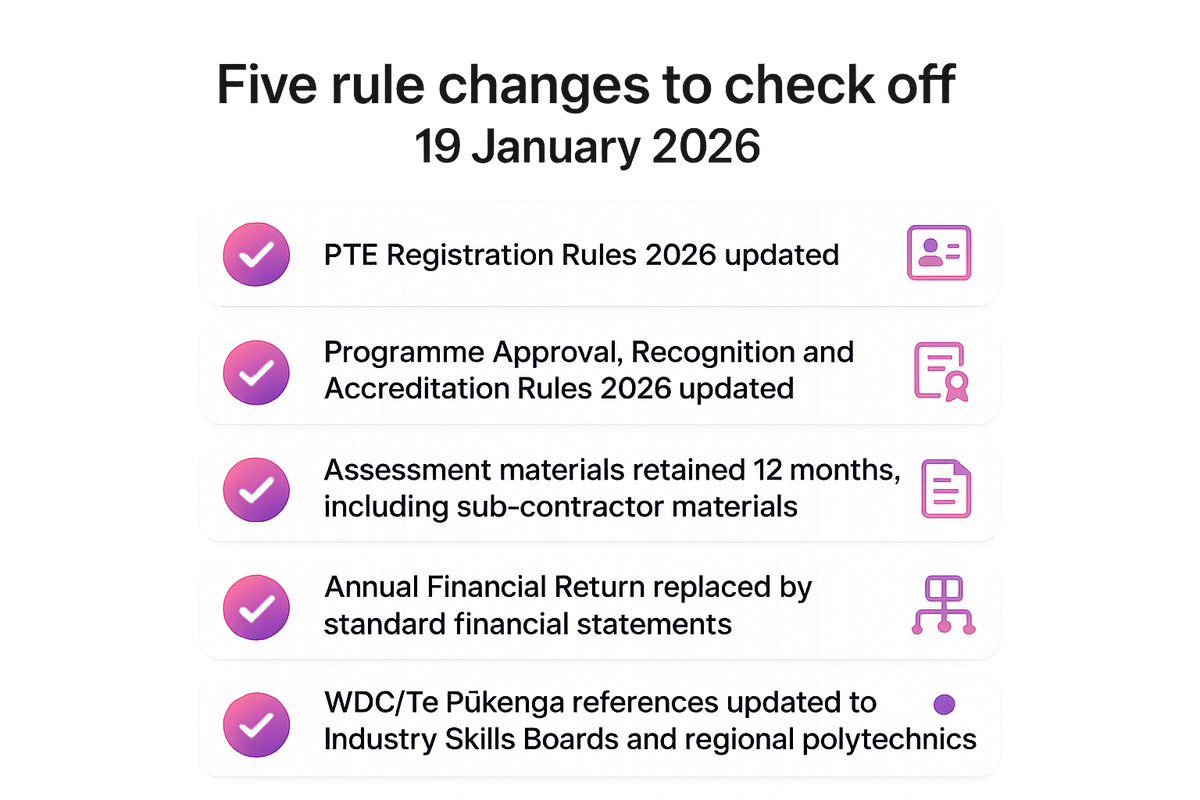
On 19 January 2026, NZQA brought in updated rules across registration, programme approval, records and finance in one go. The practical detail matters more than the headline:
- PTE Registration Rules 2026 — updated conditions for maintaining registration as a private training establishment.
- Programme Approval, Recognition, and Accreditation Rules 2026 — revised requirements for programme and accreditation processes.
- Enrolment and academic records rules — a new requirement to retain student assessment materials, or full copies, for at least 12 months from completion, including materials produced by sub-contractors.
- Finance rules — the Annual Financial Return is replaced by standard annual financial statements, alongside a general duty to maintain adequate internal financial controls.
- Terminology and structural updates — Workforce Development Councils are now Industry Skills Boards, and Te Pūkenga is being disestablished in favour of regional Institutes of Technology and Polytechnics from 1 January 2026.
If your policies, TAS documents or sub-contractor agreements still reference the old bodies or the old retention period, that is a gap NZQA can find before you do.
What a rating actually costs you
NZQA's stated approach is to work informally with a provider first. But where non-compliance is serious, it retains the power to impose conditions on registration or approval, withdraw approval or accreditation, or cancel registration outright. Compliance visits and follow-up work arising from non-compliance are charged at $190 (GST exclusive) per staff member per hour — a direct cost attached to every gap that surfaces late rather than early.
There is a downstream cost too. Immigration New Zealand has confirmed it will keep using existing EER category ratings for visa conditions for 12 months from early 2026 as a transitional measure. Your quality rating does not stay inside NZQA's system — it feeds visa decisions, marketing claims, and provider reputation well beyond the regulator's own paperwork.
Building your own early warning, not a rectification scramble
None of this requires waiting for NZQA's final iQAF design to lock in. Three things are worth doing this quarter regardless of how the scoring model settles:
- Map every current obligation to a named owner and a retrieval location. If you cannot say in thirty seconds where the evidence for a given standard lives and who last touched it, that is your actual risk register — not the one in your policy folder.
- Set a review cadence for policies and TAS documents tied to rule changes, not to a review date. The 19 January 2026 changes affected registration, programme approval, records and finance rules at once; a standing quarterly scan for regulatory updates catches this kind of simultaneous change before it compounds.
- Treat your annual self-review report as a live document, not an annual event. If iQAF scoring draws on evidence NZQA already holds, the report you'd submit today is the best test of whether your evidence trail would survive scrutiny tomorrow.
Key takeaways
- From 1 January 2026, NZQA replaces periodic EER with an annual self-review report and improvement-plan discussion — compliance is now a standing obligation, not a scheduled event.
- The proposed iQAF rating model is expected to draw on evidence NZQA already holds, making stale or scattered evidence a direct risk to your provider's rating.
- Five NZQA rule sets changed on 19 January 2026, including a new 12-month retention requirement for student assessment materials and the replacement of the Annual Financial Return with standard financial statements.
- Workforce Development Councils are now Industry Skills Boards, and Te Pūkenga is transitioning to regional polytechnics — check every policy and TAS reference.
- NZQA charges $190 (GST exclusive) per staff member per hour for compliance visits triggered by non-compliance, on top of statutory powers that include withdrawing accreditation or cancelling registration.
Our take
The iQAF transition is being framed by NZQA as simplification — one framework instead of periodic reviews plus separate consistency checks. For compliance managers, though, it shifts risk earlier and makes it harder to see coming. A four-yearly audit gave you a deadline to rally around. A standing evidence obligation gives you no deadline at all, just a constant low hum of exposure if your records are scattered across drives, inboxes and whoever remembers to update the spreadsheet. The providers who come out of this well won't be the ones who work hardest in the weeks before a review — there won't be a "before" anymore. They'll be the ones who can answer, on any given Tuesday, exactly where their evidence for any standard sits and who owns it.
FAQ
What replaces the EER audit cycle under iQAF? From 1 January 2026, NZQA is not opening new External Evaluation and Review processes or assuring consistency reviews. Instead, providers submit an annual self-review summary report and meet with NZQA to discuss an improvement plan, under the integrated Quality Assurance Framework.
What should I have in place before submitting an annual self-review report? Current, retrievable evidence against the areas NZQA is expected to assess — programme and micro-credential design, education delivery, assessment practice, and quality management systems — plus policies and TAS documentation that reflect the 19 January 2026 rule changes, including updated terminology for Industry Skills Boards and regional polytechnics.
What happens if NZQA finds non-compliance without a scheduled audit trigger? NZQA's stated approach is to work informally with a provider first. For serious non-compliance it can impose conditions on registration or approval, withdraw approval or accreditation, or cancel registration, and it charges $190 (GST exclusive) per staff member per hour for compliance visits and follow-up work.
Do the Workforce Development Council and Te Pūkenga changes actually affect my compliance documents? Yes. Workforce Development Councils have been replaced by Industry Skills Boards, and Te Pūkenga is being disestablished in favour of regional Institutes of Technology and Polytechnics from 1 January 2026. Any policy, TAS document or industry-engagement reference to the old bodies needs updating to remain accurate.