Nursing Simulation Training NZ After Te Pūkenga's Split
3 August 2026 · 7 min read
New Zealand's ten new stand-alone polytechnics must each build their own clinical simulation capacity for nursing from January 2026, just as placement shortages and a nursing workforce reliant on overseas-trained staff make realistic practice more critical than ever — a gap AI-generated coached scenarios could help close faster than costly physical rebuilds.
What changed on 1 January 2026
Te Pūkenga has been replaced by 10 stand-alone polytechnics from 1 January 2026, with full disestablishment set for 31 December 2026. That means decisions that were previously made under one centralised body — simulation infrastructure, curriculum design, clinical placement strategy — are now being made institution by institution.
For nursing programmes specifically, this is a big shift. A centralised Te Pūkenga could theoretically have coordinated simulation investment across the network. Ten independent polytechnics now each carry that cost and complexity alone.
Why polytechnics carry most of the load
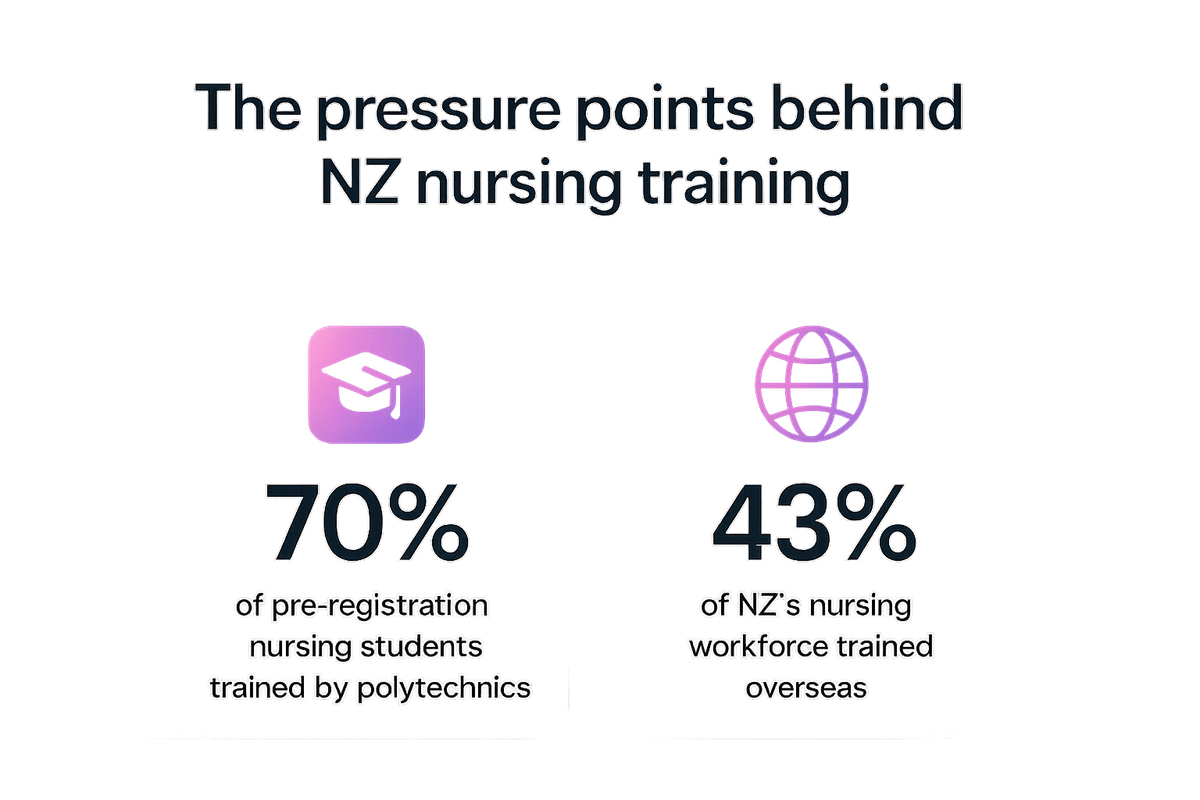
A Kaitiaki Nursing New Zealand research brief (24 November 2025) confirms the polytechnic sector trains roughly 70 percent of all pre-registration nursing students in New Zealand — about three times the volume trained through the university sector. That's not a marginal share. It means most of the country's future nursing workforce moves through programmes now sitting inside newly independent ITPs, each responsible for its own simulation and curriculum decisions.
The same brief goes further, questioning whether aged residential care placements should keep standing in for teaching foundational nursing skills, given how complex the care required in those settings has become. That's a direct challenge to how much of the current placement model can be relied on going forward.
Why the urgency now
Clinical placements are already stretched, and the domestic pipeline of qualified nurses hasn't kept pace with demand.
- Internationally qualified nurses now make up around 43 percent of New Zealand's nursing workforce, with more than 80,000 nurses holding current Annual Practising Certificates in 2026.
- Commentary in The Conversation (4 March 2026) argues this reliance on overseas-trained staff isn't sustainable, and notes New Zealand has no equivalent to Australia's financial support for students facing what's known as placement poverty.
- With no comparable support scheme, students who can't afford unpaid or low-paid placement hours face a real barrier to completing clinical requirements — adding pressure on polytechnics to build competence through means other than scarce placement hours alone.
Put together, that's a workforce shortfall and a placement system under strain, at exactly the moment simulation capacity is being decentralised rather than consolidated.
The cost of rebuilding simulation capacity ten times over
Southern Institute of Technology offers a useful data point on what serious investment in simulation actually costs. SIT has spent close to half a million dollars rebuilding its clinical simulation suite into a training ward designed to mirror real hospital conditions, with school leadership citing improved clinical judgement, decision-making and confidence as the payoff (whatsoninvers.nz, 20 July 2026).
That's one polytechnic, one facility, one investment cycle. Multiply that across ten newly independent institutions, each with different rolls, budgets and starting points, and the collective capital requirement — and the duplicated design effort — becomes significant. Physical rebuilds also take time: procurement, construction, equipment sourcing. Workforce pressure doesn't wait for capital works to finish.
Where technology-enabled practice already fits in
NZ nursing educators aren't waiting for the infrastructure question to resolve itself before engaging with technology-enabled alternatives.
- Nursing Praxis in Aotearoa New Zealand published a discussion on AI's role in nursing education (24 December 2025), engaging directly with where artificial intelligence might sit in clinical teaching.
- Auckland-based simulation educator Erin Carn-Bennett, of the Douglas Starship Simulation Programme, has spoken publicly about AI's emerging role in healthcare simulation (HealthySimulation.com, 21 May 2025).
- Separate NZ research into remote, mixed-reality simulation devices has canvassed nursing educators' and students' perspectives on simulation delivered outside a traditional physical ward — evidence that appetite for scalable, technology-enabled practice already exists in the sector.
None of this replaces hands-on skills work with a mannequin or a real patient. But coached, contextual practice — a difficult handover conversation, an escalating aged-care scenario, a culturally safe interaction with a distressed whānau member — doesn't strictly need a physical ward to be valuable. It needs realism, repetition and feedback. That's exactly the kind of scenario AI-generated role play and simulation can generate quickly and adapt to a learner's actual placement context, without every polytechnic separately commissioning six-figure physical rebuilds to get there.
Key takeaways
- From 1 January 2026, Te Pūkenga has been replaced by 10 stand-alone polytechnics (full disestablishment by 31 December 2026), meaning simulation investment decisions are now made institution by institution.
- Polytechnics train roughly 70 percent of pre-registration nursing students in New Zealand — three times the university sector's volume — so most of this pressure lands inside the newly independent ITPs.
- Around 43 percent of NZ's nursing workforce is internationally trained, and New Zealand has no equivalent to Australia's placement-poverty financial support, intensifying pressure on scarce placement hours.
- Serious physical simulation investment is real money: SIT's rebuild cost close to half a million dollars for one facility.
- NZ nursing-education literature and practitioners are already discussing AI and remote/mixed-reality simulation as ways to extend clinical practice beyond what physical infrastructure alone can deliver.
Our take
Decentralising Te Pūkenga into ten polytechnics risks decentralising the cost of simulation too — ten separate procurement cycles, ten separate design efforts, ten different timelines for getting to the standard SIT has just reached. That's slow at a moment nursing workforce numbers can't afford slow. AI-generated coached practice won't replace a mannequin ward, but it can extend the volume of realistic, contextual scenario practice — handovers, escalation, culturally safe care — without every institution replicating six-figure infrastructure from a standing start. The open question for the sector is how NZQA and individual polytechnics will define what counts as legitimate simulation hours delivered this way, given how central simulation already is to nursing qualifications on the NZQF.
What this looks like in practice for any given polytechnic — and how much of it is generated versus built by hand — is worth sitting with as budgets for 2026 and beyond take shape.
FAQ
Why are NZ polytechnics investing in nursing simulation right now? Because Te Pūkenga has been replaced by 10 stand-alone polytechnics from 1 January 2026 (full disestablishment by 31 December 2026). Each institution now decides its own simulation investment independently, at a time when placement capacity and workforce shortages make realistic clinical practice more critical.
How much of NZ's pre-registration nursing training happens in the polytechnic sector? Around 70 percent, according to a Kaitiaki Nursing New Zealand research brief (24 November 2025) — roughly three times the volume trained through the university sector.
What has SIT done with its nursing simulation facility? Southern Institute of Technology has spent close to half a million dollars rebuilding its clinical simulation suite into a training ward designed to mirror real hospital conditions, aiming to improve clinical judgement, decision-making and confidence (whatsoninvers.nz, 20 July 2026).
Is AI already being discussed in NZ nursing education? Yes. Nursing Praxis in Aotearoa New Zealand published a discussion on AI in nursing education (24 December 2025), and simulation educators such as Auckland's Erin Carn-Bennett of the Douglas Starship Simulation Programme have spoken publicly about AI's role in clinical simulation (HealthySimulation.com, 21 May 2025).
Why does reliance on overseas-trained nurses matter for simulation training? Internationally trained nurses make up about 43 percent of NZ's nursing workforce, with over 80,000 nurses holding current Annual Practising Certificates in 2026 — a domestic training shortfall that increases pressure on polytechnics to build clinical competence at scale beyond scarce, costly placement hours.