NZQA Audit Readiness for PTEs: The Annual Prep Trap
3 August 2026 · 7 min read

Audit-ready used to mean a project you ran in the weeks before an External Evaluation and Review panel turned up. That project doesn't exist any more. From 19 January 2026, NZQA retired the periodic EER cycle for good and replaced it with mandatory annual self-review, a submitted improvement plan, and a dated discussion with the regulator — meaning you now have to be able to prove compliance on any given Tuesday, not just once every few years.
Why this lands on your desk, not just your provider's risk register
The annual self-review summary report isn't a shared institutional artefact you can quietly delegate upward at crunch time. It's a dated, named deliverable submitted through NZQA's provider portal, and it's followed by an annual discussion between your provider's leaders and NZQA about the report and your improvement plan. Someone has to own the evidence trail behind every claim in that report, all year, not assemble it retrospectively. In most PTEs, ITPs and wānanga, that someone is you.
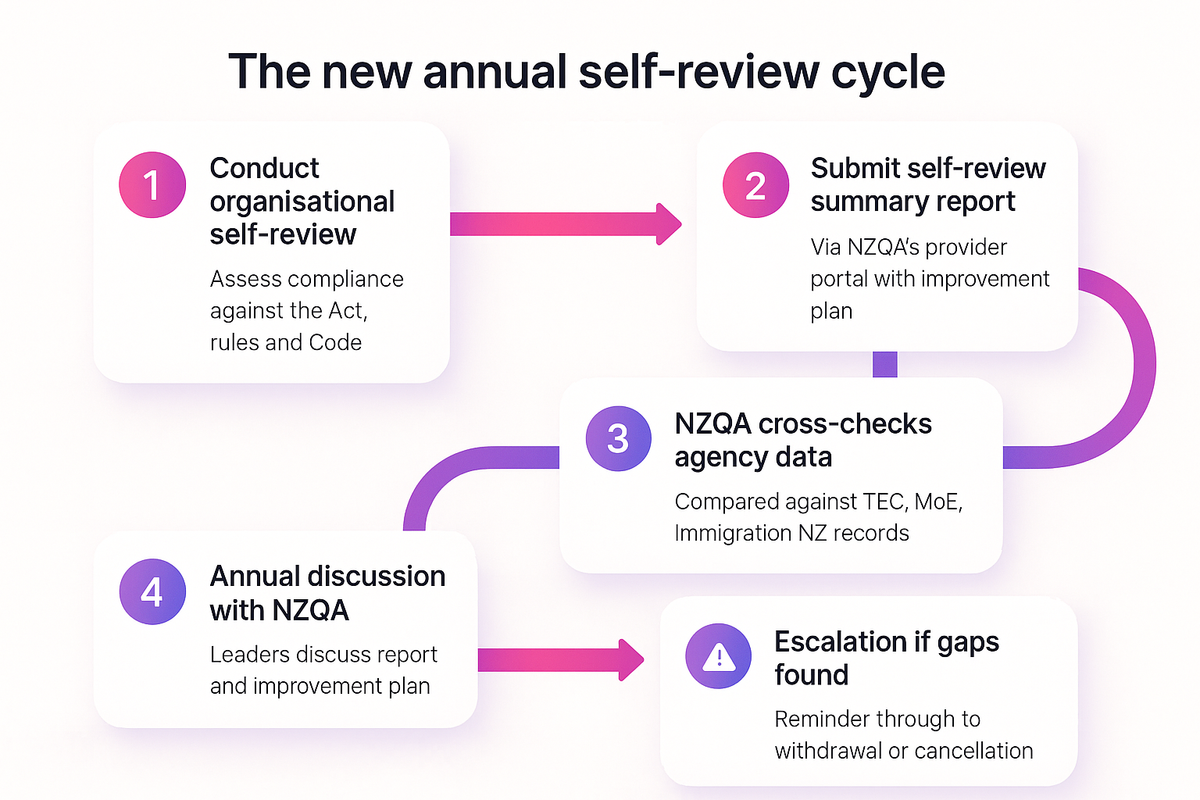
The stakes have also changed shape. NZQA has said plainly that it will weigh your improvement plan against other information and performance data it already holds from agencies including the Tertiary Education Commission, the Ministry of Education and Immigration New Zealand. Under the old EER model, a gap in your evidence was mostly your problem to find. Under self-review, NZQA can spot an inconsistency you didn't even know existed — because it's cross-referencing your story against someone else's data before you've said a word.
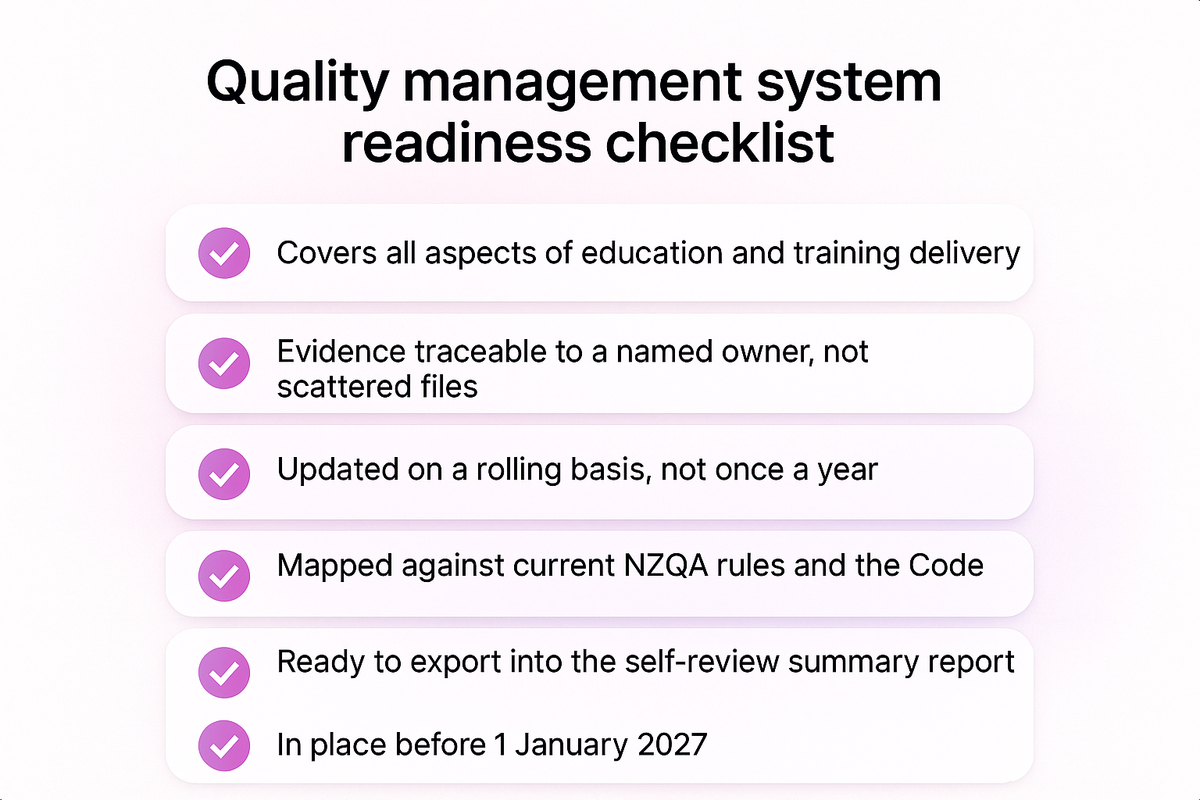
Add to that a hard deadline: every provider must have, or build by 1 January 2027, a quality management system covering all aspects of its education and training. That's not a best-practice nudge. It's a dated compliance obligation you'll be judged against, in the same way you're judged against enrolment data or financial viability.
What actually changed on 19 January 2026
NZQA's new integrated Quality Assurance Framework came into force through a cluster of new rules: the Quality Assurance of Tertiary Education Providers Rules 2026, the Programme Approval, Recognition, and Accreditation Rules 2026, the Private Training Establishment Rules 2026, and the Consent to Assess Against Standards Rules 2026. Together they replace the Quality Assurance (including EER) Rules 2022. NZQA is not beginning any new EER processes from 1 January 2026 — full stop. Instead, every tertiary education provider now runs an organisational self-review each calendar year, and submits a self-review summary report confirming compliance with the Education and Training Act 2020, NZQA's rules, and the Education Code of Practice, with an improvement plan attached.
Worth noting too: sub-contracting requirements have moved out of the Programme Approval, Recognition, and Accreditation Rules and into the Quality Assurance of Tertiary Education Providers Rules 2026. That's not a filing tidy-up — it signals NZQA now treats how you manage sub-contracted delivery as an organisational quality assurance matter, not a programme-level administrative footnote. If you're relying on a partner or sub-contractor for any part of delivery, that relationship now sits inside the same continuous compliance frame as everything else.
Your evidence now has a silent second opinion
This is the part that should change how you spend your week, not just your year. Evidence that lives across shared drives, individual inboxes and personal spreadsheets was always a headache to pull together for an EER. Under annual self-review with cross-agency data checking, it's a structurally bigger risk, because NZQA doesn't need your evidence to spot a problem — it has its own view of enrolment numbers, funding data and immigration compliance already.
That means the traditional audit-panic scramble — reconstructing six months of evidence from memory and inbox searches — doesn't just cost you a stressful fortnight any more. It risks submitting a self-review claim that NZQA can independently contradict, which reads very differently to a regulator than an honest gap you flagged yourself.
The enforcement ladder hasn't moved
NZQA's statutory escalation path is unchanged in substance: a reminder, a formal letter, a requested action plan, and — if things don't improve — withdrawal of programme accreditation, cancellation of consent to assess, or cancellation of PTE registration under the Education and Training Act 2020. The self-review model hasn't softened those consequences. If anything, it's compressed the window between a missed signal and a formal response, because NZQA now has a dated, annual checkpoint to notice that signal in the first place.
Key takeaways
- EER is gone for new processes from 1 January 2026 — annual self-review, a submitted improvement plan, and an NZQA discussion are now the standing requirement for every provider.
- NZQA cross-checks your self-review claims against data it already holds from TEC, the Ministry of Education and Immigration New Zealand, so scattered or stale evidence is a higher-stakes gap than it was under EER.
- Every provider needs a functioning quality management system by 1 January 2027 at the latest — a firm, dated obligation, not an aspiration.
- Code self-review and TEO self-review are now one combined submission cycle, so pastoral care evidence needs the same continuous ownership as academic and operational evidence.
- The statutory enforcement ladder — reminder through to withdrawal or cancellation — is unchanged, so an early-warning gap still carries an existential consequence for registration.
Our take
The rule change is really a change in what NZQA assumes about you. Under EER, the regulator assumed your compliance state was unknown until proven at a point in time. Under annual self-review, it assumes your compliance state is knowable at any time, and is now willing to check that assumption against its own data. That's a meaningful shift in posture, not just paperwork.
The providers who find this transition genuinely stressful are the ones who never left the old rhythm — treating self-review as EER-lite, done once a year in a burst, with evidence pulled together retrospectively from wherever it happens to live. The providers who find it manageable are the ones who've already made continuous evidence ownership a daily habit rather than an annual event, so the self-review report is closer to an export than a reconstruction. If your team is still living in the first camp, the 2027 quality management system deadline is a reasonable forcing function to make the shift now, on your own timeline, rather than in the run-up to your first annual discussion with NZQA.
FAQ
What is the deadline for having a quality management system under the new NZQA rules? Providers that don't already have a quality management system covering all aspects of their education and training must have one in place before 1 January 2027, under the Quality Assurance of Tertiary Education Providers Rules 2026.
Does the annual self-review summary report replace External Evaluation and Review entirely? Yes, for new processes. NZQA is not beginning any new EER processes from 1 January 2026; providers instead complete organisational self-review each calendar year and submit a self-review summary report through NZQA's provider portal, followed by an annual discussion with NZQA about the report and improvement plan.
What happens if NZQA finds a gap between our self-review claims and its own data? NZQA has stated it weighs improvement plans against other information and performance data it holds from agencies including TEC, the Ministry of Education and Immigration New Zealand. Where inconsistencies surface, providers remain subject to the existing statutory escalation ladder under the Education and Training Act 2020 — from an informal reminder through to withdrawal of accreditation or cancellation of registration.
Has Code of Practice self-review changed as part of this? Yes. Self-review and attestation under the Education (Pastoral Care of Tertiary and International Learners) Code of Practice is now combined with the annual TEO self-review submission, consolidating what used to be two separate reporting cycles into one.
Does the new framework affect sub-contracted delivery arrangements? Yes. From 19 January 2026, sub-contracting requirements moved from the Programme Approval, Recognition, and Accreditation Rules into the Quality Assurance of Tertiary Education Providers Rules 2026, positioning sub-contracting oversight as an organisational quality assurance responsibility rather than a programme-level matter.