NZQA Audit Readiness for PTEs: Beyond the Annual Scramble
30 July 2026 · 7 min read

NZQA Audit Readiness for PTEs: Beyond the Annual Scramble
Audit-readiness at a New Zealand PTE used to mean surviving one intense week every few years, when an External Evaluation and Review panel arrived and worked through your evidence. That week is disappearing. Under NZQA's integrated Quality Assurance Framework, ongoing self-review becomes the standing obligation, and the burden of proving quality now sits with you, every year, not with a panel every few years.
Why this hits your desk
You've built your working year around a rhythm: keep the lights green day to day, then throw everything at evidence collation in the run-up to an EER visit. That rhythm is being retired. From July 2026, all non-university tertiary providers, including Industry Skills Boards delivering work-based training, must complete an annual, evidence-based self-review covering the whole organisation — quality assurance systems, learner wellbeing and safety, and learner outcomes — culminating in a meeting with a self-review evaluator (SRE).
iQAF's founding premise is explicit: providers own quality and quality improvement. That's a deliberate shift of responsibility from an external panel's periodic check to your own continuous evidence trail. It lands on your desk because you are, in practice, the person who has to produce that trail, defend it, and know before anyone else if it's got a hole in it.
Layered on top of the framework change is a genuinely busy rule year. Five NZQA rule sets were updated in 2025 alone, and a full Private Training Establishment Rules 2026 replacement took effect on 19 January 2026, bringing new record-keeping obligations with it. Policies and evidence registers now need constant, traceable maintenance — not an annual patch-job before a visit that no longer happens on a fixed cycle.
From event to state: what iQAF actually changes
iQAF went live on 1 January 2026. NZQA has stopped initiating new EER processes, and category ratings will cease as existing EERs are phased out. Immigration New Zealand has said it will grandparent existing EER categories for visa purposes, which is useful to know if a stakeholder asks why your provider's rating looks frozen in time.
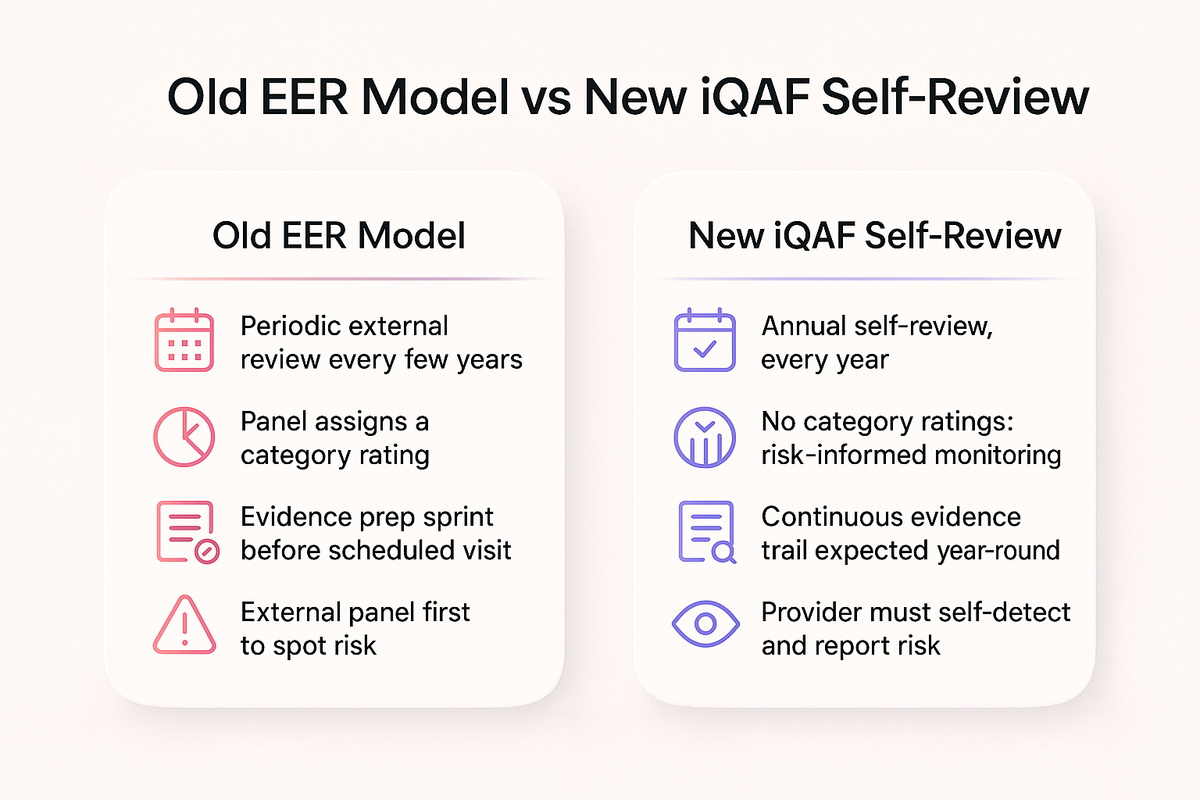
In its place: an annual, whole-of-organisation self-review, backed by an annual meeting with an SRE from July 2026. There's no more "we'll get to that before the next visit." The evidence has to exist continuously, because the review cadence is now every twelve months, not every three to five years.
The paperwork under your paperwork: PTE Rules 2026
The Private Training Establishment Rules 2026 replaced both the PTE Registration Rules 2025 and the PTE Enrolment and Academic Records Rules 2022 from 19 January 2026. The annual registration fee is gone. In its place is a new retention obligation: PTEs must keep all student assessment materials, or full copies, including those from sub-contractors, for at least 12 months from completion.
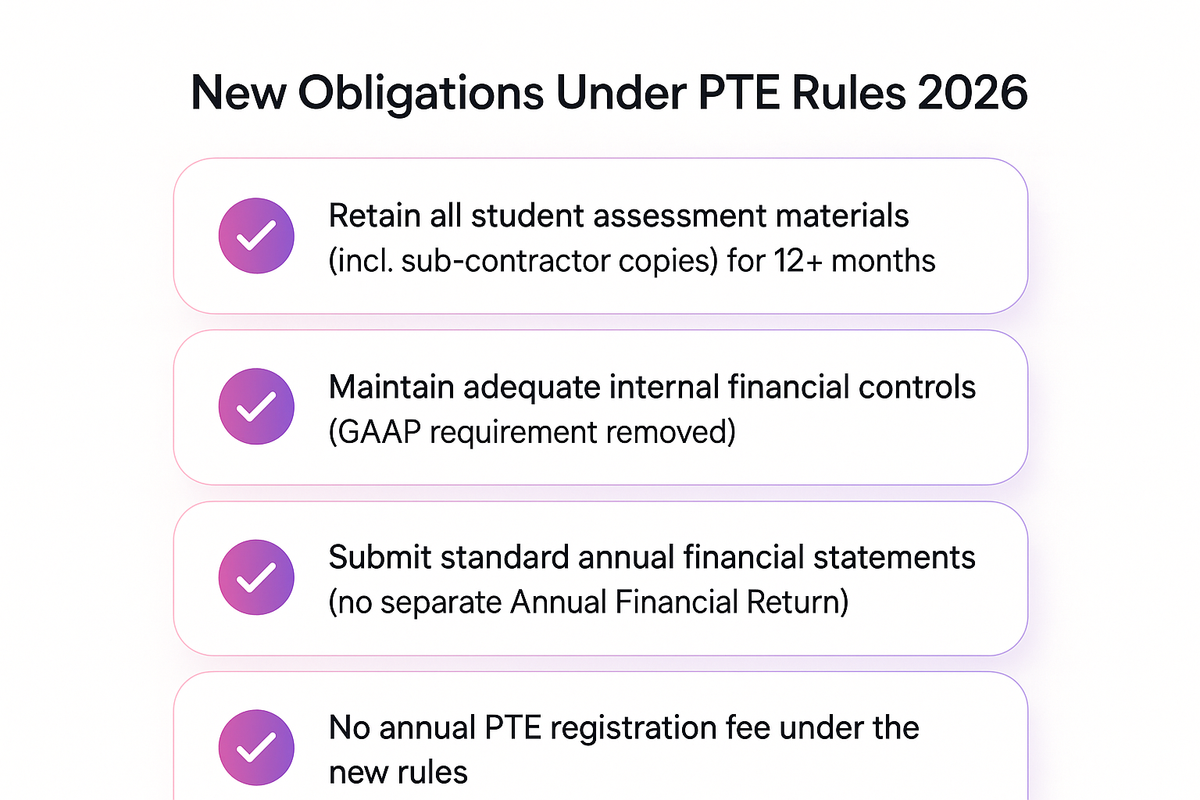
The financial reporting change is easy to miss but matters just as much for your evidence base. PTEs no longer submit a separate Annual Financial Return. Instead they provide standard annual financial statements, and the old GAAP requirement has been replaced with an obligation to maintain adequate internal financial controls. That's not just a finance-team change — it's a compliance evidence change, because "adequate internal controls" is something you now need to be able to demonstrate, not just assert.
Standing obligations don't go away
iQAF and PTE Rules 2026 sit on top of obligations that haven't moved. PTEs must still submit an Annual Declaration (SD01) under Rule 16 of the Quality Assurance (including EER) Rules 2022. Providers must also deliver at least one NZQA-approved programme or micro-credential each year, or risk their registration lapsing. None of this is new, but it's easy for a standing requirement to slip down the priority list when a bigger framework change is dominating your attention — which is exactly when it shouldn't.
Why early detection now matters more than passing day
NZQA's monitoring toolkit escalates in stages: a compliance notice, then conditions on registration, accreditation or consent to assess, then withdrawal of approval, then cancellation of registration. Under the old EER model, an external panel visit was, in effect, a scheduled early-warning check — someone else looking for problems on a known date. Under a self-review model, that external safety net is gone. You are the first line of detection, and the annual SRE meeting only works if you walk in with problems already identified and being worked, not discovered on the day.
There's an upside worth naming here too. iQAF was developed partly in response to sector feedback about rising compliance burden, and NZQA has said the framework is meant to be more risk-informed and lighter-touch for providers who can demonstrate strong performance. Read plainly: a genuinely solid, well-evidenced internal quality management system may now translate into materially less regulatory attention, not just a clean scorecard once every few years.
New entrants, same rules
Your compliance neighbourhood is also getting bigger and more mixed. Industry Skills Board programmes must transition to polytechnics, PTEs or Wānanga by 1 January 2028, and some former Te Pūkenga work-based learning divisions are becoming industry-governed PTEs. That means organisations new to PTE-style obligations are being absorbed into the same annual self-review and record-keeping regime you already operate under — worth knowing if you're benchmarking, hiring, or fielding questions from a board unfamiliar with what PTE registration actually requires day to day.
Key takeaways
- iQAF replaces periodic EER visits with an annual, evidence-based self-review and SRE meeting from July 2026 — audit-readiness is now a continuous state, not a scheduled event.
- PTE Rules 2026 (from 19 January 2026) removed the annual fee but added a 12-month retention obligation for all student assessment materials, including from sub-contractors.
- Annual financial statements and a requirement to maintain adequate internal financial controls have replaced the separate Annual Financial Return and GAAP requirement — treat this as compliance evidence, not just a finance-team task.
- Standing obligations — the SD01 Annual Declaration under Rule 16, and delivering at least one approved programme or micro-credential each year — still apply and still carry registration risk if missed.
- NZQA's escalating enforcement ladder, and the removal of the external panel as an early-warning check, means self-detected risk signals now matter more than ever for the Compliance Manager.
Our take
iQAF is, at heart, an admission that periodic external review was never a great proxy for continuous quality — and a bet that providers can be trusted to prove their own. That's a genuine vote of confidence in the Compliance Manager role, but it's an unfunded one: nobody is handing you extra hours to build a continuous evidence trail, they're just removing the deadline that used to force the work into a manageable sprint. The providers who do well out of this won't be the ones who work harder before each SRE meeting. They'll be the ones who've made evidence-production a routine by-product of how they already run assessment, moderation and enrolment — so the annual review is a formality, not a scramble.
FAQ
Does EER still exist for PTEs? NZQA has stopped starting new EER processes and category ratings will cease as existing EERs are phased out under the integrated Quality Assurance Framework, which went live 1 January 2026. Immigration New Zealand has said it will grandparent existing EER categories for visa purposes.
What is the annual self-review, and when does it start? From July 2026, providers — including Industry Skills Boards delivering work-based training — must complete an annual, evidence-based self-review covering the whole organisation, quality assurance systems, learner wellbeing and safety, and learner outcomes, followed by a meeting with a self-review evaluator (SRE).
What changed with the PTE Rules 2026? Effective 19 January 2026, the PTE Rules 2026 replaced the PTE Registration Rules 2025 and the PTE Enrolment and Academic Records Rules 2022. The annual registration fee was removed, but PTEs must now retain all student assessment materials, or full copies including from sub-contractors, for at least 12 months from completion.
Do I still need to submit an Annual Declaration? Yes. PTEs must still submit an Annual Declaration (SD01) under Rule 16 of the Quality Assurance (including EER) Rules 2022, alongside the new iQAF self-review obligations — this standing requirement hasn't been replaced.