NZQA Compliance Risk Monitoring for Compliance Managers
11 October 2026 · 7 min read
The end of EER categories doesn't make compliance lighter. It makes it continuous. Under iQAF, the question is no longer whether your PTE survives one external review. It is whether you can show, on any given Tuesday, where the organisation stands against the Rules and what you're doing about the gaps.
Why this lands on your desk
You now own an annual cycle, not an event. The Quality Assurance of Tertiary Education Providers Rules 2026 require an up-to-date quality management system, an annual self-review, a report to NZQA and a discussion with NZQA about it. "Audit-ready" is a permanent state, not a pre-visit sprint.
The annual summary report covers teaching and learning, assessment, and learner wellbeing and safety. It also sets out planned improvement actions and answers a thematic question set by NZQA. Someone has to be able to find the evidence behind every one of those sections, and that someone answers for the gaps. Usually that's you.
Meanwhile the resource side is going the wrong way. The brief's sources point to reduced TEC agency funding from 2026/27, and QTI, an industry advocacy body, reports heightened PTE overheads. You are being asked to monitor more, with the same team.
What actually changed
From 1 January 2026, NZQA stopped starting new external evaluation and review (EER) processes and consistency reviews. Those already under way will be completed. The EER category rating system ends. If your marketing still cites an EER category, Rule 10 requires an accompanying statement.
NZQA replaced the Evaluative Quality Assurance Framework with the integrated Quality Assurance Framework (iQAF) for PTEs and institutes of technology and polytechnics. From July 2026, all non-university tertiary providers delivering education and training undertake self-review, including Industry Skills Boards (ISBs) delivering work-based training.
Two details matter for risk. The discussion summary from your annual NZQA meeting is not published. And Pastoral Care Code self-review reporting is now combined with the annual self-review submission, so a Code gap is now a gap in the same document as everything else.
One caution: the sources I've worked from don't give self-review templates or first-submission dates. Check NZQA's self-review page rather than relying on anyone's summary, including this one.
Where risk builds quietly
The old model gave you a deadline and a panic. The new one gives you a year in which small problems can compound without anyone noticing. Four areas deserve attention.
Sub-contracting
Sub-contracting now needs a formal documented arrangement that lets NZQA exercise its quality assurance and enforcement powers over the sub-contractor. Advertising must state that delivery is through a sub-contracting arrangement. Both are binary, checkable facts. That makes them ideal for continuous monitoring, and embarrassing to discover late.
Pastoral Care Code evidence
You still review practice against the Education (Pastoral Care of Tertiary and International Learners) Code of Practice 2021. Immigration NZ is clear that international students cannot study at an institution that is not a Code signatory. Weak Code evidence is a visa and recruitment problem as well as a regulatory one.
Standards ownership
Eight Industry Skills Boards replaced workforce development councils from 1 January 2026 and now lead standard-setting. NZQA rules refer to standards on the Directory of Assessment and Skill Standards. The sources don't list individual standard changes, so your job is to know who to watch (the directory and your relevant ISB) and to log what you checked and when.
Rules and records
The PTE Rules 2026 replace the PTE Registration Rules 2025 and the PTE Enrolment and Academic Records Rules 2022, and remove the annual fee. Non-funded PTEs provide financial returns every two years unless NZQA notifies otherwise. The Programme Approval, Recognition and Accreditation Rules 2026 reduce approval requirements for qualifications made up entirely of skill standards. The Quality Assurance Rules also carry assessment records retention requirements. Fewer approvals can mean looser habits, so keep the records discipline tight.
A quarterly early-warning routine
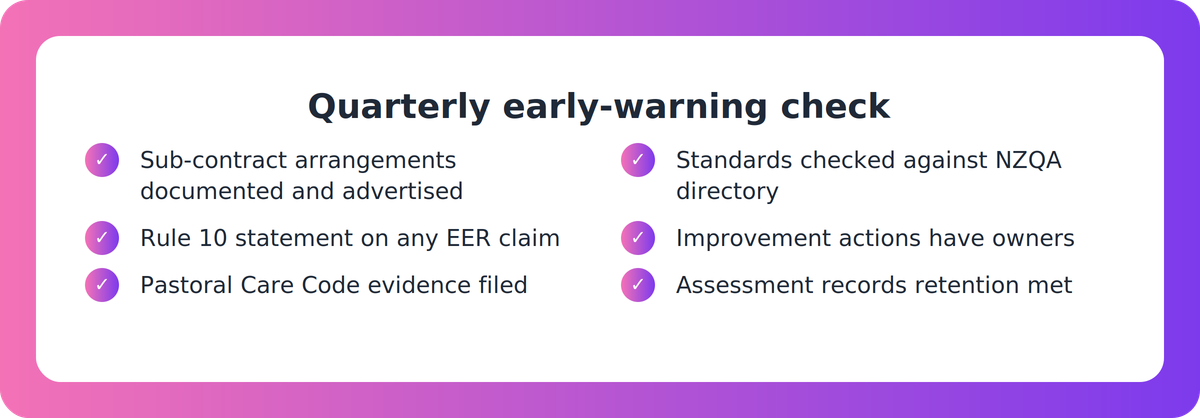
Early warning doesn't need to be sophisticated. It needs to be regular, owned and written down. Start with a short quarterly check that asks whether each item below is true today, who says so, and where the evidence sits.
- Every sub-contractor has a signed, documented arrangement and compliant advertising.
- Every claim to an EER category carries the Rule 10 statement.
- Pastoral Care Code evidence for the year to date is filed where the self-review will draw on it.
- Standards used in programmes have been checked against the NZQA directory and the relevant ISB.
- Each improvement action from the last self-review has an owner and a status.
- Records retention is being met for assessment records.
A red item in March is a task. The same item in a submission window is a finding.
Stop being the bottleneck
If every document review runs through you, your own calendar becomes the compliance risk. Ownership should sit with the people who run the process, such as the programme manager for assessment evidence and the pastoral lead for Code evidence. Your role is to set the standard, sample the work and escalate.
Two changes help straight away. Give each requirement a named owner and a "last verified" date. And move evidence out of inboxes and personal drives into one findable structure. Tooling matters less than the discipline. A well-kept shared folder with owners and dates beats a sophisticated system nobody updates.
Our take
The real risk now isn't failing a review. It's not knowing. A provider with decent practice but scattered evidence will look worse in an annual self-review than one with average practice and a clear, current picture of itself. The advantage goes to whoever can see their own position.
So treat early warning as part of the compliance function, not a nice extra for when things are quiet. Judge yourself by how many problems you found before NZQA, a learner or an international student's visa application did. That's a better measure than a clean audit ever was, and it's the one that will matter under iQAF.
Key takeaways
- From 1 January 2026 NZQA stopped starting new EER processes. Compliance is now an annual, provider-led self-review under iQAF, not an episodic event.
- The annual summary report covers teaching and learning, assessment, and learner wellbeing and safety, plus improvement actions and an NZQA thematic question.
- Sub-contracting arrangements, Code evidence, standards changes and records retention are the areas where risk builds unnoticed.
- A quarterly check with named owners and "last verified" dates is a practical early-warning system you can start this week.
- Reducing your own review bottleneck is a risk control, not just a time-saver.
FAQ
What does the end of EER mean for NZQA compliance risk monitoring?
NZQA has stopped starting new EER processes and consistency reviews, and the EER category rating system ends. Oversight shifts to annual self-review under iQAF, so monitoring has to run all year rather than peak before a visit.
What must the annual self-review summary report cover?
It covers teaching and learning, assessment, and learner wellbeing and safety. It also sets out planned improvement actions and answers a thematic question set by NZQA. You then discuss it with NZQA, and the discussion summary is not published.
Is Pastoral Care Code reporting separate from the self-review?
No. You still review practice against the Code of Practice 2021, but Code self-review reporting is now combined with the annual self-review submission. Immigration NZ also states that international students cannot study at a non-signatory institution.
What should we check for sub-contracted delivery?
Confirm there is a formal documented arrangement that lets NZQA exercise its quality assurance and enforcement powers over the sub-contractor. Also confirm that advertising states delivery is through a sub-contracting arrangement.
A good first step this week is to pick the single item on your list you can't currently evidence in under five minutes, and put a name and a date next to it.