Why Spreadsheets Fail the New NZQA Evidence Audit Trail
10 August 2026 · 6 min read
NZQA has quietly retired the compliance calendar most Compliance Managers have run their whole career against. External Evaluation and Review — the periodic, point-in-time audit that gave you a date to prepare for and a rating to defend — is gone from 1 January 2026, with no new EER or consistency reviews being started and the category rating system tied to it ceasing altogether. What replaces it is not a lighter regime. It is a continuous one, built around an integrated Quality Assurance Framework (iQAF) that expects evidence of compliance to be live, current and traceable on any given Tuesday, not reconstructed from a spreadsheet the week an audit letter arrives.
Why this hits your desk, specifically
This is not a policy shift you can hand to someone else to monitor. Three obligations now sit directly with you.
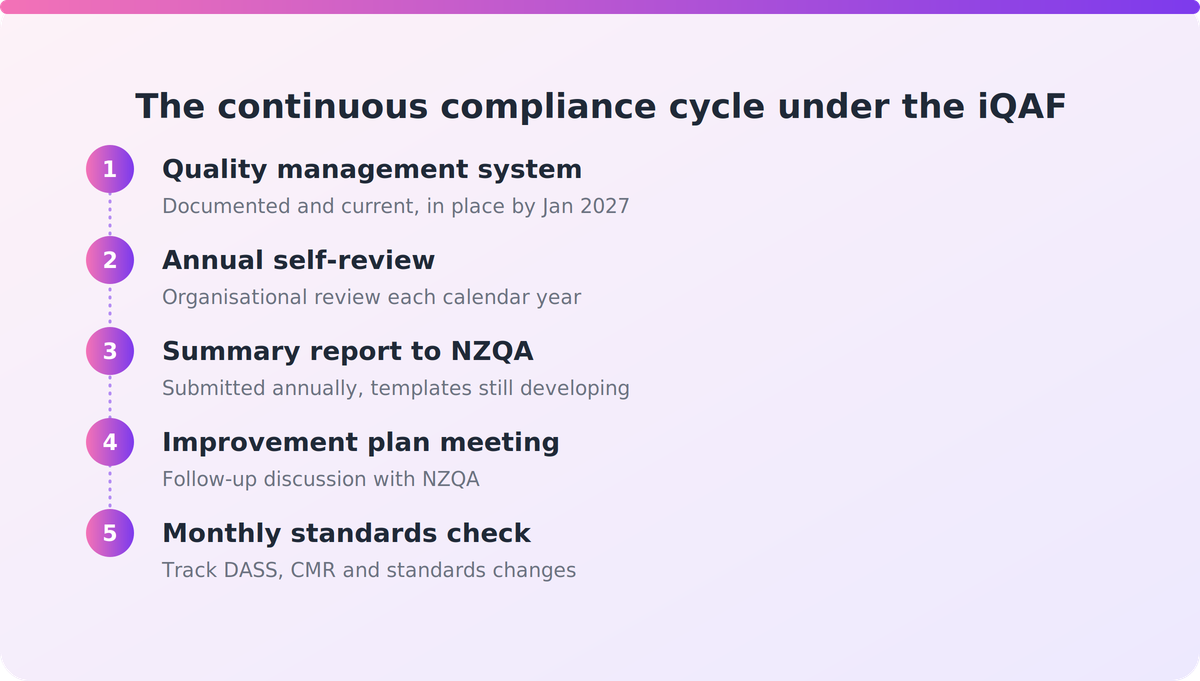
First, every provider must have, create and 'give effect to' a quality management system across all aspects of its education or training — and if you don't already have one, it has to be established before 1 January 2027. NZQA can request a copy at any time, not just during a scheduled review.
Second, you now own an annual cycle: an organisational self-review every calendar year, an annual self-review summary report submitted to NZQA, and a follow-up meeting to discuss your improvement plan. NZQA is still building templates to support this, which means the shape of 'good' evidence is still being defined — all the more reason to have your own house in order early.
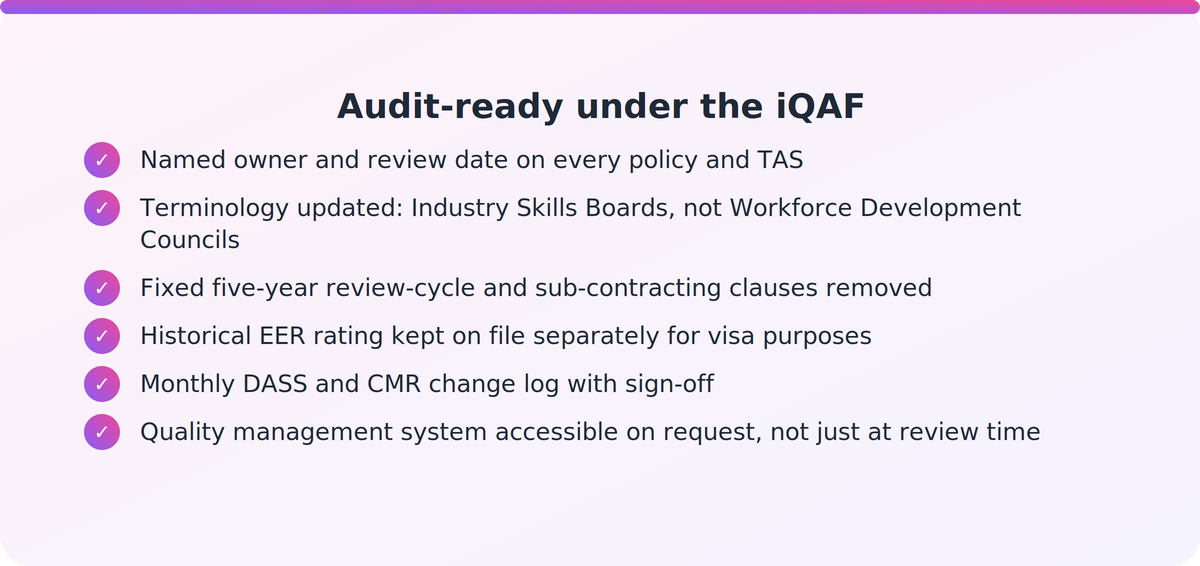
Third, a wholesale rewrite of NZQA's rule suite took effect on 19 January 2026 — the Quality Assurance of Tertiary Education Providers Rules 2026, updated Programme Approval, Recognition and Accreditation Rules, and new DASS Listing and Operational Rules. These replace the 2022 EER-based rules, retire fixed five-year review-cycle clauses and sub-contracting provisions, and rename Workforce Development Councils as Industry Skills Boards. Every TAS document, policy or consent-to-assess record that still references old terminology or old cycle clauses is, technically, out of date until you fix it.
The transitional trap: Immigration New Zealand hasn't moved on yet
Here's the wrinkle that catches people out. NZQA has moved past the EER model, but Immigration New Zealand will keep relying on existing EER ratings for 12 months from early 2026 for visa purposes — including part-time work rights conditions for English language students. That means your last EER rating still matters for a specific, time-limited purpose even though the regime that produced it no longer exists. If your evidence trail can't show both your current iQAF-era compliance position and your historical EER standing, you have a gap that two different regulators are watching for two different reasons.
A monitoring duty with no audit to catch what you miss
Unit standards are being progressively replaced by skill standards, with Standard Setting Bodies setting two-year transition periods and a requirement that skill standards show a clear link to graduate profile outcomes. Consent and Moderation Requirements remain a live, standard-by-standard obligation tracked through the Directory of Assessment and Skill Standards. NZQA reports monthly on approved changes to qualifications, skill and assessment standards, DASS classifications and CMRs — and expects providers to check that feed every month.
That's the structural risk in a spreadsheet-and-inbox system. Under EER, a missed standards change might surface at the next scheduled visit. Under the new framework, there is no scheduled visit. A gap sits there until your annual self-review catches it — or until NZQA asks for your quality management system and finds it hasn't been updated.
Add a sector restructure on top
All of this is landing while the sector itself is mid-restructure. Te Pūkenga (transitionally NZIST) is being disestablished, ten regional polytechnics and eight Industry Skills Boards became operational from 1 January 2026, and a two-year transition governs work-based training arrangements. Commentary has already flagged the compressed stand-up timeline as a risk of operational turbulence through the year. If your provider has any work-based training arrangements or references to the old Workforce Development Council structure, that's another set of documents that needs a currency check, not just a terminology find-and-replace.
What 'audit-ready' actually means now
Audit-ready under EER meant a folder you could hand over on request. Audit-ready under the iQAF means being able to answer, on any day, who owns each policy, when it was last reviewed against current rules, and what evidence supports that review. That's a materially different bar, and it's one a distributed set of spreadsheets, shared drives and email threads was never built to clear.
Key takeaways
- EER and its category ratings end from 1 January 2026; there is no scheduled audit left to catch a gap before NZQA does.
- A documented, functioning quality management system is mandatory by 1 January 2027 if you don't already have one — and NZQA can ask for it at any time.
- The annual self-review summary report and improvement-plan meeting is now a standing obligation you own, not a one-off event.
- Immigration New Zealand keeps relying on old EER ratings for 12 months for visa purposes — track both your historical rating and your current position.
- New rule sets from 19 January 2026 change terminology (Workforce Development Councils to Industry Skills Boards) and remove old review-cycle clauses — check every TAS and policy for stale language.
- Standards, DASS classifications and Consent and Moderation Requirements change monthly; that feed needs a named owner and a checked-off process, not an assumption someone's watching it.
Our take
The end of EER will read to some providers as deregulation. It isn't. It's a shift from episodic scrutiny to standing accountability, and standing accountability is harder to fake with a spreadsheet than a periodic audit ever was. The providers who cope well with 2026 won't be the ones who work hardest in the lead-up to a visit — there isn't one — they'll be the ones who can show, on any random day, exactly who owns each piece of evidence and when it was last checked against current rules. That's less about finding more hours in the week and more about building a system where currency and ownership are the default state of your evidence, not a project you run once a year under pressure.
FAQ
Do we still need to prepare for an EER-style audit in 2026? No. NZQA has discontinued new External Evaluation and Review and consistency reviews from 1 January 2026, and the category rating system tied to EER has ceased. Compliance is now assessed through a standing quality management system and annual self-review under the integrated Quality Assurance Framework, not a scheduled visit.
What happens to our existing EER rating? Your last EER rating stops being NZQA's compliance mechanism, but Immigration New Zealand will keep relying on existing EER ratings for 12 months from early 2026 for visa purposes, including part-time work rights conditions for English language students. Keep that historical rating documented and separate from your current iQAF evidence.
When exactly does our quality management system need to be in place? If you don't already have one covering all aspects of your education or training, it must be established before 1 January 2027. NZQA can request a copy of your quality management system at any time, not only around that deadline.
How often do we need to check for changes to standards and CMRs? NZQA publishes an approved-changes report monthly, covering qualifications, skill and assessment standards, DASS classifications and Consent and Moderation Requirements. Providers are expected to check this feed every month as a standing monitoring duty, independent of any audit cycle.