Interpretation Creep: A Compliance Manager's Guide to NZQA's 2026 Shift
26 August 2026 · 8 min read
Interpretation creep used to be a slow leak — a policy drifting gently away from the standard it was meant to reflect, the kind of thing you'd catch and fix before the next review. In 2026 it isn't slow anymore. NZQA rewrote its quality assurance framework, replaced its core PTE rules, and renamed the standard-setting bodies your TAS documents reference, all inside the same few weeks.
Why this is landing on your desk now
You own the currency of every policy, TAS and evidence file this provider holds. Between late 2025 and early 2026, NZQA revoked and replaced multiple core rule sets — PTE registration, programme approval, qualification and micro-credential listing among them — and the Private Training Establishment Rules 2026 commenced on 19 January, superseding both the 2025 registration rules and the 2022 enrolment and academic records rules. Each of those replacements demands a fresh terminology and evidence check against whatever you've already got filed.
At the same time, the move from External Evaluation and Review (EER) to the integrated Quality Assurance Framework (iQAF) changes what 'audit-ready' actually means. You're no longer preparing a folder for a periodic panel visit — you're expected to produce and defend an ongoing improvement narrative. That redraws your entire evidence-collection cycle, not just the paperwork inside it.
And underneath all of it sits a quieter problem: any TAS still naming Workforce Development Councils or Te Pūkenga as the relevant standard-setting body is now technically wrong. The Education and Training (Vocational Education and Training System) Amendment Act 2025 disestablished Te Pūkenga, re-established 10 regional polytechnics, and replaced Workforce Development Councils with eight Industry Skills Boards, effective 1 January 2026. It's the kind of gap that's easy to miss and, at $190 (GST exclusive) per NZQA staff member per hour for a compliance visit triggered by non-compliance, expensive to have someone else find first.
What moved under you in the space of three weeks
Four changes landed almost on top of each other, and each one touches documents you're responsible for keeping current:
- The iQAF went live on 1 January 2026, replacing the Evaluative Quality Assurance Framework that had run since 2009. NZQA has stopped starting new EER processes and consistency reviews, though any already underway will be completed.
- The PTE Rules 2026 commenced 19 January 2026, replacing the 2025 registration rules and 2022 enrolment and academic records rules. Non-funded PTEs now provide financial returns biennially unless NZQA specifies otherwise, and the old GAAP compliance requirement has been replaced with a requirement for adequate internal financial controls — a different test, not just a renamed form.
- The VET Amendment Act 2025 renamed the bodies behind every TAS that still says Workforce Development Council or Te Pūkenga.
- The annual self-review summary report becomes a standing obligation, with NZQA to issue templates and work through scheduling with providers over the coming months.
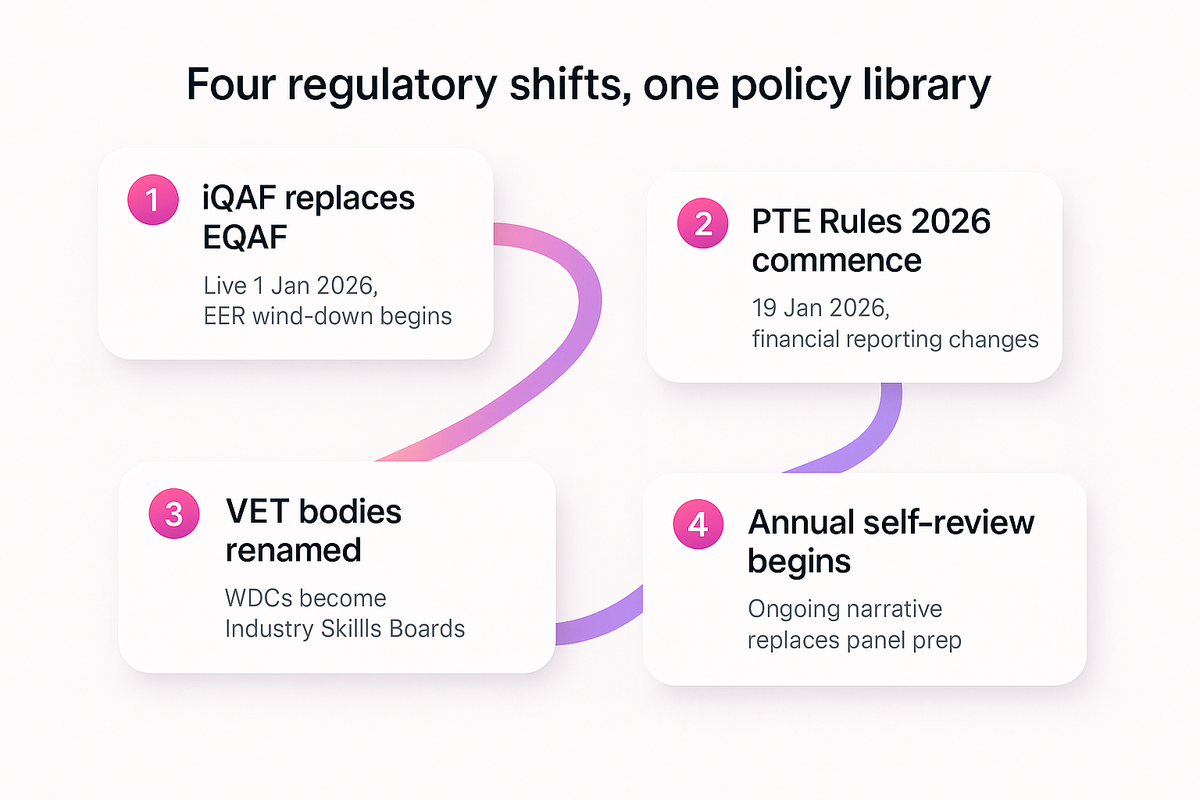
None of these is a single missed clause you can patch in an afternoon. Together, they're a structural resync of your entire policy library against a regulator that rebuilt itself while you weren't looking.
The annual self-review report is a different evidence discipline
Under the iQAF, providers must submit an annual self-review summary report to NZQA and meet to discuss an improvement plan. Providers currently on self-monitoring status will be asked to submit annual programme evaluation reports as a transition measure, and NZQA has been clear that providers are still expected to keep reviewing their practices against the Education Code of Practice as EER winds down.
The practical effect: the old rhythm of 'prepare hard for the panel visit, relax until the next cycle' doesn't map onto this model. You need evidence that reads as a continuous improvement story, defensible in any given month, not a file assembled in the weeks before an external evaluator arrives. That's a change to your evidence-collection calendar, not just your document templates.
The terminology trap sitting in your policy library right now
A TAS that names a Workforce Development Council as the body that set or endorsed a standard is no longer describing anything that exists in that form. It's not the kind of thing that triggers a dramatic breach finding on its own — but it's precisely the sort of small, structural inaccuracy that a compliance visit is built to surface, and NZQA's enforcement toolkit still includes compliance notices, conditions on registration, approval or accreditation, programme withdrawal, and registration cancellation.
Smaller process changes deserve the same scrutiny. NZQA closed the risk@nzqa.govt.nz complaints inbox in favour of a web form. If your complaints-escalation policy or staff guidance still points people to that email address, it's wrong today, not eventually.
Traceability beats a tidy policy library
A well-organised policy library isn't the same thing as a defensible one. What you actually need, for every live document, is a clear line back to the rule, standard or body that justifies it — and a way of knowing the moment that link goes stale.
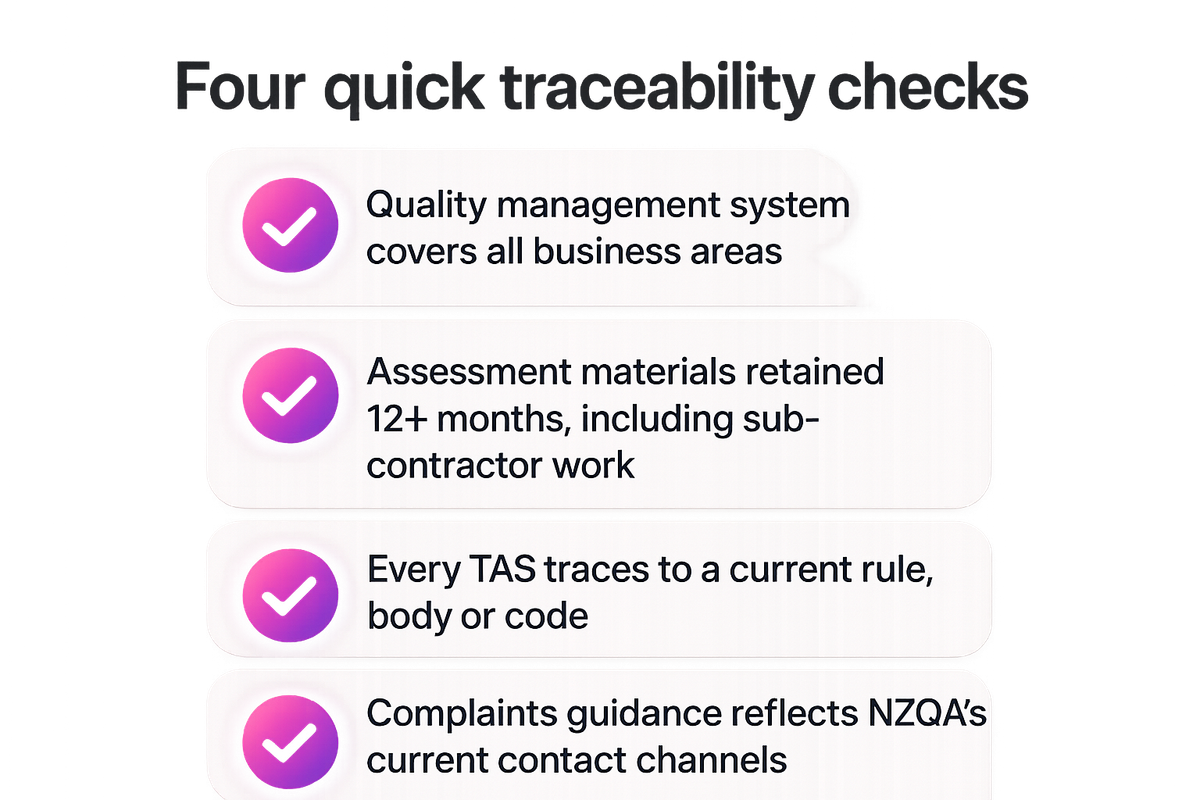
A few things worth checking now rather than at the next scheduled review:
- Your quality management system covers all aspects of your education and training business, not just the parts NZQA has historically asked about.
- Assessment materials, including anything produced by sub-contractors, are retained for at least 12 months from completion.
- Every TAS and policy document can be traced to a current rule, standard-setting body or code — and you know when that link was last verified.
- Complaints and escalation guidance reflects NZQA's current contact channels, not the ones that closed.
Key takeaways
- The iQAF replaced the Evaluative Quality Assurance Framework on 1 January 2026; NZQA has stopped starting new EER and consistency review processes, though in-progress ones will be completed.
- The PTE Rules 2026 (from 19 January 2026) changed financial reporting expectations, including biennial financial returns for non-funded PTEs and a shift from GAAP compliance to a requirement for adequate internal financial controls.
- The VET Amendment Act 2025 disestablished Te Pūkenga, re-established 10 regional polytechnics, and replaced Workforce Development Councils with eight Industry Skills Boards from 1 January 2026 — any TAS naming the old bodies needs updating.
- The annual self-review summary report under the iQAF turns compliance evidence into an ongoing improvement narrative rather than a periodic panel-visit exercise.
- Non-compliance-triggered compliance visits cost $190 (GST exclusive) per NZQA staff member per hour, making the cost of missing a quiet guidance shift direct and budgeted, not abstract.
Our take
The temptation right now is to treat 2026 as one big catch-up project — assign someone to sweep every policy for outdated references, tick it off, move on. That will fix the immediate problem and do nothing for the underlying one. Guidance didn't just change once this year; it changed structurally, and it will keep changing as NZQA issues templates for the self-review report and works through the practical detail of the iQAF over the coming months.
The more durable fix is treating currency as a standing discipline rather than a project: a simple register that maps each policy or TAS to the specific rule, standard or body behind it, with a date it was last checked. Read eQuate and NZQA's rules pages as an ongoing input to that register, not as background reading. It's less satisfying than a big clean-up sprint, but it's the only version of 'audit-ready' that actually survives a year where the regulator itself is still mid-rebuild.
FAQ
What is the iQAF and how is it different from EER? The integrated Quality Assurance Framework went live on 1 January 2026, replacing the Evaluative Quality Assurance Framework that had operated since 2009. NZQA has stopped starting new External Evaluation and Review processes and consistency reviews, though those already underway will be completed, and providers now work towards an annual self-review summary report and improvement-plan discussion instead of a periodic panel visit.
Do we need to update TAS documents that reference Workforce Development Councils? Yes. The Education and Training (Vocational Education and Training System) Amendment Act 2025, in force from 1 January 2026, replaced Workforce Development Councils with eight Industry Skills Boards and disestablished Te Pūkenga in favour of 10 re-established regional polytechnics. Any TAS or policy still naming the old bodies is out of date and should be corrected for accuracy and traceability.
What actually changed under the PTE Rules 2026? The PTE Rules 2026 commenced 19 January 2026, replacing the 2025 registration rules and the 2022 enrolment and academic records rules. Non-funded PTEs now provide financial returns biennially unless NZQA specifies otherwise, and the previous GAAP compliance requirement has been replaced with a requirement to maintain adequate internal financial controls.
What does an NZQA compliance visit cost if it's triggered by non-compliance? NZQA charges $190 per staff member per hour (GST exclusive) for compliance visits and related follow-up triggered by non-compliance, separate from any consequences for registration, approval or accreditation status.