NZQA Self-Assessment Report Process: The Wrong Rhythm
4 October 2026 · 6 min read
NZQA Self-Assessment Report Process: The Wrong Rhythm
The annual NZQA self-review summary is a snapshot, not a compliance rhythm. Under iQAF, NZQA watches your data, complaints and agency alerts all year, and the report is only one input among many. Plan your year around the submission date and you will keep scrambling, with no early warning in between.
Why this lands on your desk
You own audit-readiness and the quality management system the Quality Assurance of Tertiary Education Providers Rules 2026 now require. Those Rules came into force on 19 January 2026. They cover far more than one report: an up-to-date quality management system, annual self-reviews, reporting on the self-review to NZQA and discussing it with them, monitoring, sub-contracting and assessment records retention.
Then there is the clock. NZQA's summary-report template only becomes available on the portal 10 weeks before your submission date. If your evidence lives in drives, inboxes and spreadsheets, ten weeks is a thin margin. It is thinner still when you are also the person every document passes through for review.
What changed: from a review event to a standing conversation
iQAF went live in January 2026. From 1 January, NZQA is not starting any new external evaluation and review (EER) or consistency reviews, though those already underway will be completed. Periodic external review is being replaced by ongoing self-review and dialogue.
Under the new model, every tertiary education organisation conducts an annual self-review, submits a succinct summary on an NZQA template through the TEO Portal (MyNZQA) and takes part in an annual conversation with NZQA. From July 2026 this applies to all non-university tertiary providers, and each provider's first submission is scheduled with NZQA.
Notice the word *succinct*. The summary is short because the work behind it is meant to be continuous. A short report cannot rescue a thin year.
The regulator's view of you is built all year
NZQA has said it may increase the frequency or intensity of monitoring where data, complaints, or alerts from providers and agencies point to risk. It has also said quality assurance activities will be informed by risk assessments. NZQA's final summary reports are not public, so your submission is read inside a picture the regulator is already building from other sources.
That changes what "on track" means. A clean report in the annual cycle doesn't help much if a complaint trend or a critical incident was visible in March and nobody on your side connected it to anything.
The report now carries more than it used to
Code of Pastoral Care self-review reporting is merged into the annual submission. The report must include a published summary of the Code self-review, including on your website, plus annual complaints and critical-incident data.
Complaints and incidents happen on random Tuesdays, not at submission time. Anything you reconstruct from memory in the final weeks will be less accurate than anything logged when it happened. It will also be harder to trace to an owner, and traceability is where your credibility sits.
Other deadlines still run in parallel
The self-review is not the only date you carry. For PTEs, NZQA's registration guidance includes:
- Non-funded PTEs must submit financial statements within 5 months of year-end.
- Fee protection arrangements are checked quarterly or annually, depending on trust type.
- A PTE must deliver at least one NZQA-approved programme or micro-credential each year, or its registration could lapse.
Each has its own owner and evidence trail. If they live in your head, you are the single point of failure for your own compliance calendar.
What a continuous rhythm looks like
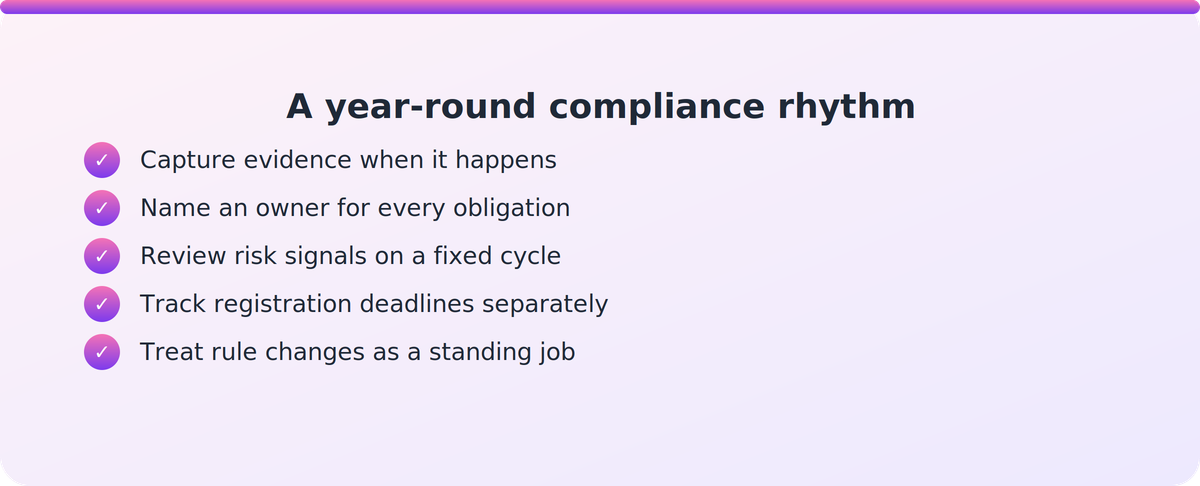
You don't need a new framework. You need a few small habits that run all year, so the annual summary becomes a by-product.
Capture evidence when it happens
File the moderation outcome, the complaint resolution and the incident review into one traceable place at the time. Reconstructing them later costs far more than recording them as they occur.
Name an owner for every obligation
Each item in the Rules, the Code and your registration conditions should have a named person and a review date. "The quality team" is not an owner.
Review risk signals on a fixed cycle
Pick a monthly or quarterly slot. Look at complaints, critical incidents, completion and assessment data, and anything agencies have flagged. Ask the question NZQA will ask: what would this look like from the outside?
Treat change as a standing job
The ground is still moving. The Rules update terminology, with ISBs replacing Workforce Development Councils, and remove the need for ISB endorsement of Type 2 programme changes. NZQA's thematic question for the July 2026 to July 2027 review period is "Use of Generative AI in Delivery and Assessment". Immigration NZ will keep using existing EER ratings for 12 months from early 2026. What replaces them for visa purposes was not confirmed in the sources I reviewed, so watch for updates rather than assume.
Key takeaways
- The annual self-review summary is a snapshot of continuous practice, not the compliance rhythm itself.
- NZQA may increase monitoring when data, complaints or agency alerts signal risk, so your exposure is judged all year.
- The template arrives only 10 weeks before submission. The test is whether evidence already exists and traces to an owner.
- The report now includes Code of Pastoral Care reporting, a published summary, and annual complaints and critical-incident data.
- Registration deadlines such as financial statements and fee protection checks run on separate clocks.
Our take
The temptation is to read iQAF as a lighter regime: no more EER, just a short report. That reading is a trap. The report got shorter because the scrutiny moved from an event to a relationship. A relationship is built from consistent small signals, not from one good presentation.
The best compliance managers will treat the submission as the least interesting part of the year. If the summary takes a heroic effort, the problem is not the template. It is that the year did not leave the evidence behind.
FAQ
When does the NZQA self-review summary have to be submitted?
From July 2026 the annual self-review applies to all non-university tertiary providers. Each provider's first submission is scheduled with NZQA, so confirm your own date rather than assuming a common one. Submission is through the TEO Portal (MyNZQA).
How much notice do we get of the template?
The template becomes available only 10 weeks before your submission date. That is too short to start gathering evidence from scratch, so the evidence needs to exist before the template arrives.
Is the Code of Pastoral Care a separate report now?
No. Code self-review reporting is merged into the annual TEO submission. The report must include a published summary of the Code self-review, including on your website, plus annual complaints and critical-incident data.
Are our summary reports public?
NZQA's final summary reports are not public. However, NZQA has said it will increase monitoring where data, complaints or alerts point to risk, so the report is read alongside other information about you.
A first step for this week
Pick one obligation, such as complaints or critical incidents, and answer three questions. Who owns it? Where does the evidence live today? When did anyone last look at it for risk, not just for the record? If the answers take more than a minute, you have found where to start.