NZQA Skill Standards Transition: Your Content Library
8 October 2026 · 6 min read
Skill standards are replacing unit standards on the NZQA directory, and every assessment tool, assessor guide and study guide you've built is tied to a standard that is changing. The quiet worry for PTEs and polytechnics isn't the new standard. It's whether the library has to be rebuilt, and whether a moderator can follow what you changed.
What actually happens to your unit standard content?
Your content doesn't vanish. But it does drift out of date, one standard at a time, as each unit standard converts to its replacement.
The real cost isn't only rework. Moderators and validators need to see how an existing tool relates to the replacement standard. An upgrade that nobody can trace is hard to defend, even if the assessment itself is sound.
So the choice isn't really "rebuild or ignore". It's whether you can carry content forward with its evidence trail intact.
Treat the mapping as the asset, not the document
A useful principle for any transition: the mapping is the thing worth protecting.
If every assessment tool is mapped to the requirements of its standard, then a converted standard becomes a re-mapping and revision job. If the mapping lives in someone's head, or a spreadsheet last touched in 2021, it becomes a rebuild.
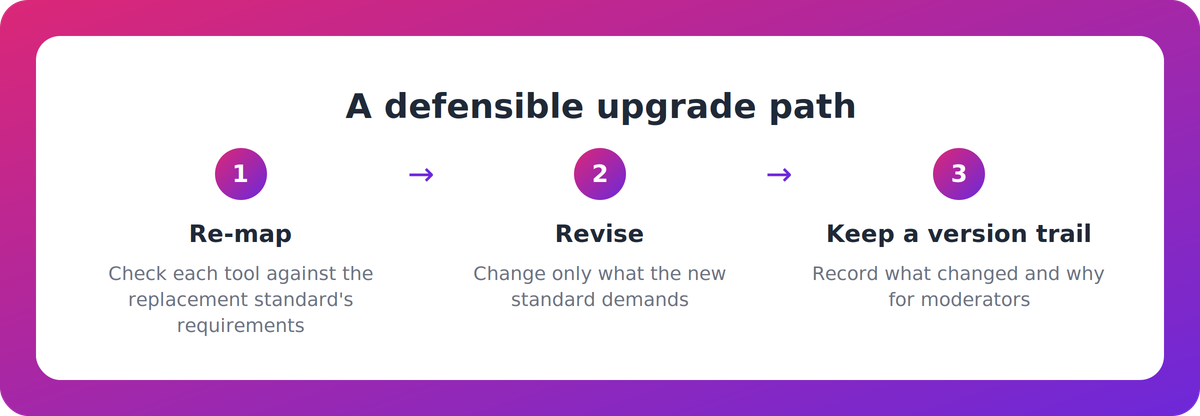
A defensible upgrade path has three parts:
- Re-map. Check each tool against the replacement standard's requirements and record where coverage holds and where it doesn't.
- Revise. Change only what the new standard actually demands.
- Keep a version trail. Record what the tool looked like before, what changed and why, so a moderator can follow it.
None of this is glamorous. It's the difference between "we updated our materials" and "here's the evidence that we did".
How does VETos handle the upgrade?
We built VETos around that principle. It holds both unit standards and skill standards, so you can pull either into a workspace and build directly against it.
For existing materials, VETos supports upgrading unit-standard content to the skill-standard replacement as standards convert. The mapping is regenerated against the new standard, and a version trail is kept that moderators can follow.
For new development, skill standards bring learning outcomes and assessment specifications. VETos drafts assessment and learning content against these directly, and maps everything it generates back to the standard and its requirements.
Knowing when a standard has changed
A conversion you don't notice is a risk in itself. VETos's compliance tracking is built to detect NZQA unit standard updates from the standards you upload, then trigger workflows to regenerate the assessments and resources that depend on them.
The Standards Management System sits underneath this:
- A standards library you can filter by level, expiry and compliance status
- Version control with full history and audit logs
- Tracking of which assessments and learning materials were developed against each standard
That last point matters most in a transition. When a standard changes, you can see what it touches.
Starting from what you're entitled to deliver
Before generating content, VETos builds a map of what the provider is entitled to deliver: qualifications, units or standards, and requirements such as consent and moderation requirements in NZ. It keeps new and upgraded content inside your actual scope.
Where the tool stops and your responsibility starts
Be sceptical of anyone who says software makes a transition compliant. It doesn't.
- NZQA rules out generative AI for external assessment.
- For internal assessment, you stay responsible for keeping your moderation systems and AI-use policies current.
- AI can build a traceable coverage map. It can't prove compliance by itself.
VETos includes a QA Engine that checks assessments against the NZQA Principles of Assessment and external moderation expectations. That's a useful pre-moderation check. It doesn't replace your moderator.
We should also be straight about what we can't tell you. We haven't documented an NZ customer outcome tied specifically to a skill standards conversion, and we don't state how much existing content converts automatically. Expect to review and revise, not click and forget. The one speed figure we can point to, 80% faster content development in a Mast Academy case study, is a general measure of content development, not a skill standards conversion result.
What to ask any vendor about the transition
If you're weighing approaches, these four questions separate a real upgrade path from a rewrite with better branding:
- How do you detect superseded standards? Manual re-uploads, or tracked changes that flag dependent content?
- What happens to existing mapping? Is it regenerated against the replacement standard, or discarded?
- Is there a version history a moderator can follow? Ask to see one, including who changed what.
- How much converts automatically? A straight answer includes what still needs human review.
If the answers are vague, the audit trail probably is too.
Key takeaways
- Your unit standard library doesn't have to be rebuilt, but it does need re-mapping to the replacement skill standards.
- The mapping is the asset. Protect it, and a converted standard becomes a revision job.
- An upgrade without a version trail is hard to defend to a moderator.
- VETos holds both standard types, regenerates mapping on upgrade and keeps a version trail. The extent of automatic conversion isn't stated, so plan for human review.
- Tools don't remove accountability. Moderation and AI-use policy stay with the provider.
Our take
Most providers will treat the skill standards shift as a content problem. It's an evidence problem. The PTEs that handle it well will be the ones who can show a moderator, standard by standard, what changed and why. We'd rather you ask hard questions about traceability than be impressed by generation speed.
FAQ
Do I have to rebuild my assessments when a unit standard converts to a skill standard?
Not necessarily. The practical approach is to re-map existing tools against the replacement standard, revise what the new requirements demand, and keep a version record. VETos supports upgrading unit-standard materials to their skill-standard replacements, but how much converts automatically isn't stated, so plan for review.
Why does a version trail matter for moderation?
Moderators and validators need to see how existing materials relate to the replacement standard. A version trail shows what changed, when and why. Without it, an upgraded assessment is hard to defend even if the content is good.
Can VETos tell me when a unit standard changes?
Its compliance tracking is described as detecting NZQA unit standard updates from standards you upload, then triggering workflows to regenerate dependent assessments and resources. It also tracks which materials were developed against each standard.
Does using AI make my assessments compliant with NZQA?
No. AI can build a traceable coverage map and run a QA check against the NZQA Principles of Assessment, but it can't prove compliance alone. NZQA rules out generative AI for external assessment, and providers must keep moderation systems and AI-use policies current for internal assessment.
Can I build new content directly against skill standards?
Yes. Skill standards include learning outcomes and assessment specifications. VETos can draft assessment tools, assessor guides, study guides and SCORM packages against them, mapped back to the standard's requirements.
Take a closer look
If you're sizing up the transition across a large library, it's worth seeing how upgrade, re-mapping and version history work on one of your own standards. You can explore VETos for NZ at supahuman.com and bring your four vendor questions with you.