NZQA Standard Coverage Mapping After EER
5 October 2026 · 7 min read
From 1 January 2026, NZQA stopped starting new external evaluation and review processes, so the burden of proof now sits with providers. A list of standards on a programme document won't satisfy eight Industry Skills Boards. You need current evidence, in your own records, of what each assessment covers against each standard.
What actually changed on 1 January 2026?
NZQA's new tertiary quality assurance framework went live on 1 January 2026. NZQA stopped starting new EER processes and consistency reviews. Providers now submit an annual self-review summary report and meet NZQA to discuss their improvement plan (NZQA, 15 January 2026).
The integrated quality assurance framework (iQAF) covers PTEs, wānanga, polytechnics, ISBs and government training establishments. NZQA's quality assurance hub notes that eight ISBs and ten polytechnics were stood up on the same date.
The practical effect is simple. No outside reviewer arrives to build the picture of your assessment quality for you. If coverage is to be demonstrated, it has to come from your own files.
Why doesn't a standards list hold up any more?
A tick-box map says "this programme includes these standards". It doesn't say what a learner is actually asked to do, or whether that task covers every element and performance criterion.
That was always a thin defence. It's thinner now, for three reasons:
- Self-review needs evidence. You're describing your own quality, so claims need something behind them.
- Boards have their own expectations. Moderation, consent and endorsement are no longer one-size-fits-all.
- The standards themselves are moving. Coverage you proved against a unit standard may not transfer.
We found no NZQA or TEC readiness data on how providers are coping with this, so treat what follows as analysis, not a benchmark.
Why can't you carry coverage across from unit standards?
Skill standards are progressively replacing unit standards, sector by sector. They don't map one-to-one. NZQA's guidelines for listing skill standards on the DASS (April 2025 version) say a skill standard may incorporate elements of superseded unit standards that are still current and required.
So a new skill standard might pull from several old unit standards, or only part of one. Copying last year's mapping across is a guess.
Some unit standards won't be replaced at all. The Services ISB's Cookery Level 3 & 4 review found 15 of 32 unit standards with no usage since at least 2021. It proposes to expire them without replacement.
If your programme leans on any of those, you need to know exactly what it covers today and what, if anything, picks that up later.
Which review timelines touch your scope?
Replacement is running on fixed, sector-specific timelines. Two examples from the research:
- Services ISB, SELO review (1 qualification, 6 unit standards): review meetings planned for September 2026, registration by January 2027.
- Manufacturing and Engineering ISB, fire protection review: proposes skill standards in 2028–29 across nine qualifications.
You don't need to track every board. You do need to know which reviews touch your consent and programme scope, and roughly when.
How do ISB expectations differ?
Compliance now varies by board, and it's risk-targeted. The Transport ISB's 2026 Quality Assurance Approach covers moderation, provider engagement, consent to assess and programme endorsement. The Construction and Specialist Trades ISB has published a 2026 External Moderation Plan. It says it is strengthening assurance around learner competence in high-risk activities such as working at height and crane operation.
If you deliver across sectors, you'll face different moderation emphasis from different boards. A single generic mapping document won't answer all of them.
NZQA's own rules have shifted too:
- Consent-to-assess applicants must show how they'll meet the new Quality Assurance of Tertiary Education Providers Rules, and keep complying.
- Programme approval requirements are reduced for qualifications made up entirely of skill standards.
- NZQA's guidance on assuring national consistency (Te Hono o Te Kahurangi) is under review. Revised guidance is expected after 1 September 2026, so check NZQA directly for the current status.
What does an auditable coverage map look like?
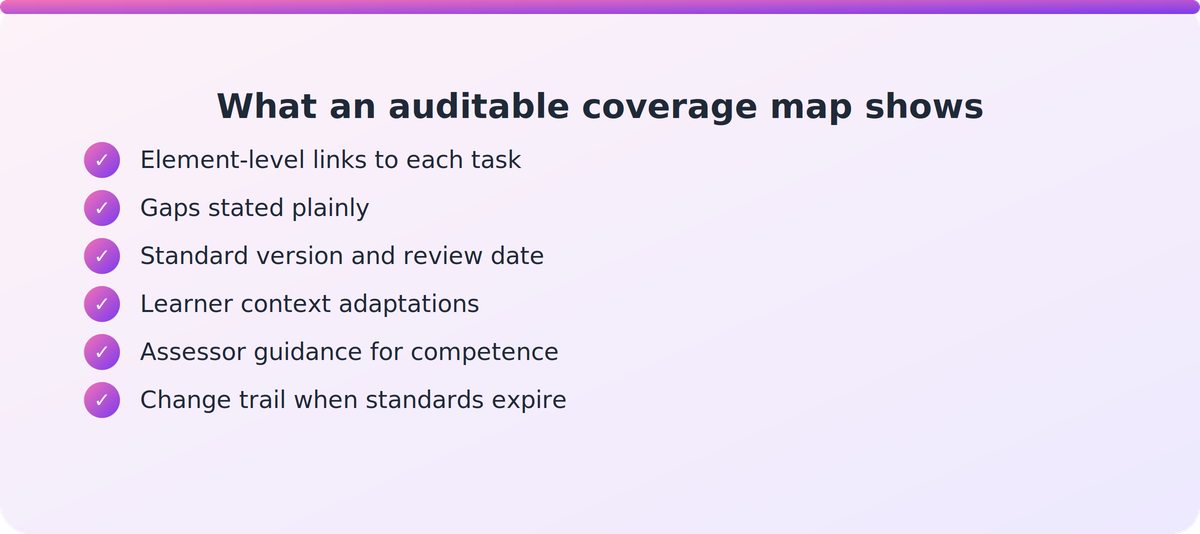
This is our interpretation, not an NZQA template. But a map that can survive scrutiny from a board or NZQA should show the following.
A coverage record you can defend
- Element-level links. Each assessment task is tied to specific outcomes and performance criteria, not just the standard's title.
- Gaps stated plainly. Anything the assessment doesn't cover is visible, along with what you're doing about it.
- Version and date. You can say which version of the standard you mapped against, and when you last checked.
- Learner context. Where assessment is adapted for ESOL, LLN, workplace or distance delivery, the map shows it still covers the same ground.
- Assessor guidance. The guide tells assessors what a competent response looks like, so moderation isn't reconstructing intent after the fact.
- A change trail. When a standard is expired or replaced, you can show what you reviewed and what you changed.
Doing this by hand across a full portfolio is slow, which is why many providers put it off. It's also the problem we build tooling for at Supahuman. Whatever method you use, the test is the same: could someone else read your record and agree the coverage is real?
A useful exercise for your next self-review is to pick one qualification and try to prove coverage from the file alone, without anyone explaining it.
Key takeaways
- NZQA stopped initiating new EER processes on 1 January 2026. Providers now evidence quality through annual self-review and a conversation with NZQA.
- Eight ISBs set their own moderation, consent and endorsement expectations, and some are risk-targeted.
- Skill standards don't map one-to-one onto unit standards, so coverage must be re-checked, not carried across.
- Some unit standards are being expired without replacement. Cookery Level 3 & 4 alone has 15 of 32 on the list.
- A defensible map links tasks to elements, shows gaps, and records the version and date of review.
Our take
The providers who struggle won't be the ones with weak assessment. They'll be the ones whose good assessment can't be shown to cover what the standard now asks. With EER gone, your records are the review. We think the sensible move is to treat coverage mapping as a living quality record, rebuilt whenever a standard changes, not a document written once for consent and filed away.
FAQ
Did NZQA abolish external evaluation and review?
NZQA stopped starting new EER processes and consistency reviews from 1 January 2026. Under the new framework, providers submit an annual self-review summary report and meet NZQA to discuss their improvement plan.
Do skill standards map directly onto unit standards?
No. NZQA's DASS guidelines say a skill standard may incorporate elements of superseded unit standards that are still current and required. Providers should re-check coverage against each new skill standard rather than assuming the old mapping carries over.
Are all expiring unit standards being replaced?
Not necessarily. The Services ISB's Cookery Level 3 & 4 review found 15 of 32 unit standards with no usage since at least 2021 and proposes to expire them without replacement. Check the review for your sector.
Do all ISBs apply the same moderation expectations?
No. The Transport ISB has a 2026 Quality Assurance Approach, and the Construction and Specialist Trades ISB has a 2026 External Moderation Plan focused on high-risk activities. Check the board that covers your standards.
Is NZQA's national consistency guidance changing?
NZQA's guidance on assuring national consistency (Te Hono o Te Kahurangi) is under review, with revised guidance expected after 1 September 2026. Confirm the current status with NZQA directly.