Standards Drift: A Compliance Manager's Guide to NZQA's 2026 Reset
1 September 2026 · 6 min read
NZQA didn't tweak the External Evaluation and Review model this year — it retired it. From 19 January 2026, the integrated Quality Assurance Framework (iQAF) went live alongside rewritten Programme Approval, PTE, DAS and Qualification Rules, all reissued within weeks of each other. For Compliance Managers, that turns "audit-ready" from something you prepare for periodically into a state you have to prove, evidence and repeat every single year.
Why this lands on your desk now
This isn't background regulatory noise — it's a dated deliverable. Every provider without an existing quality management system meeting Rule 4(2) of the Quality Assurance of Tertiary Education Providers Rules must build one before 1 January 2027, and produce it to NZQA on request. That's a hard deadline with your name on it, not a future-tense policy discussion.
On top of that, the annual TEO self-review summary report — submitted through the NZQA provider portal in structured, character-limited fields (2,000 characters per initiative) — makes you personally accountable for surfacing areas for improvement every calendar year. Under the old EER cycle, that scrutiny landed every three to four years and an external evaluator did some of the judgement work for you. Now it's annual, and it's yours alone.
What actually changed, and when
The pace of change in early 2026 is the part worth sitting with. In a matter of weeks, NZQA reissued or replaced:
- The Quality Assurance of Tertiary Education Providers Rules — ending new EER and consistency review processes, introducing the annual TEO self-review obligation from July 2026 for all non-university providers.
- The Directory of Assessment and Skill Standards Listing and Operational Rules — removing the five-year maximum review period for standards and introducing 'current', 'expiring' and 'discontinued' statuses.
- The Qualification and Micro-credential Listing and Operational Rules — similarly removing maximum review periods and introducing an expiring-status process for qualifications and micro-credentials not reviewed or awarded within a specified window.
- The Private Training Establishment (PTE) Rules 2026 — replacing EER with self-review and monitoring, and moving the annual financial return to a biennial cycle unless NZQA directs otherwise for a specific PTE.
Each of these instruments touches a different document set you're responsible for: your programme approval files, your standards register, your PTE compliance calendar. None of them landed on the same day, and none of them wait for you to catch up.
The end of the external checkpoint
For years, an EER report gave you something concrete to point to — a category rating, an external judgement that validated (or challenged) your internal evidence base. That checkpoint is gone. NZQA's self-review summaries aren't published, so there's no external report to lean on and no category rating to reference in your next board paper.
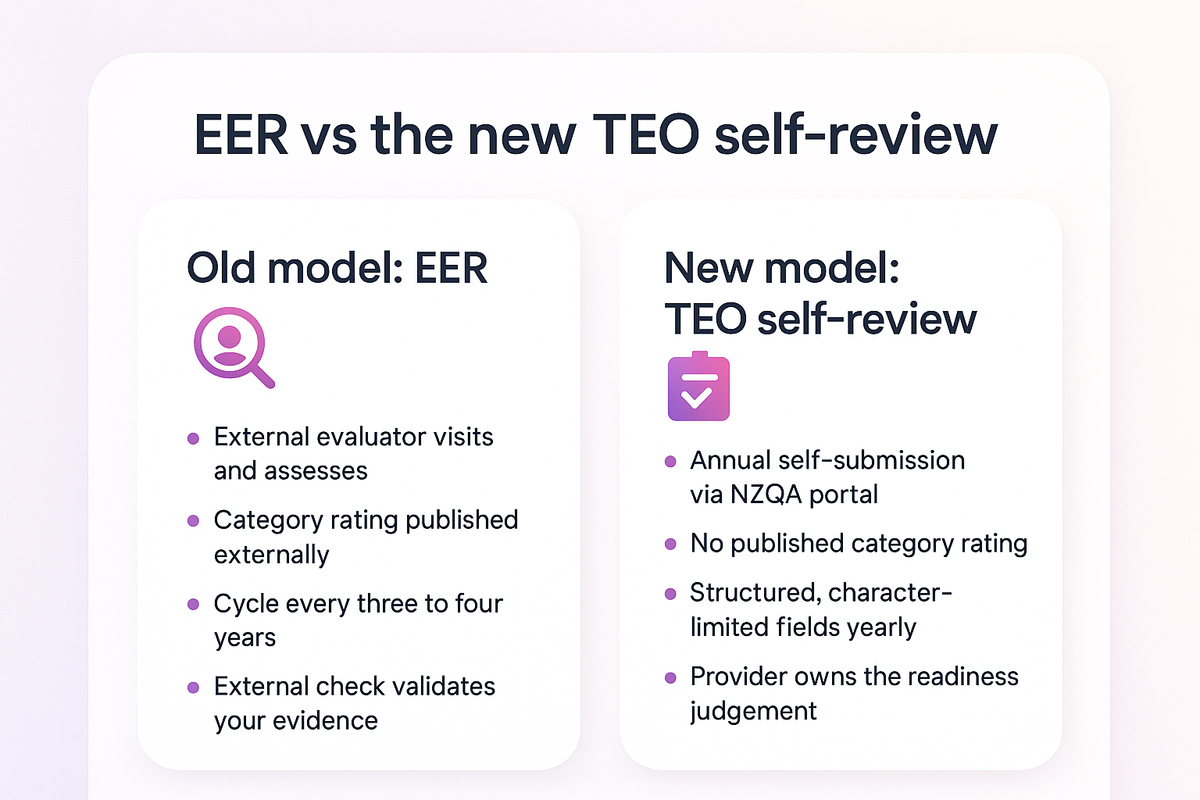
That shift matters more than it sounds. It means the burden of judging your own audit-readiness now sits entirely inside your organisation, with no external second opinion until NZQA specifically asks to see your quality management system.
Where drift hides
The sector-wide restructure compounds this. Te Pūkenga was disestablished from 1 January 2026, Workforce Development Councils ceased on 19 December 2025, and eight Industry Skills Boards commenced on 1 January 2026. Every policy, training and assessment strategy, and evidence document that still references a WDC, an old EER category, or a five-year standards review cycle is technically out of date — even if nobody has flagged it yet.
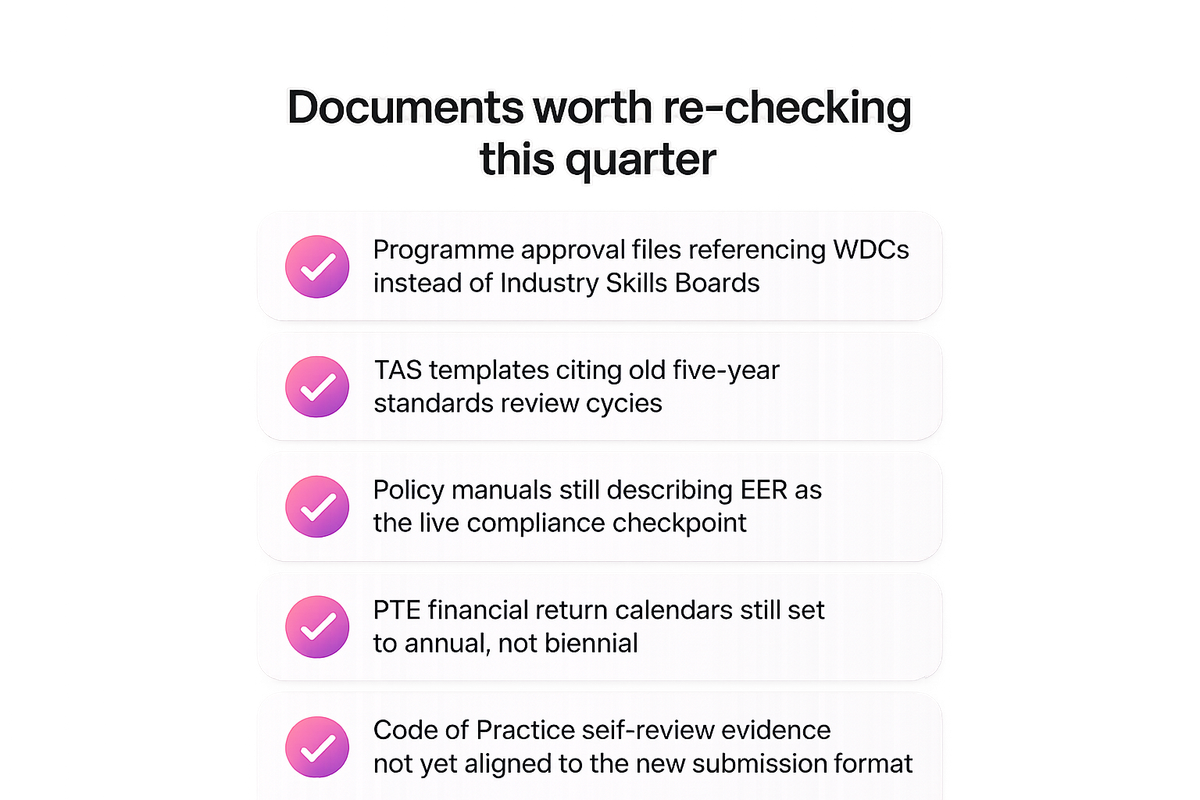
This is where the real risk sits for a Compliance Manager: not in failing an audit, but in not noticing that the internal record has quietly fallen out of step with what the current Rules actually say.
Key takeaways
- Build (or confirm) a Rule 4(2) quality management system before 1 January 2027 — this is a fixed deadline, not a rolling target.
- The annual TEO self-review summary report is submitted via the NZQA provider portal in structured, character-limited fields, confirming compliance with the Act, the Rules and the Code.
- Code of Practice self-review is being folded into the same annual submission; in the interim, you still need to complete a Code self-review and publish a summary on your website, without a separate attestation.
- Standards and qualifications no longer expire on a fixed five-year cycle — track 'current', 'expiring' and 'discontinued' statuses directly, because the old review-period assumption in your documentation is now wrong.
- Audit your policy and TAS language for outdated references — WDCs, EER categories, annual PTE financial returns — since these instruments changed within weeks of each other in early 2026.
Our take
The shift from EER to annual self-review isn't really about a lighter compliance burden, even though NZQA has framed some of it that way — fewer site visits, a biennial financial return for PTEs. It's about NZQA moving the evidentiary weight onto the provider, permanently. A three-year cycle gave you time to catch drift before an evaluator did. An annual, self-submitted, unpublished report gives you no such buffer, and no external validation to fall back on if your internal judgement is wrong.
The providers that handle this well won't be the ones who work harder before their next submission. They'll be the ones who treat every Rules change — DAS statuses, qualification expiry, ISB terminology — as a live update to a running record, not a document to revisit next audit cycle. That's a genuine change in how compliance work has to be structured, not just a change in paperwork.
FAQ
What's the deadline for the Rule 4(2) quality management system? Providers that don't already have a quality management system meeting Rule 4(2) of the Quality Assurance of Tertiary Education Providers Rules must establish one before 1 January 2027, and be able to produce it to NZQA on request.
Does the annual TEO self-review replace Code of Practice self-review too? Code of Practice self-review is being folded into the same annual TEO self-review submission over time. In the interim, providers must still complete a Code self-review and publish a summary on their website, with no separate attestation required.
Can I still reference an EER category rating in reporting or marketing? NZQA has ended new EER and consistency review processes as part of the iQAF, and TEO self-review summaries are not published externally, so there's no new category rating being generated to reference going forward.
How do the DAS and Qualification Rules changes affect how I track standards? The 2026 Directory of Assessment and Skill Standards Rules and the Qualification and Micro-credential Listing and Operational Rules both removed fixed maximum review periods, replacing them with 'current', 'expiring' and 'discontinued' statuses — meaning you need to check status directly rather than assume a standard is valid for a set number of years.
Worth asking yourself this week: if NZQA asked to see your quality management system tomorrow, would every document in it use today's terminology — or last year's?