NZQA Standard Changed? Here's Your Compliance Workflow
15 July 2026 · 6 min read
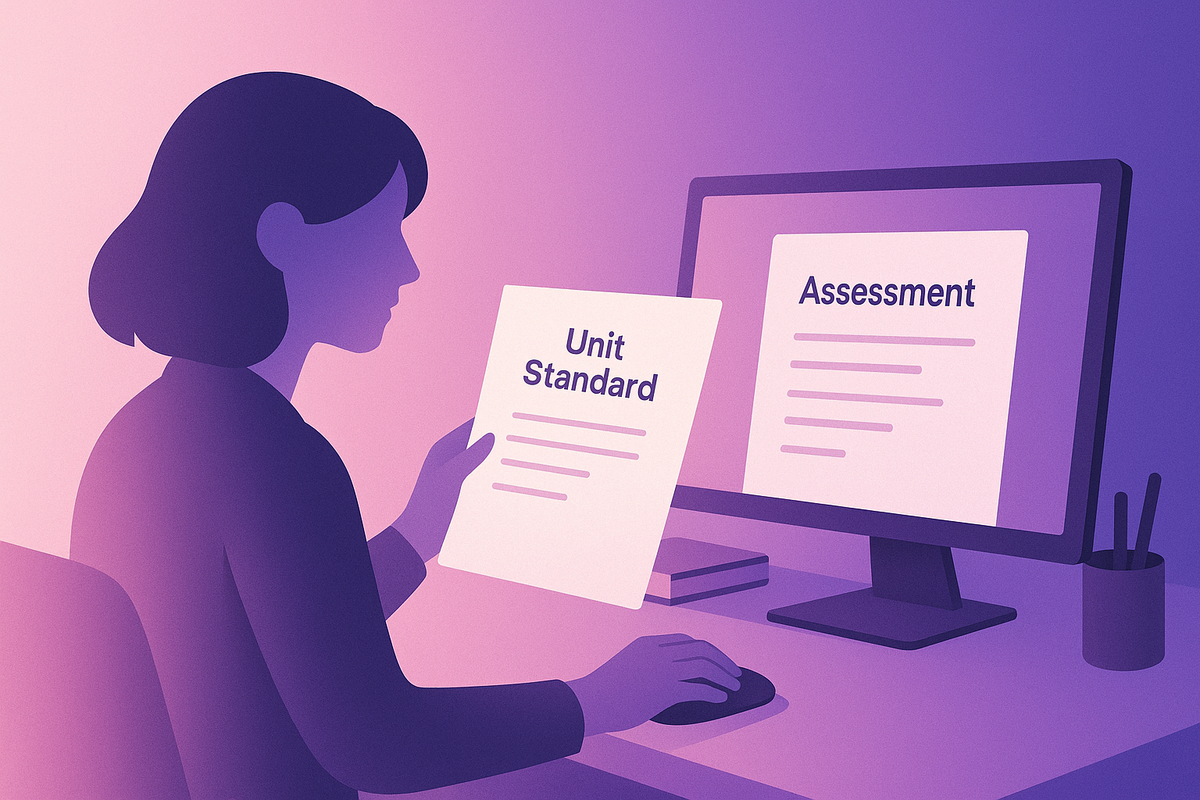
A unit standard gets reviewed, a version number ticks over, and somewhere in your resource library an assessment, a learner guide or an assessor tool quietly stops matching what NZQA now expects. Most Private Training Establishments and Industry Training Organisations only find out at moderation or during an NZQA audit — by which point it's a finding, not a fix.
Why standard revisions are so easy to miss
NZQA reviews and revises unit standards on an ongoing basis, and providers are expected to keep delivery and assessment aligned to the current version. In practice, most programme teams track this manually — someone checks the NZQA website periodically, or a revision only comes to light when a moderator flags a mismatch.
That approach breaks down fast when you're running more than a handful of qualifications:
- A single revision can touch assessments, training material, assessor guides and moderation records all at once.
- Providers delivering across classroom, workplace and distance modes often hold several resource variants per standard, all needing the same update.
- ESOL and LLN learner materials are frequently adapted versions of a base assessment — meaning a revision multiplies the update workload rather than just adding one task to it.
- Nobody owns "watching" every standard a PTE or ITO holds, so the gap between revision and detection can stretch for months.
The cost isn't abstract. Outdated resources raise the risk of a non-compliance finding at your next NZQA audit, with funding and reputational consequences that follow. And by the time it surfaces at moderation, you're rewriting under time pressure instead of on your own schedule.
How VETos closes the gap between a standard update and your assessments
VETos is built to catch this earlier. It includes automated monitoring of NZQA unit standard updates, checked directly against the standards a provider has uploaded into their own library — not a generic feed, but your specific set of qualifications and standards.
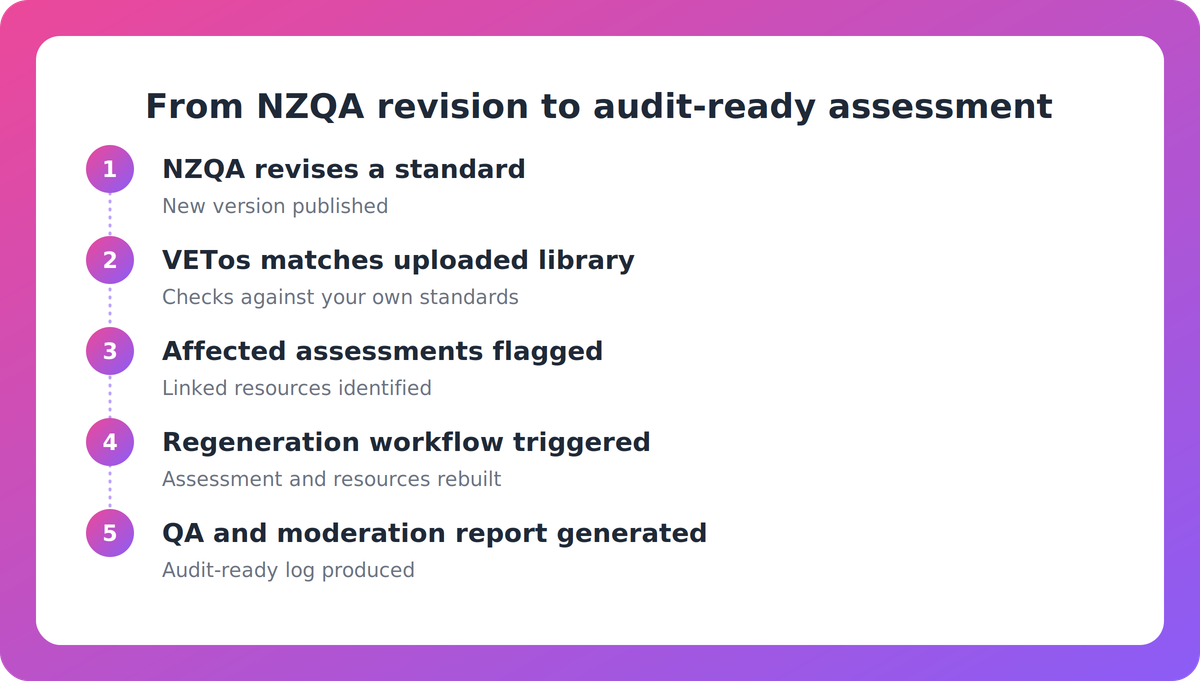
When a relevant change is detected, VETos can trigger a workflow to regenerate the assessments and resources tied to that standard, rather than leaving a team to rediscover the mismatch weeks or months later. According to the VETos Service Description, the platform provides "automated monitoring of both regulatory changes (NZQA...) and organisation-driven off-framework updates," "detects NZQA unit standard updates... (from uploaded Standards)" and "triggers workflows for regenerating dependent assessments and resources," with audit-ready logs kept alongside.
What this looks like in a working programme team
- The compliance library shows every standard you hold, filterable by level, expiry and compliance status — so you can see at a glance what needs attention instead of relying on spreadsheets or someone's memory.
- When an assessment is regenerated, the Theory vs Practical mode selector in the VET Workspace helps make sure the rebuilt assessment actually matches what the revised standard is asking for — practical evidence gathering versus theory-based questioning — reducing the mismatch that often causes rework after a moderator review.
- A quality assurance engine geared to moderation readiness flags assessor judgement discrepancies against NZQA moderation principles and produces moderation-ready validation reports, so the updated assessment arrives at review already checked.
Concrete proof, not a promise
This isn't a roadmap item. It's documented against real use. Supahuman has published an account of a New Zealand PTE delivering Level 5 Diplomas that used this kind of standards tracking to flag affected resources and generate draft updates automatically — rather than restarting the rewriting and moderation-prep cycle from scratch every time a standard changed.
Mast Academy, a named New Zealand PTE customer delivering 22 qualifications and more than 400 NZQA-aligned unit standards, uses a companion tool that Supahuman describes as knowing "the unit standards that are registered within NZQA" along with the assessment outcomes and resources linked to each one. That's the scale this is meant to hold up at — not a handful of standards, but a full portfolio.
Key takeaways
- NZQA unit standard revisions are ongoing, but most PTEs and ITOs only discover a mismatch at moderation or audit — when it's expensive to fix.
- Manual tracking multiplies with delivery modes and learner variants (classroom, workplace, distance, ESOL, LLN), each needing a parallel update.
- VETos monitors NZQA changes against your own uploaded standards and can trigger regeneration of affected assessments and resources before they're reviewed.
- A filterable compliance library gives programme teams ongoing visibility by standard, level, expiry and status.
- The Theory vs Practical mode selector and moderation-focused QA engine help ensure regenerated assessments actually match the revised standard's intent, with audit-ready logs to show it.
Our take
The honest risk in vocational assessment isn't usually bad assessment design — it's assessment design that was correct when it was written and has since drifted out from under a revised standard, unnoticed. Manual tracking asks staff to do something humans are genuinely bad at: continuously watching for a change that happens irregularly and rarely announces itself. Automating detection against your own standards library doesn't remove the judgement calls in updating an assessment — but it does mean those calls get made on your timeline, not a moderator's.
FAQ
How often does NZQA revise unit standards? Reviews happen on an ongoing basis across the NZQF, not on a fixed annual cycle, which is part of why manual tracking is hard to sustain — there's no single date in the year to check against.
What happens if I keep delivering against an outdated unit standard version? Assessments that no longer match the current standard risk a non-compliance finding at moderation or NZQA audit, which can carry funding and reputational consequences for the provider.
Does VETos monitor every NZQA standard automatically, or only mine? VETos checks NZQA unit standard updates against the standards a provider has specifically uploaded into their own library, so monitoring is scoped to the qualifications you actually deliver.
Does regenerating an assessment after a standard change guarantee it passes moderation? No tool replaces assessor and moderator judgement. VETos aims to align regenerated assessments with the revised standard's intent and flag likely discrepancies before review, but sign-off still sits with your moderation process.
Is this workflow proven with a real New Zealand provider, or still conceptual? Supahuman documents use with a New Zealand PTE offering Level 5 Diplomas and names Mast Academy, delivering 22 qualifications and 400-plus NZQA-aligned unit standards, as a customer using related capability.
If you're managing NZQA-aligned qualifications across multiple modes or learner cohorts, it's worth asking how your team would currently find out about a unit standard revision — and how long that discovery usually takes. Get in touch with Supahuman to see how the VETos workflow handles it in practice.