NZQA Unit Standard Coverage Mapping Software Guide
19 July 2026 · 8 min read

NZQA Unit Standard Coverage Mapping Software Guide
There's no NZQA-endorsed 'coverage mapping' software category. NZQA's own system of record for moderation is its External Moderation Application (EMA), through which providers submit materials, manage moderation plans and track results. What a PTE is actually shopping for is a third-party evidence-preparation tool that maps assessments to unit standard elements and performance criteria before anything goes near the EMA.
What "coverage mapping software" actually means for a PTE
NZQA requires every tertiary education organisation to run an effective internal moderation system — one that keeps assessment materials and decisions fair, valid, consistent and appropriate for the level, under the Programme Approval, Recognition and Accreditation Rules. Crucially, NZQA doesn't prescribe a template for how that internal system should look, for either pre- or post-assessment moderation. Providers design their own processes to fit their own delivery.
That gap — no mandated format, but a clear compliance obligation — is exactly why software and AI tools exist in this space. A genuine coverage-mapping tool helps a PTE organise and evidence its own internal moderation work. It is not a NZQA product, it doesn't submit anything to NZQA on your behalf in place of the EMA, and it shouldn't be marketed as if it does.
Is this a replacement for NZQA's External Moderation Application?
No, and any vendor implying otherwise should be questioned closely. The EMA, introduced in 2017, is the official channel providers use to submit moderation materials, manage moderation plans and view results. Workforce Development Councils run national external moderation for industry standards; NZQA itself runs national external moderation for general education, generic and Field Māori standards. Before assessing against any standard on the Directory of Assessment and Skill Standards, a TEO must first gain consent to assess from NZQA, then participate in the applicable national external moderation system.
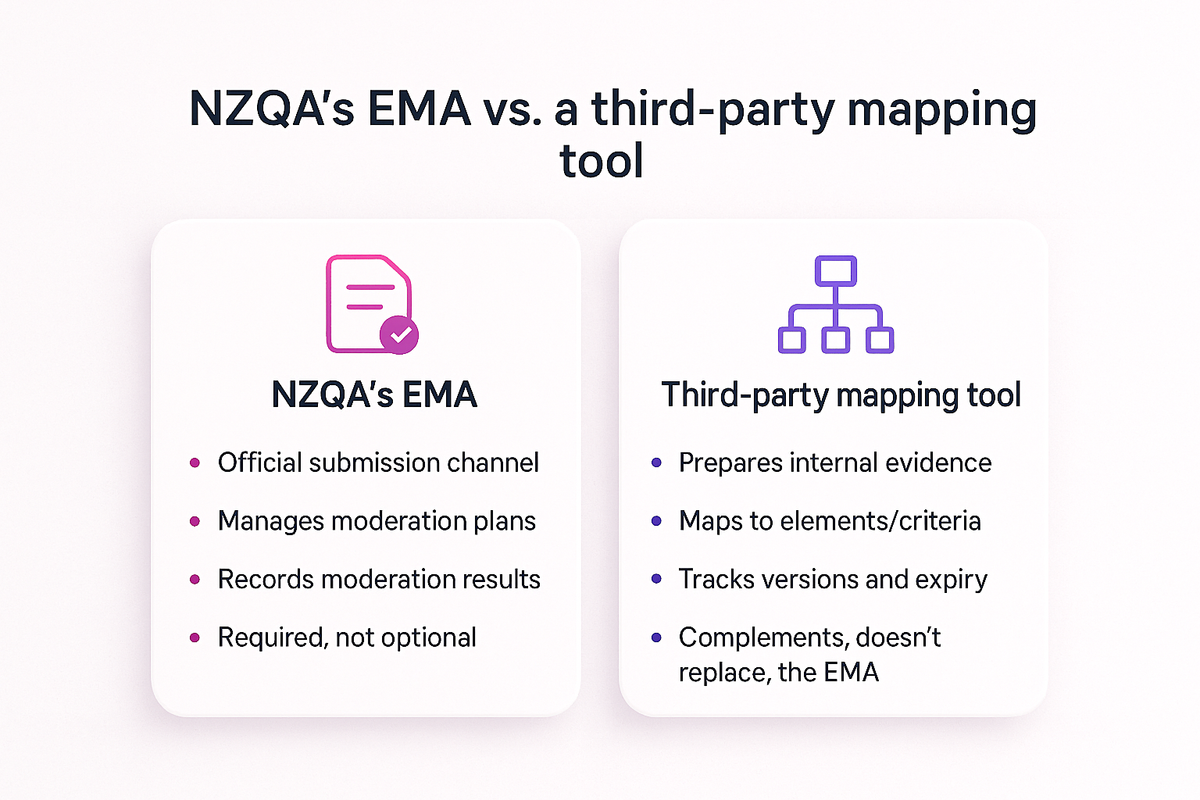
Third-party mapping software sits *alongside* this official structure. It's an internal working layer — helping you prepare, organise and quality-check evidence — that feeds into the EMA process, not a substitute for it.
What NZQA actually checks: fair, valid, consistent
Whatever tool you use, NZQA moderators are applying three specific principles: assessment must be fair, valid and consistent. That's the lens to test any software claim against, rather than taking a vendor's word for "NZQA compliance" at face value.
This also means coverage has to be demonstrated at a granular level. Consent and Moderation Requirements (CMR) documents — set by standard-setting bodies such as Workforce Development Councils, NZQA and the Ministry of Education — spell out the specific capability, consent and moderation requirements for each standard. A tool that maps only to standard titles or total credit values isn't doing the job; it needs to trace coverage down to individual elements and performance criteria.
Checklist: what to check before you trust any tool's compliance claims
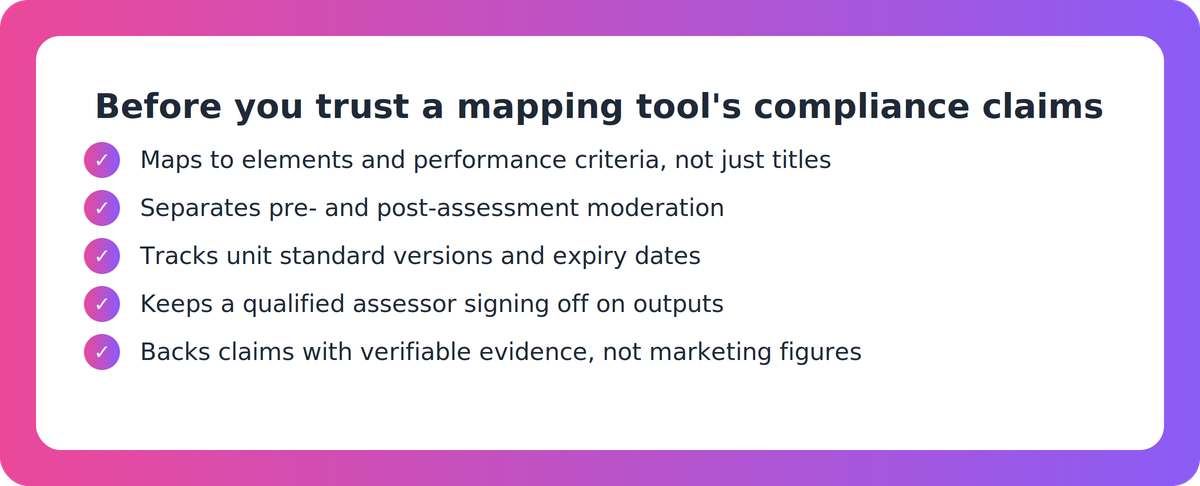
Before relying on any coverage-mapping or AI-assisted tool, check that it:
- Maps to individual elements and performance criteria within each unit standard, not just standard titles or credit totals
- Treats pre-assessment moderation (approving materials before learner use) and post-assessment moderation (checking assessor decisions) as the distinct processes NZQA describes
- Tracks unit standard versions, review dates and last-date-for-assessment cut-offs
- Helps retain learner assessment evidence in a form consistent with the PTE Enrolment and Academic Record Rules
- Is positioned honestly as a complement to the EMA, not a replacement for official submission and reporting
- Backs any time-saving, pass-rate or compliance claims with verifiable references — customer case studies or moderation outcome data — rather than unaudited marketing figures alone
- Keeps a qualified assessor or moderator reviewing, adjusting and signing off on any AI-generated mapping, rather than presenting it as a finished compliance artefact
Version and expiry tracking is ongoing, not a one-off
Unit standards carry credit values — one credit equals 10 notional hours of learning, practice and assessment — and they're periodically reviewed, each with a specific last date for assessment. That means checking you're assessing against a current, non-superseded version isn't a task you do once at enrolment; it's a standing compliance job for as long as you deliver against that standard. Any tool worth using needs to track this on an ongoing basis, flagging standards approaching review or expiry rather than assuming a mapping done last year still holds.
Can AI-generated mapping still meet NZQA's fairness, validity and consistency tests?
AI can genuinely speed up the drafting and mapping work — building the links between assessment tasks and the specific elements or performance criteria they're meant to cover, and drafting supporting material like assessor guides. That's a real, useful piece of the workload.
But speed isn't the same as sign-off. AI-generated mapping still has to be reviewed, adjusted and approved by a qualified assessor or moderator before it's used with learners or presented at a moderation visit. Tools like VETos, which build a standards-to-assessment graph and generate moderation-ready validation reports, are designed with this in mind — AI drafts, a human reviews and refines, and the assessor remains accountable for the final decision. That's the workflow to look for in any AI tool in this space, not one where AI output goes straight to learners or straight to NZQA unchecked.
Worth noting: vendor case studies, including any published by AI vendors themselves (Supahuman's own published example involves a New Zealand PTE reporting a substantial reduction in course-creation time), are self-reported. They're a reasonable starting point for a conversation, not independent proof — ask for detail and references before weighting them heavily in a purchase decision.
Key takeaways
- There is no NZQA-endorsed coverage-mapping product category — the EMA is NZQA's official system, and third-party tools are an internal evidence-preparation layer that sits alongside it.
- NZQA doesn't mandate a moderation template, so judge any tool against its actual principles: assessment must be fair, valid and consistent.
- A genuine coverage tool maps to elements and performance criteria, tracks version and expiry status continuously, and treats pre- and post-assessment moderation as distinct steps.
- AI can speed up drafting and mapping, but a qualified assessor or moderator must still review, adjust and sign off before anything reaches learners or a moderation visit.
- Treat vendor time-saving or pass-rate claims as a starting point for questions, not proof, unless backed by verifiable evidence.
Our take
The honest answer for most PTEs is that this category is younger and messier than the marketing suggests — there's no NZQA seal of approval to look for, so the burden is on you to test any tool against the actual moderation principles rather than a vendor's claims. AI genuinely helps with the grunt work of tracing assessments back to performance criteria and keeping pace with standard reviews, which is real, recurring admin. But the sign-off still belongs to a qualified assessor, and any provider — including us — that suggests otherwise should be treated with caution.
FAQ
What software actually helps a PTE prove unit standard coverage to NZQA moderators? There's no single NZQA-endorsed product. What helps is a mapping tool that traces your assessments down to specific unit standard elements and performance criteria, tracks version and expiry status, and produces evidence you then submit and manage through NZQA's own External Moderation Application.
Is this kind of tool a replacement for NZQA's External Moderation Application (EMA)? No. The EMA is NZQA's official system for submitting moderation materials, managing moderation plans and viewing results. Third-party coverage-mapping software is a preparation layer that works alongside the EMA — it doesn't replace the submission and reporting channel.
What should a PTE check before trusting an AI or mapping tool's compliance claims? Check that it maps to elements and performance criteria (not just standard titles), distinguishes pre- from post-assessment moderation, tracks version and expiry dates, and keeps a qualified assessor reviewing and signing off on any AI-generated output. Ask for verifiable evidence behind any time-saving or pass-rate claims.
Can AI-generated assessment mapping still meet NZQA's fairness, validity and consistency requirements? It can support meeting them, but only when a qualified assessor or moderator reviews, adjusts and approves the mapping before it's used. AI output on its own, unchecked, doesn't satisfy NZQA's requirement for an effective, human-accountable internal moderation system.
Do PTEs still need to gain consent to assess before using any of these tools? Yes. Consent to assess from NZQA is required before assessing against standards listed on the Directory of Assessment and Skill Standards, and PTEs must then participate in the applicable national external moderation system run by NZQA or the relevant Workforce Development Council. No software changes that requirement.
---
If you're evaluating options, start by pulling up NZQA's own guidance on internal moderation and the national external moderation principles, and score any shortlisted tool against them directly rather than against a vendor's feature list. If you want to see how an AI-assisted mapping and assessor-guide workflow looks in practice — including where human sign-off sits in the process — Supahuman's VETos team is happy to walk through it, no pressure either way.